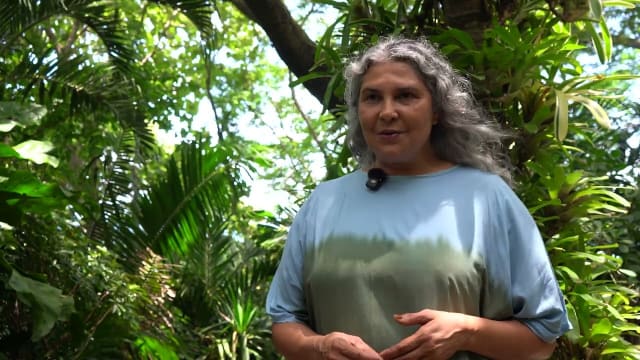
In a talk built around a single memory, Radhanath Swami goes back to the years when he was working as an assistant cook and the world seemed to be coming apart around him. The head cook he worked beside, a man named Joel, had once fed 5,000 sailors on a battleship in the Pacific during World War II, and he had seen more death than most people will ever witness. When the young Radhanath kept complaining about the problems of the age, Joel gave him a four-word answer: just do your cooking. From that small scene the talk widens into an argument about how anyone who wants to help a troubled world should begin. Radhanath Swami's answer is not to withdraw into peace alone. It is to awaken love at the root of one's life, because love, unlike outrage or fear, reliably produces responsible care for every living being. Drawing on the Bhagavad Gita and the Srimad Bhagavatam, he argues that spiritual growth is not an escape from responsibility but its foundation, and that the highest dharma is whatever awakens loving devotion to God.
Whowasthecook,andwhydoeshisadvicestillland?
The story is worth slowing down for, because Joel is not presented as a wise man in the usual sense. He is a humble, hardworking cook who had lived through something enormous and had come out the other side with a plain rule for daily life. "He was like a father to me," Radhanath Swami says of him, describing a man who was "really nice, very humble, very hardworking, very gracious" (at 14:35 in the talk). When the younger man poured out his worries about injustice and suffering, Joel did not argue the point. He simply pointed to the stove.
That is the first move of the talk: the most reliable response to a broken world may be the next task in front of you, done well and without contempt for the people who are doing it. Radhanath Swami does not pretend this is easy or that it cancels out real injustice. He acknowledges that Joel's advice sounds like a joke, which is why the audience laughs at the punchline. The deeper point is that a person who is busy being outraged about everything often ends up doing nothing about anything.
Radhanath Swami places his own restlessness inside a longer history. He describes his grandparents being persecuted in Eastern Europe and arriving in a new country "without understanding language, with no money, with nothing." He describes his parents' generation living through the Great Depression, then World War I and World War II. And then he describes his own generation coming of age in the 1960s, when civil rights protests filled the streets and the Vietnam War was, in his telling, a conflict in which "countless innocent people were being killed."
What stands out is his description of the gap between generations. Young people believed they alone could see the problems clearly. The parents answered, in effect, that they had already lived through worse and knew what trouble was. Radhanath Swami does not dismiss either side. He admits he joined the civil rights movement and the counterculture because the injustice made "absolutely no sense" to him. The question he is really asking is what sustains a person through a time like that, when activism and anger can burn out as quickly as they ignite.
This is where the talk gets its spine. Radhanath Swami distinguishes between two kinds of motivation. One is reaction to what is wrong. The other is a positive force that flows from a person's own nature. He is not saying that injustice should be ignored. He is saying that the strongest engine for lasting change is not hatred of the problem but love for the people caught in it.
To make the argument, Radhanath Swami turns to a gathering of sages recorded in the Srimad Bhagavatam, where they questioned the sage Suta Goswami. He notes that the text runs to some 80,000 verses and that one verse summarizes the rest. That verse, he explains, speaks of the dharma that gives true happiness and satisfaction to the true self. He then defines the word itself, which he says is translated in many ways: as religion, as occupation, as a way of life, or as a person's nature. In his reading, dharma includes all of these at once.
"The supreme dharma is that which awakens loving devotional service to the supreme being." (Radhanath Swami, in the talk, at 6:20)
He then draws a bridge to the Christian scriptures he refers to, noting that the first and greatest commandment is to love God with all your heart, mind, and soul, and that the proof of that love is that you love your neighbor as yourself. For him this is a universal principle, and the Bhagavatam expresses it in more intimate language. The implication for social action is significant. Dharma, in this framing, is not a set of rules that sits apart from daily work. It is the quality that makes a family relationship, a job, and a community obligation feel like service rather than burden.
Whydoeslove,ratherthanpeace,leadtorealaction?
The talk's most distinctive claim is that peace is not the end of the spiritual path. "Peace is wonderful," Radhanath Swami says. "But beyond peace, beyond liberation, is divine love." He describes liberation and peace as included within that love rather than standing in for it. A person who has merely settled into calm may stop reacting to the world without yet caring for it. A person whose heart has been awakened to love, he argues, begins to see others differently.
He explains this with the idea of equal vision. Seeing every living being with equal vision, he clarifies, "doesn't mean we treat everybody different" in the sense of ignoring harm. If someone attacks us, we defend ourselves. If someone becomes our closest friend or dearest partner, we reciprocate accordingly. The difference is in what we see underneath: "the real person behind that ego is a sacred part of God's love." That recognition is where, he says, real compassion comes from.
He also describes the stages that lead there. A person who realizes his relationship with the body, the mind, and the world from the standpoint of the eternal self becomes joyful. He stops "hankering, lamenting, in need of just things for happiness." From that joy, he cares for everyone because he loves. Radhanath Swami says that bhakti, the devotional path, begins at that place. In Sanskrit, he explains, bhakti refers to the eternal, ecstatic, unending love that is the nature of the soul in contact with God, and bhakti yoga is the practice that leads toward that aspiration.
Canaspiritualpersonstillworkhardintheworld?
Radhanath Swami addresses a criticism he says he hears often, particularly in London. Some people believe that to be spiritual is to become lazy. He recalls people telling him to get a job when he walks down the street. He does not argue with them. Instead he tells the story of his own last paycheck, from 1969, when he was an assistant cook in a hospital. After that, he moved to London and began searching for "a real purpose to work for, a real purpose to live for."
The logic of the talk is that work is not the problem. Work performed out of restlessness or self-interest, or work that is forced upon people, can feel empty. Work performed as an expression of love becomes a kind of worship. This is why the cook's advice matters so much. Joel did not tell his assistant to stop caring about the world. He told him to care about the task in front of him, which is where care actually becomes concrete.
To make the point about the source of love, Radhanath Swami uses an image from a later passage in the text. If you offer water to the root of a tree, the root does not keep it for itself. It distributes the water to the trunk, the bark, the branches, the twigs, the leaves, the flowers, and the fruit. If you water only the leaves, they will shine for a few minutes, and then they will begin asking for water, because they are not being nourished at the source.
"When we actually love the supreme being, when actually our love is coming from that spiritual place as a part of God for the supreme, then our love naturally extends to every living being." (Radhanath Swami, in the talk, at 8:46)
He concludes that "there's no more powerful force that motivates people than love." The analogy carries a practical lesson for anyone trying to make a difference in a troubled world. Campaigns, outrage, and short bursts of compassion are like watering the leaves. They can produce a bright moment, but they dry out quickly if nothing feeds the root. Inner growth is the root. The care that flows outward from it is what keeps a person going through decades of difficulty.
The talk ends where it began, with the paradox Joel seemed to embody. Radhanath Swami says that "we have to be in this world, but not of this world." He calls on his listeners to stand up with courage and with faith, though not blind faith. He wants what he calls reasonable, realized faith, because without it, he warns, people "just fight about what's religious and what's spiritual." The question he leaves open is whether people are willing to take up the path of spiritual purification and elevation, which he describes as the way to connect with the love within ourselves that the world is in desperate need of.
For a reader who feels overwhelmed by the state of the world, the talk offers a grounded starting point rather than a grand plan. Do the work in front of you with care. Watch what drives your engagement: is it love or only reaction? Look for the source of your care rather than its symptoms. And remember that the cook at the battleship, who had seen more death than most of us will ever face, still found it meaningful to say: just do your cooking.
Wheretogofromhere
If this talk resonated, the best next step is to listen to the full recording and notice how Radhanath Swami moves between personal memory, scripture, and everyday observation. The Bhagavad Gita and the Srimad Bhagavatam are the two texts he returns to most, and reading their passages on dharma, devotion, and equal vision will deepen the ideas in a way a summary cannot. It is also worth reflecting on your own "Joel" moment: the person whose plain, steady example taught you more about how to live than any argument ever did. The talk suggests that the way to make a difference is rarely dramatic. It begins with love at the root, and then the next honest task done well.
Comments
Loading the conversation…
Transcript
[0:00] He was like a father to me. He was
[0:02] really nice man, very humble, very
[0:04] hardworking, very
[0:06] >> [music]
[0:06] >> gracious. And I would tell him about all
Monk in the bhakti tradition who has spent over 50 years guiding individuals toward deeper purpose and directing transformative social initiatives across India, Europe, and North A…
Radhanath Swami argues that the most lasting difference comes from awakening love at the root of your life rather than from anger or fear alone. He draws on a head cook's advice to focus on your responsibilities, and says that when action flows from love, even small contributions become meaningful. He presents this as a foundation for responsible care toward every living being.
In the talk, Radhanath Swami explains that dharma can be translated as religion, occupation, way of life, or a person's nature, and that its meaning includes all of these. He quotes the teaching that the supreme dharma is that which awakens loving devotional service to the supreme being. He says this love is what extends naturally to our work, families, and communities.
Radhanath Swami says some people wrongly believe spiritual life makes a person lazy, but he argues that work done from love becomes a kind of worship. Action driven only by reaction to injustice can burn out, whereas action rooted in compassion is sustained. He describes spiritual growth as the source that keeps a person engaged over decades.
The analogy compares love for God to watering the root of a tree, which distributes water to every part of the tree. Radhanath Swami explains that if you water only the leaves, they shine briefly and then need nourishment again. Similarly, when love flows from the spiritual source, it naturally extends to all living beings.
Radhanath Swami says peace is wonderful but that beyond peace and liberation is divine love, which is the essence of bhakti. He describes bhakti as the eternal, ecstatic, unending love that is the nature of the soul in contact with God. In his view, peace and liberation are included within that love rather than being its final goal.
In the talk, Radhanath Swami uses this phrase to describe living fully engaged in daily responsibilities while keeping one's deeper identity anchored in the spiritual self. He connects it to the cook's lesson that a person can acknowledge the world's problems and still focus on the task at hand. The idea is grounded participation rather than withdrawal.