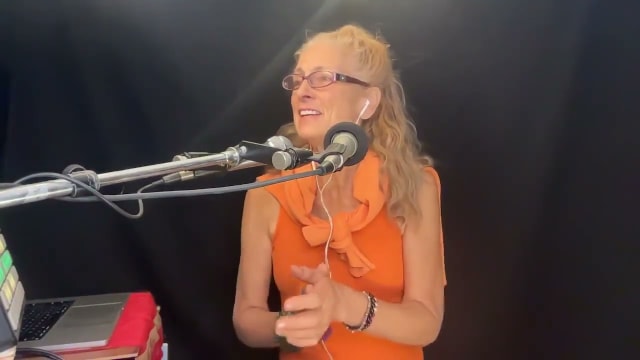
Eyes closed, breath dropping low, a teacher's voice asking you to place your hands on your own thighs and whisper, "These thighs are mine. This body is mine. This ground is holy." That is where Dr. Marie Mbouni's Lilith devotion begins, and it is an unusual place for a spiritual practice to start. Instead of lifting the listener up into light, this eleven-minute guided session, published as Day 11 of her 13 Frequencies of the Goddess series, moves downward and inward, touching the body region by region and asking each part to be claimed. The figure at its center is Lilith, whom the video description calls "the first woman, the wild one who chose truth over submission." The practice treats wildness not as disorder but as a form of truth, and it asks the listener to hear their own voice, sigh, hum, or growl as sacred material. What follows is a close reading of how the devotion is built, what each stage asks of the body, and why its central claim, that your body is holy ground, carries more weight than it first appears.
Dr. Mbouni opens by admitting the figure is not widely known. "Not many people know Lilith," she says at the start of the session (0:16). She describes a recent experience of self-guided healing in which Lilith appeared to her, and she says that story belongs to another day. The devotion is therefore framed as an introduction, not a lecture. The video does not walk through a mythology or a history. It gives the listener an encounter.
The video description supplies the frame the practice rests on: Lilith as the first woman, the one who refused submission, and a current associated with "reclamation," "dissolving shame," "breaking chains," and "restoring sovereignty." The speaker's stated purpose at the opening is to "bring this notion that our wildness, our untamed nature is sacred." That is the thesis of the whole devotion, and every stage is built to test it on the body.
It helps to notice what the practice does not do. It does not ask the listener to become someone else, or to pray to an external authority for permission. Instead, the figure of Lilith is imagined standing in front of the listener, and what she offers is a sentence, not a command: "Your body is holy ground. Claim it as yours." (about 2:44). The authority in the room is the listener's own body, invoked as sacred rather than as a problem to be fixed.
The structure is simple enough to follow with eyes closed. Breath comes first, with an inhale through the nose and a long exhale through the mouth. Then the listener is invited to imagine Lilith before them, to let the spine lengthen into what the speaker calls a "sovereign position," and to notice the figure's hair "like a beautiful midnight" and eyes "blazing with fierce truth." Only after that visualization does touch begin.
The touch sequence moves through the body in a rough descent and ascent. Hands rest first on the thighs (about 3:08), then rise to the belly, which the speaker says can be the lower or upper belly "wherever it feels good." The hands then move to the breasts, "supporting them and lifting them," with an instruction to breathe deeply into the heart. From there the hand moves to the throat, and finally one hand rests on the throat while the other rests on the third eye or crown. At each point the listener whispers a formula that follows the same pattern: a claim of ownership, a claim of holiness.
The repetition is the point. "These thighs are mine. This belly is mine. This life force is mine. This ground is holy." The phrasing changes slightly as the hands travel, from body to life force to heart to voice to wisdom, but the grammar holds. Possession and sanctity are placed side by side, so that reclaiming the body is never framed as an act of control over something dirty or dangerous. It is an act of recognition.
Physical touch is doing real work here. A devotion that asks you to put your hands on your own breasts and throat is asking you to inhabit places that many people have learned to hold at a distance, and the speaker is careful to frame it as remembrance rather than performance. The instruction to remember "that it is safe to be in your body" comes before the touch sequence begins, so the body is primed for the practice before it is asked to do anything.
The most striking moment in the recording is not a line of text. It is a sound. When the hand reaches the throat, the speaker notices her own voice has become "a little scratchy," and she reads it as a sign of movement. "Meaning there's a lot that is being transmuted, released and cleared from your throat," she says (about 5:39). Whether a listener experiences anything similar will vary, and the video does not claim a universal effect. But the observation is useful because it reframes a physical sensation as information. A rasp in the voice becomes evidence that something is moving, rather than a flaw to be cleared quickly.
This connects directly to the devotion's emphasis on voice. The throat stage ends with the words "this voice is mine," and the third-eye and crown stage adds "this wisdom is mine" and "I am sovereign. I am free." The sequence moves from the voice that speaks outward to the perception that sees inward, and then to the claim of freedom that holds them both. Reclaiming the voice, in this framing, is not only about speaking more. It is about no longer apologizing for the sound that comes out.
"Your body is holy ground. Claim it as yours."
Dr. Marie Mbouni, Day 11 Lilith devotion (about 2:44)
Around the seven-minute mark the devotion shifts from touch to breath and sound. The listener takes a deep inhale into the belly, allowing it to expand, and on the exhale allows a sound to rise. The speaker names the options generously: "It could be just a sigh or a hum or a whisper or a growl." Then she goes further and gives permission for the sound to be imperfect. "Is it a whimper? That's fine. Is it a growl? That's fine. Is it a hum? That's fine. You are allowed to be exactly where you are."
This is the most grounded instruction in the devotion, and it is worth taking seriously. Many spiritual practices quietly grade the sound they ask for. Here, the sound is the practice, whatever it happens to be. The instruction pairs each inhale with letting shame and guilt dissolve, and each exhale with sounding what she calls "your soul sound." The sequence is a small, repeatable form of release: breath in to take in the body, breath out to give the body a voice.
For someone practicing alone, the practical lesson is that you do not need to have a particular kind of voice to take part. A whimper that comes out during the exhale is not a failure of the devotion. It is the devotion, working at the level the body can reach that day.
The devotion closes with a spoken vow. One hand goes to the womb, one to the heart, and the listener speaks aloud: "Beloved Lilith, awaken my sovereign wildness. I reclaim my voice. I reclaim my body. I reclaim my freedom." The hands then come together in prayer, a bow is offered to the goddess, and gratitude is spoken for the practice. The session ends with "And so it is."
The closing structure matters. Reclamation is named three times, voice, body, freedom, and each one has been touched and tested during the session. By the time the words are spoken aloud, they are no longer abstract. The listener has already said "this voice is mine" and "this body is mine," so the invocation reads less as a wish and more as a summary of what just happened in the body.
The devotion is designed to be followed while listening, which means the practical question is how to make it your own. A few observations from the structure of the video are useful. First, take the breath instructions literally and slowly; the whole practice depends on the exhale. Second, let the touch sequence be gentle and choose the belly placement that feels right, as the speaker suggests. Third, treat the whispered claims as sentences you can say in your own register, not as a script to perform. Fourth, when the sound stage arrives, make whatever sound is actually there. A sigh, a hum, a growl, or a near-silent exhale all count, in the teacher's own words.
Finally, pay attention to what the devotion says about wildness. The description insists that "wildness is not chaos, but truth unbound." That line is a useful test for any practice that claims to free you. The question is not whether the practice makes you feel powerful or dramatic. It is whether it makes you more honest with your body, your voice, and your freedom.
If this devotion opens something for you, the video description points to the full 13 Frequencies of the Goddess Journey, of which this session is Day 11. Read it as one stage in a longer sequence rather than a standalone event, and let each day build on the last. The description also links to a separate resource on nourishment and sleep, which is a reminder that the speaker frames the body's care in practical terms alongside its sacredness.
For a first session, try the devotion once with the video, then once more with only the breath and the final invocation, speaking the three reclamations in your own words. Notice which line is hardest to say, and return to it. That line is usually the one the practice is asking you to hear.