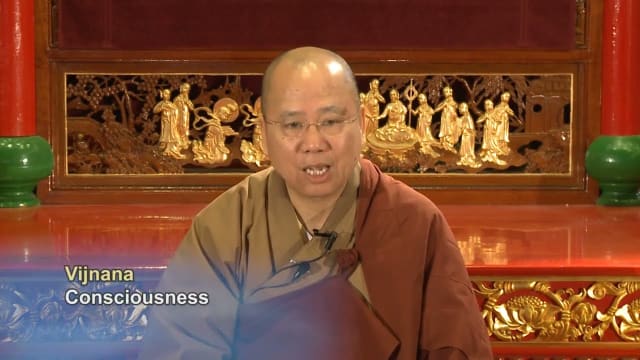
In the sixth installment of a lecture series on the Great Compassion Dharani, Venerable Guan Cheng, abbot of the International Buddhist Temple in Richmond, British Columbia, stops to ask a question most chanters never pause over: what is a dharani, and why can't its words simply be translated into English? His answer runs through a rosary, a metaphor about garbage, a comparison between Buddhism and psychology, a parable about a knot tied in a bell, and a string of Sanskrit imperatives that he treats as instructions for a lifetime. The talk, published by Buddhistdoor Global with permission, is less a lecture on sound than on how a short formula is meant to work on the mind that recites it. What follows draws on the opening stretch of that transcript and tries to explain the ideas in full, for readers who have not watched it.
Guan Cheng begins with terms. A mantra is shorter, a dharani longer. The word dharani is Sanskrit, and he offers an image to hold it: a rosary, a string that ties all the beads together. A dharani, in his account, gathers a philosophy and its meaning into a brief form so that it can be remembered. The beads are the individual teachings; the string is the memory that keeps them in one place.
That image matters because it changes what chanting is for. If a dharani is a compressed summary, then reciting it is less like making a pleasing sound and more like running a thread through a set of ideas every time you pass them. Guan Cheng makes this explicit later in the passage, saying that chanting is a way of remembering the Buddha's teaching, and that the practitioner should hold the dharani in mind and act on it.
The lesson had been moving word by word through the text, and at the point where the talk picks up, Guan Cheng has spent weeks on a single term, malamala. His explanation is blunt: the word itself means garbage, and here garbage is a metaphor for mental garbage, the afflictions the mind accumulates. He lists them in the familiar way: greed, hatred, violence, jealousy, fraudulence, arrogance, and injury. "You name them," he says. "We already learned them."
He also gives a number. By his summary there are 51 mental afflictions, and they arise together with the eight consciousnesses that form when the senses meet the outside world. He calls the eight consciousnesses the "consciousness kings," since they are the major ones, with the 51 accompanying them. For a reader new to this framework, the point is structural: the mind is not a neutral container, and the afflictions are not occasional visitors. In Guan Cheng's telling, they "arise all the time," and you may not notice them doing so.
This is why the word that opens the mantra's second section is treated as urgent rather than archaic. You cannot liberate a mind you have not looked at, and the garbage is the first thing that has to be seen.
Guan Cheng recalls a newcomer to his class who described Buddhism as a course in psychology. He agrees, with a qualification that gives the comparison its teeth. "Buddhism is a course of psychology except that this course of psychology takes 20 years to explain because it's so deep, so profound," he says. Then he draws the line that separates it from the modern discipline:
"It's not just to analyze other people. It also analyze about yourself, your own mind. And it's not just about analysis of it. The Buddha wants us to understand our own mind first and then attempt to liberate yourself from the prison of your own mind."
Psychology, in this framing, can stop at analysis. The Buddhist path asks the analyst to become the one who acts, and the action is practice rather than discussion. Guan Cheng puts it in one line: "In the liberation it's not just empty talk. It's not just language. It's your practice."
He reduces that practice to three words, which he gives in Sanskrit and English: discipline, samadhi (concentration), and prajna (wisdom). The three are the scaffolding on which the dharani's instructions hang.
The most memorable image in this stretch is a parable about a bell. Someone ties a bell around a ship's neck with a knot. Whoever tied the knot is the only one who can untie it. Guan Cheng pushes the logic to its end:
"The person who untied it must be the person who tied it. Don't get anybody else to do it. Nobody else can. You understand your own mind. You liberate your own mind. Nobody can, not even God. If God can liberate you, can liberate your mind, he has already done so. You don't have to wait."
It is a sharp refusal of waiting. Liberation in this teaching is not handed down, delegated, or deferred to a higher power. It is also not an intellectual achievement; it is the untying itself, done by the same hands that tied the knot. The afflictions are self-made, and so the release has to be self-made too.
Guan Cheng takes the phrase mahima hridaya apart. Maha means great, and he notes that Indian speakers hear it immediately in the Taj Mahal. Mahima also carries the sense of greatness. Hridaya means heart, but he complicates the English reading. In ancient usage, he says, the heart meant the brain, and the everyday phrase "from the bottom of my heart" still means the bottom of the mind. The heart is, as he puts it, "a center of the palpitation" that pumps blood, and yet we speak of it as the seat of thought. The translation is not a neutral conversion; the word carries the mind inside it.
He also admits the limit of his own method. Every Sanskrit word in the dharani, he says, "contains so much meaning" that a one-line gloss cannot hold it, and a full unpacking of each term would take far longer than the series allows. That is why he refuses to translate the dharani into a tidy slogan. The words are held as they are, and their meaning is allowed to accumulate over repeated study.
This is the part of the passage where the talk turns from analysis to instruction. Kuru kuru kamam means to attempt the task and finish it. Guan Cheng reads it as a call to do the work until it is done, and then to recognize that a fully realized state must be completed rather than endlessly rehearsed: "Don't just do it and do it and never get it done."
Duru duru vijayate asks for steadiness. "Hold fast, hold on and never let go of it," he says. He is candid about human failings here. We practice one day, drop it the next, pick it up on the third. The dharani asks for endurance and consistency, and he applies that directly to compassion: "Your compassion must be consistently applied." Compassion that appears on Tuesday and disappears on Wednesday does not yet count, in his reading, as practice. The victory the words describe, he notes, belongs to the one who keeps going until liberation is reached.
The dharani's central phrase is mahakarunacittadharani, which Guan Cheng breaks into parts: maha, great; karuna, kindness, compassion, mercifulness; citta, heart; dharani, summary. Together, he says, it is "a dharani of great compassion and great mercifulness from the heart." The phrase tells you what the chant is a summary of.
He then lays out the sequence that turns recitation into liberation. You chant the dharani constantly, you remember it, you commit it to what he calls the alaya consciousness, and you practice it accordingly. Over time, he says, you will liberate yourself from mental afflictions. The word for the one who achieves this, svaraya, he glosses as the one who is liberated. The chanter becomes the liberator, and the knot is untied by the one who tied it.
Read this way, the talk is less a commentary on sounds than a training manual. The rosary holds the beads; the beads are the teachings; the mind must be turned over, bead by bead, until the garbage it has been accumulating is seen, sorted, and set down. Guan Cheng is clear that this is slow, and he says the series has already spent months on a single mantra. For him, that pace is the point.
This article draws on the opening portion of the sixth talk in Guan Cheng's series on the Great Compassion Dharani, published by Buddhistdoor Global. Watching the full video will show how he moves through the rest of the mantra's phrases, and the transcript makes clear that the sections around "malamala," "mahima hridaya," and "kuru kuru" are each built to be heard in sequence. Readers who want the broader context can look at the series itself, along with the International Buddhist Temple's own materials at buddhisttemple.ca and the Buddhistdoor Global archive at buddhistdoor.net. The most practical starting point, based on this talk, is small: pick one term, learn what it means, and keep returning to it, because Guan Cheng's argument is that consistency, not intensity, is what turns a summary into a change of mind.