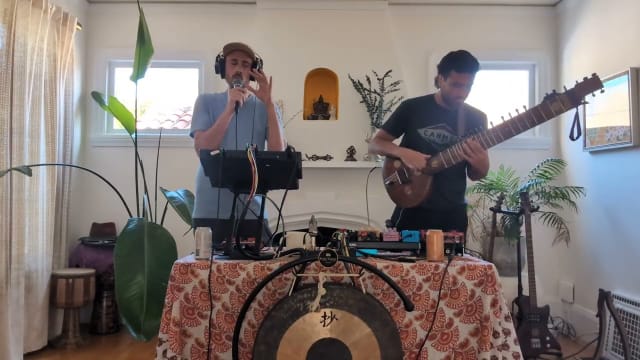
Listen closely. The voice arrives before any picture does, asking a question that sounds almost like an instruction: have you noticed it? Over seven minutes and forty-nine seconds, the video "Everything Is Opening (feat. MC Yogi)," posted by Egemen Sanli in November 2024, builds a single image into a whole devotional world. The central Nexus of the lotus, the hub of the wheel, a space that opens from above and brightens the center: these images repeat, slightly reshaped, until the poem's real subject becomes clear. It is not a lotus so much as a state of surrender, and the poem's claim is that the state is already present and only needs to be noticed. What follows is a reading of the poem's structure and its key ideas, drawn from the video itself, with the words given as they appear in the transcript.
A note on sources before going further. The video is a poem performed over music, not an interview, and the transcript carries no biography, origin story, or account of how the piece was made. The title credits MC Yogi as a featured artist, but the material does not describe his role, so this reading does not attribute any part of the performance to him. Everything below stays with the text.
The first word is "listen," and the second is "closely." The poem's first full sentence is a question, "have you noticed it," and it does not say what "it" is until the image arrives. That structure matters. A statement would ask the listener to agree. A question asks them to look, and the poem then supplies the thing to look at: "the central Nexus of the lotuses, the inner Hub of the wheel, and the space that opens us."
The refrain follows almost immediately. At 0:25 the line "listen closely, everything is opening" lands for the first time, and it returns again and again, including at the very end. The phrase "everything is opening" is the poem's thesis, but it arrives as a sound before it becomes an argument. The repetition does most of the work. By the fifth or sixth return, the listener is no longer parsing a claim; they are being asked to stay in a particular kind of attention.
The lotus and the wheel are old images in contemplative and yogic traditions, where the lotus is often used for inner centers and the wheel for a turning, ordered whole. The poem does not explain these traditions, and it does not need to. What it does is place the imagery in motion. The "space that slowly opens us from above" raises "the lower half" and "brightens the center," and the inner field is "showered" with "the sunlight of awareness." Each verb is one of growth or illumination, not of effort or correction.
The imagery gets richer when the poem names the quality of the light. It is "loving non-judgmental kind pure awareness," in one of the later returns at 7:03 of the transcript timeline. That phrase reframes the lotus. The opening is not about achieving a clean inner state; it is about an awareness that does not judge what it shines on. A lotus grows out of mud, and the poem's light does not ask the mud to leave first.
This is the poem's most provocative move, and it arrives around the 1:49 mark. Sanli writes:
"Let's let go of this ego balloon, forgiving ourselves for judging our past and our parents. We are already healed now. Simply remembering God has already repaired us."
— Egemen Sanli, "Everything Is Opening" (1:49)
The sequence is worth noticing. The poem asks for letting go, then for forgiveness, then declares the healing already complete. The order matters because most contemplative writing treats healing as a destination reached by work. Here healing is treated as a fact to be remembered. The verb is "remembering," not "achieving." The practical question the poem leaves open is what it would mean to live as though the repair had already happened, rather than waiting to earn it.
The poem's language of grace reinforces the point. A few lines later it describes love as "predestined like a preset," the listener as "the beneficiary of an abundant internal wealth," and love as "our inheritance." These are words of possession, not pursuit. The listener is not told to go find grace. They are told they already hold it and need only stop covering it up.
Ecstatic love poetry, across many devotional traditions, uses the language of romance and marriage to describe the soul's relationship to the divine. The Beloved is the one the lover longs for and eventually merges with. Sanli's poem uses this vocabulary openly. At 2:31 he writes that "even death brings us closer to this marriage," and that "while still in these bones, draped in this skin, I will carry him." The pronoun "him" is the Beloved, and the marriage is the union the whole poem circles.
What is distinctive is how the poem makes union sound ordinary. Lines like "we are always being guided, provided with everything we need to succeed, simply by being quiet" recast devotion as a matter of stillness and relaxation rather than heroic effort. The Beloved is not far away. The poem's instruction is to stop leaving: "relaxing, letting go, returning to embrace this infinite grace."
One of the poem's most unexpected lines comes in the middle section, where the speaker reaches for the limits of thought. "How can we summit what we can't mount? How can we calculate what we cannot count?" These questions build toward an admission that thought fails at this scale, and then the poem makes a surprising claim: "even God lets us enjoy our doubt, all the foolish stuttering and stumbling symbols that fall from our mouth."
That is a generous theology. Doubt, stammering, and clumsy language are not treated as obstacles to be cleared before the real experience begins. They are part of the play. The poem then turns on the intellectual class, saying that "the dry parched intellect of the paragraphs pared by pundits, priests, and clerics" is less alive than the inward wedding it points toward. Critique of the scholastic is an old move in mystical poetry, and this poem makes it quickly, without contempt.
Its image for the human condition is blunt. "We are all insects in heaven, marching in line," it says at 3:57, followed by a conductor "patiently waiting for us to hum and harmonize all the time." The metaphor is comic and tender at once. We think we are in charge of our minds, and the poem's answer is that we are a small part of a song being sung by something larger. The conductor is not impatient. The conductor waits.
In the final third, the poem moves toward cosmology. "The universe giving birth to the universe in a single verse, the entire story in a single word." The claim is compressed, and the poem's logic is to say the beginning is not an event among others but the source of all of them: "the beginning is love; love is always first; from love every everything bursts forth, dispersed, scattered to expand and flourish from one and all its many extensions."
The grammar here is worth slowing down for. "Every everything" is an intentional stutter, a way of making the total seem to tumble outward. "Omnidirectional blessings" closes the same thought at roughly 6:46. The poem's cosmos is not a machine that started and ran down. It is love still expressing itself in every direction, which is why the imagery keeps moving: "expanding, dancing, pulsing, rising, dissolving, collapsing." The verbs are in continuous motion, and the poem does not stop them to reach a conclusion.
Repetition is the poem's practical method. The refrain appears at the start, returns in the middle, and closes the piece with a triple statement: "everything is opening, everything is opening, everything is opening." If the poem were only describing an experience, the refrain would be a summary. Instead it functions like a mantra or a breath. Each return asks the listener to re-enter the attention the phrase names.
The poem also ends where it began, with the lotus and the wheel. "We are always in the present; we are always in the presence," it says near 6:51, and then returns to the central Nexus and the sunlight of awareness. The circular form is the argument. If everything is always already opening, the only task is to keep returning to the place where that is visible. You cannot get there by leaving, which is why the poem keeps insisting on presence.
The best way into this poem is the simplest one: play the video once without reading, then once more with the transcript in front of you. The transcript has rough spots, so the printed lines are a guide rather than a final text, but the structure becomes obvious on a second listen. Notice where the refrain returns, where the poem turns from image to claim, and where it turns back. Pay particular attention to the lines about healing and grace, which are the most practical and the easiest to skim past.
For further listening, the video description links to the artist's Spotify, iTunes, SoundCloud, Instagram, and Facebook pages, which are the places to find more of Sanli's work. A reader who wants to go deeper into the traditions behind the imagery should look to the wider body of ecstatic and devotional poetry, where the lotus, the wheel, and the Beloved have long lives of their own. The poem asks for nothing more than attention. Start there.