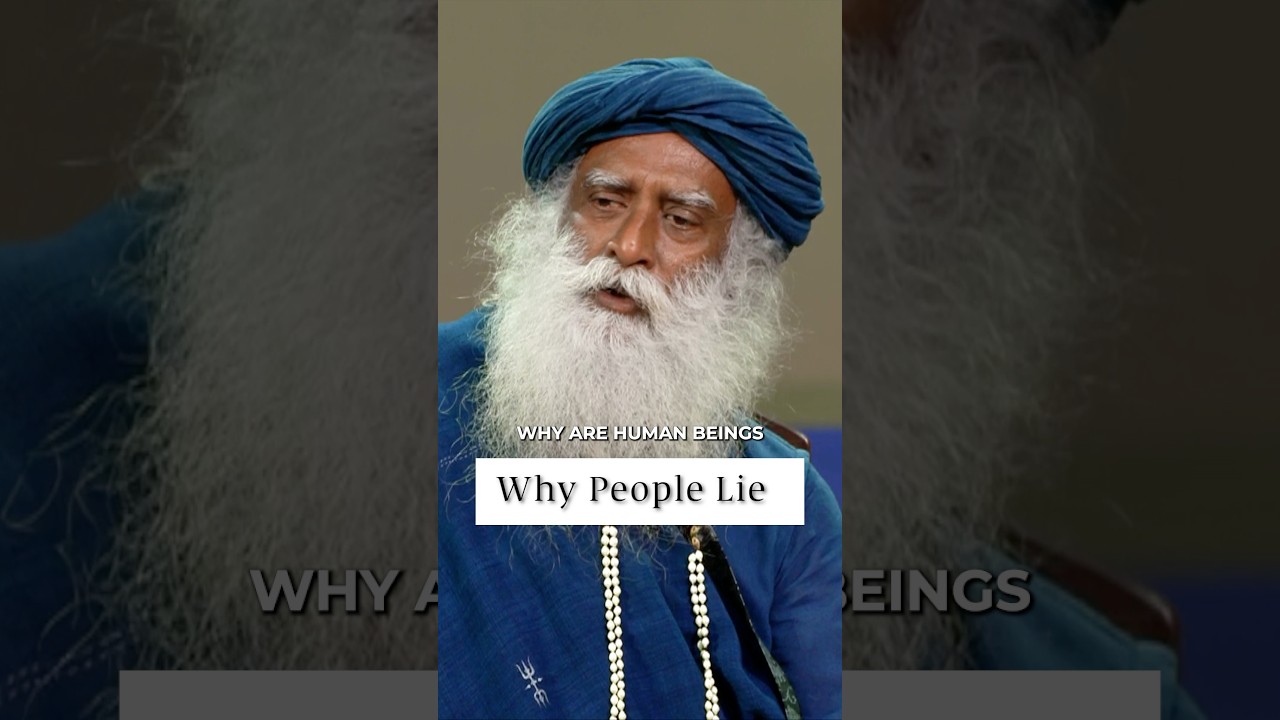
A crowd goes up, a race-caller's cadence cuts through the music, and somewhere under the cheering a teacher begins to talk about the West's appetite for dominance and the gentleness Asia might offer the world. That is the texture of this two-minute-and-change clip, posted in mid-October to gather highlights from a week of events in Singapore and Kuala Lumpur. It is not a full talk, and it does not pretend to be one. Read slowly, though, its fragments hold three ideas worth sitting with: that a dominant civilizational posture has run its course, that intelligence needs the same training as the body, and that we keep postponing our joy until tomorrow. The clip never fully develops any of them, which is exactly why it rewards a closer look.
The reel opens on a line that sounds more like a sporting broadcast than a spiritual gathering: "And we are finally going to get the race we want, the Bahrain Grand Prix in Malaysia. It's lights out and away we go." Music and cheering follow. The excerpt does not say who is speaking at that moment, and neither the description nor the transcript explains the race reference. Treat it as a scene-setter, a burst of crowd energy rather than a teaching, and let the rest of the clip carry the substance.
The clip's most pointed passage comes early. Sadhguru, in the clip at 0:32, puts it bluntly:
"West has aggression. West has confidence. West has a way of dominating things, but it has run its course."
Note the framing. He is not describing geography so much as a temperament: aggression, confidence, dominance on one side; a different quality on the other. Seconds later, at 0:39, he names that quality: "The gentleness of Asia needs or is very needed in the world today." The argument then turns practical. At 0:47 he says, "For this, the Asian nations, including India, China, and whatever else, must hold hands in some way."
The excerpt stops there. It does not spell out what "holding hands" would look like in policy, trade, or culture, and it would be a mistake to fill that gap with assumptions. What the clip does establish is the claim itself: that the world's current mode has exhausted itself, and that a gentler orientation from Asia is needed now.
At 1:32 the clip moves from geopolitics to the inner life, with an analogy most people will recognize from the gym:
"As body needs exercise, body needs fitness, intelligence also needs exercise and fitness. If you don't use it, it will rust just like the body."
The idea is simple and quietly radical. We tend to treat the mind as a fixed inheritance, either sharp or dull from birth. The clip insists it is a faculty that degrades without use, the way a muscle or a blade does. The corollary is that intelligence is something you maintain through practice rather than something you possess. That reframing is more demanding than it sounds, because it makes the mind's condition a matter of daily responsibility.
At 2:01, the speaker turns to relationships, and the turn is sharp. The clip reads: "Choice is not just about who you married. Choice is about how you live with them." The line moves choice from a single dramatic decision, a wedding or a signing, into a continuing act. Whoever you chose becomes less a settled fact and more a daily practice of how you show up. It is a small sentence with a large implication: the vow is the easy part, and the living is where the choice actually happens.
The clip's final passage is its most striking. Sadhguru, at 2:16, describes a word he has seen in a particular place:
"In red paint it is written on the main door of the house in Kannada Nalaba. Nalaba means come tomorrow. A whole lot of you have done this to your joy, to your love, to your ecstasy, to your blissfulness, Nalaba."
Nalaba is a Kannada word, and the speaker's translation is plain: "come tomorrow." What he does with it is the real move. A word painted on a door, a polite deferral, becomes a diagnosis of a whole population's habit. The things we most want, joy, love, ecstasy, blissfulness, are the very things we keep scheduling for later. The clip does not elaborate on how that deferral works in practice, but the accusation is clear enough: we treat our deepest aliveness as something to be put off.
Just before this passage, at 2:08, a lighter exchange plays out with the crowd, a question about being "ready for Nirvana" answered with a cheerful "Yes." The contrast is instructive. The audience affirms readiness in the moment, and the clip then asks how often that readiness gets pushed to tomorrow.
A great deal, and it is worth being candid about it. The footage moves through cheering, music, and fragments of speech with no surrounding context. The description lists the week's events in order: an evening in Singapore on 6 October with Benjamin Fok Chun-yue in conversation with Sadhguru; "Crafting a Conscious Planet," presented by MITEC, on 7 October; a "Mahasatsangam with Sadhguru in Tamil" on 8 October; "Soak in Ecstasy of Enlightenment" on 11 October; and "An Evening with Sadhguru" in Kuala Lumpur on 12 October. The description says the events engaged thousands. What it does not supply is the content of those sessions, and this clip cannot supply it either. Read it as a set of signposts, not a complete argument.
If the three ideas here caught your attention, the most useful next step is the full session recordings for the events above, which develop these themes at length than a two-and-a-half-minute reel can. Use the clip as a prompt rather than a summary: ask where in your own life you are running a skill, a body, or a relationship on disuse. And take the Nalaba question with you. The word is only four syllables on a painted door, but it asks a simple, uncomfortable thing: what, exactly, are you telling yourself to do tomorrow?