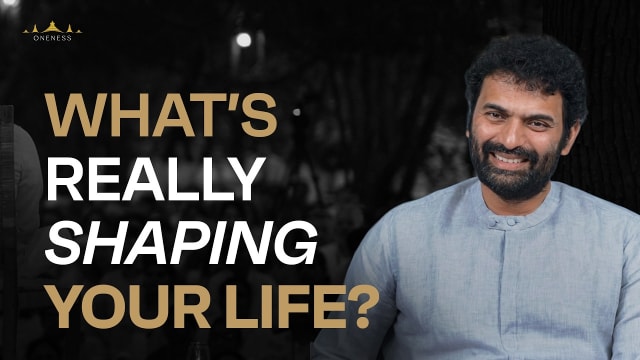
A student stands up in a hall at an abundance festival and admits something that the room, probably, recognizes. Years ago, they were afraid to speak in front of a group. Now they are at a microphone, close to finishing a bachelor's degree in computer science, asking a teacher how a young person is supposed to choose a career at all. The question is ordinary and urgent, and the answer Sri Krishnaji gives in this short Q&A is more interesting than the usual advice about salaries and job markets. He argues that the standard method of choosing a field, which starts with demand and pay, leaves out the two things that actually make work sustaining: honest knowledge of your own strengths and a sense of why you are here at all. The second question in the video, from a real estate entrepreneur in Mumbai, turns to the older and harder problem of destiny. If something is written for you, why does effort sometimes fail? Krishnaji's reply reframes destiny not as a fixed line but as something that moves with your inner state, and he ties that movement to clarity of mind.
Krishnaji begins by describing how most people decide, and he does not dress it up. The usual method, he says, comes down to "understanding where the world is going, what are the changes, which field has the maximum demand and which field pays me the most." He is blunt that this is "really not connection or passion." It is a rational reading of the market, and he does not dismiss it. He treats it as the first of three elements, not the whole decision.
The first element is market awareness, and he is specific about how to build it. You get that understanding, he says, "by meeting a lot of people, by going to lot of forums where you can understand, reading a lot." In the Q&A he names where he thinks the world is heading: artificial intelligence, robotics, and cyber security, which he calls fields that are "going to be big booms." Whatever one thinks of those forecasts, the principle is sound. A young person should know which parts of the economy are moving, and should keep up, because, as he tells the room, "it is changing at a rapid pace."
The second element is the one most career advice skips: what you are actually inclined to do. Krishnaji lays out three broad types. Some people, he says, "can be great managers, that is you could be people who can manage things very well." Some are natural marketers, who "can market or sell" almost anything. Some are technologists, the kind who would rather be "behind the computers and coding" than talk to anyone. He also names a rarer temperament, the entrepreneur, who will "risk it all" and accept the possibility of losing everything in order to explore. The point is not to sort yourself neatly into one box. It is to be, in his words, "very very honest to yourself and understand which direction you are leaning into."
This is where the Q&A gets practical. For a student who already has a degree track, the implication is that market knowledge and self-knowledge have to be held together. A high-demand field that suits your temperament is a different proposition from a high-demand field you merely tolerate. Krishnaji's test is simple: find where you are strong, and choose that.
"So whatever field you are choosing ultimately you must see where you are strong in. Choose that."
— Sri Krishnaji, Q&A video, 4:24 (paraphrased from the transcript's spoken sequence)
The third element is the one Krishnaji calls most important, and it is the one that moves the question from vocation to meaning. "You must awaken to your dharma. You must awaken to your purpose. You must have the answer to the question, why am I here on this planet?" He does not leave the question abstract. He gives his own answer as an example: he and the teachers around him are here "to enlighten humanity," they are "great communicators," and they know that is their strength. The alignment, he says, is what makes everything work. "So everything is in alignment."
He goes further, and this is the sharpest line in the career section. Purpose, he argues, has to "go beyond making money" and "go beyond becoming famous." It "should go beyond yourself." His reasoning is that real joy comes from impact: "Ultimately you will only get your true joy when you have a purpose that can impact others. Even if it is something small, it's fine, but it will still impact others."
"Ultimately you will only get your true joy when you have a purpose that can impact others."
— Sri Krishnaji, Q&A video, approximately 6:19
For a young person, that three-part structure is useful as a checklist. Ask what the world will need. Ask where your strengths actually lie, honestly, even if the answer is not flattering. Then ask what you want to give. Krishnaji's advice to the young is not to be lazy, not to fall into addictions, and not to stay in a suffering state. "Be in a beautiful state," he says, and he frames the entire career search as something done from that place rather than from fear or scarcity.
The second question, from a Mumbai entrepreneur who started in real estate three years earlier, carries a tension many people will recognize. Since childhood, the questioner has heard two sayings: that what is in your destiny will come to you, and that you create your own destiny. "I believe in self-effort," the questioner says, "yet when an important desire does not manifest despite sincere efforts, doubt crops in." How should the mind stay steady when effort does not produce the result?
Krishnaji opens with a show of hands, a teacher's trick for surfacing assumptions. He asks how many people believe their destiny is pre-written and cannot be changed. Then he asks how many believe there is a window of opportunity, through "effort, state and grace," to change it. More hands go up for the second view, and he responds warmly: "Wonderful." He is signaling that the question is not settled, and that he will not settle it in a few minutes. He notes that the topic is treated in depth at a separate program, which he calls Mahatapas, and that the full discussion lives there.
His core claim, though, arrives quickly. Every person has a destiny, he says, and destinies come in different grades: "Now you can have a great destiny, ordinary destiny. There's nothing like bad destiny." That phrasing shifts the frame from fate as a verdict to fate as a range. The question becomes not whether you have a destiny but what quality of destiny you are building.
"There's nothing like bad destiny."
— Sri Krishnaji, Q&A video, approximately 8:30
The mechanism Krishnaji offers is the heart of the answer. A great destiny, he says, is created "from a beautiful state." The reasoning he gives is part spiritual and part physiological. In a beautiful state, "you're opening the doors for universal intelligence to flow into your life." He also describes a shift in brain activity: from a beautiful state, "you are allowing your brain to move from beta to alpha to theta, which means you have greater intelligence, greater clarity, less confusion, less worry, and less anxiety." Beta is the everyday, active, often anxious waking mind; alpha and theta are the slower, quieter states associated with relaxed awareness and reverie. Krishnaji connects the shift in brain state to decision quality, not just to comfort.
The argument has a sequence. Inner state comes first. Clarity follows. Then comes discovery of dharma, which he describes as discovering "your purpose, your destiny," and only then "your enlightened state." In his telling, destiny is not a fixed outcome you wait for. It is a direction you move toward when your mind is calm enough to see it and your choices are aligned with your purpose.
This is also where the answer to the questioner's frustration begins to take shape. If effort is not producing results, the first question is not whether destiny exists but what state the effort is coming from. Krishnaji makes a related point about impulsive decisions. He describes a person who lost a job and then, by his account, lost "lakhs of rupees" in the stock market after chasing fast gains through constant trading. His point is not about trading as such. It is that a mind driven by urgency and greed makes the kind of choice that undermines any destiny worth having. He warns against that state in the same breath as he warns against laziness and addiction.
The Q&A ends on a note that many listeners will find either comforting or unfalsifiable, depending on their temperament. Krishnaji speaks of making decisions with "the divine blessing" guiding you, and he links clear decisions to the way a person who is oriented toward purpose will "have a great destiny." He does not present grace as a replacement for effort. The sequence he describes is one of effort, a beautiful inner state, clarity, and purpose, with grace working inside that sequence rather than outside it.
For a reader who is not a student of this tradition, the most useful thing to take from the video is a set of practical questions rather than a doctrine. Before you choose a career, ask what the market is doing, what your strengths are, and what purpose would make the work feel like it mattered beyond you. Before you judge your effort as failed, ask what state you were in when you made it. Those are questions anyone can test against their own life. Krishnaji's claim is that the answers will be clearer when the mind is quiet, and that the quiet is itself part of the work.
This Q&A is short, and it is a live conversation rather than a structured course, so it raises more questions than it fully answers. A reader who wants to go further can take the three career tests seriously and write them out: a short list of fields the world is moving toward, an honest account of where you are strong and where you are not, and a single sentence about how you want your work to affect others. For the destiny question, the most practical step is to notice your inner state before a major decision and to ask whether the decision is coming from clarity or from urgency. Krishnaji says the deeper teaching on destiny is taken up at Mahatapas, a program he refers to in the video, and that is the place to look for the full argument. Until then, the video offers a clear starting point: know the world, know yourself, awaken to your purpose, and make your choices from a beautiful state.