BrightStar

Browse All Events

Discover conscious gatherings

events

Yoga
Meditation
Breathwork
Qigong
Tai Chi
Sacred Music
World Music
Medicine Music
Sound Healing
Ecstatic Dance
Popular Destinations
BaliSedonaLos AngelesCosta RicaNew YorkSan FranciscoAustinMiamiJoshua TreeTulum
View All CategoriesView All Destinations

Explore All Features

Powerful tools to grow your events

Platform Features

Smart Dynamic Pricing
Ticket Categories
Assigned Seating
Abandoned Cart Recovery
Visitor Recovery
Donations & Sliding Scale
Affiliate Engine
Ticket Scanner
Coupon Codes
Custom Questions
Ticket Sharing
Upsells & Add-ons
Analytics & Reporting
Email Sequences
Waitlist / Notify / Remind
People & Places
Artists & TeachersEvent OrganizersVenues & StudiosKnowledge BaseGlossaryInspiration
View All FeaturesAbout Us
PricingBlog
Language
Saved events
Browse All Events

events

YogaMeditationBreathworkQigongTai ChiSacred MusicWorld MusicMedicine Music

Popular Destinations

BaliSedonaLos AngelesCosta RicaNew YorkSan Francisco

People & Places

Artists & TeachersEvent OrganizersVenues & StudiosKnowledge BaseGlossaryInspiration

Platform Features

Smart Dynamic PricingTicket CategoriesAssigned SeatingAbandoned Cart RecoveryVisitor RecoveryDonations & Sliding ScaleAffiliate EngineTicket ScannerCoupon CodesCustom QuestionsTicket SharingUpsells & Add-onsAnalytics & ReportingEmail SequencesWaitlist / Notify / Remind
View All FeaturesAbout Us
PricingBlog
Log inFind EventsHost Events
  • Browse All Events
  • For Seekers
  • Yoga
  • Meditation
  • Breathwork
  • Qigong
  • Tai Chi
  • Sacred Music
  • World Music
  • Medicine Music
  • Sound Healing
  • Ecstatic Dance
  • Retreats
  • Workshops
  • All Categories →
  • Bali
  • Sedona
  • Los Angeles
  • Costa Rica
  • Tulum
  • Byron Bay
  • San Francisco
  • Austin
  • New York
  • San Diego
  • Denver
  • Seattle
  • Portland
  • Miami
  • All Cities →
  • Be Found
  • Sell Globally
  • For Creators
  • For Teams
  • For Writers
  • For Teachers
  • For Kirtan Artists
  • For Studios
  • For Festivals
  • For Retreat Centers
  • For Nonprofits
  • Brand Ambassador
  • Case Studies
  • Free Ticketing
  • Elevate
  • Amplify
  • 500K+ Buyer Network
  • Abandoned Cart Recovery
  • Smart Dynamic Pricing
  • Ticket Categories
  • Recurring Events
  • Assigned Seating
  • Affiliate Engine
  • Waitlist / Notify
  • Ticket Scanner
  • Embed Widget
  • Event Syndication
  • Message Center
  • Integrations
  • Reports
  • All Features →
  • About
  • The Ecosystem
  • Blog
  • Glossary
  • Inspiration
  • Help Center
  • Contact
  • API Docs
  • Brand Assets
  • Careers
  • Press
  • Terms of Service
  • Privacy Policy

Events

  • Browse All Events
  • For Seekers
  • Yoga
  • Meditation
  • Breathwork
  • Qigong
  • Tai Chi
  • Sacred Music
  • World Music
  • Medicine Music
  • Sound Healing
  • Ecstatic Dance
  • Retreats
  • Workshops
  • All Categories →

Destinations

  • Bali
  • Sedona
  • Los Angeles
  • Costa Rica
  • Tulum
  • Byron Bay
  • San Francisco
  • Austin
  • New York
  • San Diego
  • Denver
  • Seattle
  • Portland
  • Miami
  • All Cities →

For Creators

  • Be Found
  • Sell Globally
  • For Creators
  • For Teams
  • For Writers
  • For Teachers
  • For Kirtan Artists
  • For Studios
  • For Festivals
  • For Retreat Centers
  • For Nonprofits
  • Brand Ambassador
  • Case Studies
  • Free Ticketing
  • Elevate
  • Amplify

Features

  • 500K+ Buyer Network
  • Abandoned Cart Recovery
  • Smart Dynamic Pricing
  • Ticket Categories
  • Recurring Events
  • Assigned Seating
  • Affiliate Engine
  • Waitlist / Notify
  • Ticket Scanner
  • Embed Widget
  • Event Syndication
  • Message Center
  • Integrations
  • Reports
  • All Features →

Company

  • About
  • The Ecosystem
  • Blog
  • Glossary
  • Inspiration
  • Help Center
  • Contact
  • API Docs
  • Brand Assets
  • Careers
  • Press
  • Terms of Service
  • Privacy Policy
BrightStar
© 2026 BrightStar. All rights reserved.
Inspiration

Burden the Heavens: A RitualSong of Ancestral Grief

Sabrina Jordan
Sabrina Jordan
Sep 25, 2026
5 min read
Watch · 5

Deep in a valley where smoke billows and ash drifts, a solitary figure begins to sing. The opening lines of "Burden the Heavens" arrive not as a pop song, but as an invocation—the kind of threshold moment ancient cultures recognized as sacred ground. Sabrina Jordan has written a funeral march for the modern age, one that reaches backward through time to touch something older than narrative itself: the raw, ritualistic power of calling to the dead.

The song moves through clearly defined emotional and sonic geography. The first verse establishes a landscape of loss—a valley, cold wind, withering elements—before the chorus shifts the register entirely. Where the verses describe a single, isolated death (the imagery of "watch him go" is spare, almost reportorial), the chorus expands outward into something genealogical. "Come, daughter / Daughter of the wood / Daughter of the flood / Daughter of the blood of my blood." The song is not mourning one person; it is calling across generations. The repeated invocation of "daughter" becomes a spell, a summoning, a way of saying: You belong to this lineage, this bloodline, this burden.

Read · 4 sections

Where the Talharpa Enters the Room

What makes "Burden the Heavens" arrest attention is not verse-chorus structure or melodic surprise, but texture. The talharpa—a Nordic bowed-lyre that predates the violin by centuries—becomes the song's true subject. Performed here by Channing Watson, the talharpa operates less like an accompaniment and more like a second voice, one that remembers what the human voice cannot quite articulate. The instrument's sustain, its capacity to hold a single note while the bow moves across its strings, mirrors the experience of grief itself: not something that arrives and departs, but something that settles and lingers.

Jordan and co-producer Andrew Fitzpatrick, who wrote and produced the track together, have chosen an instrument that carries profound historical weight. The talharpa belongs to Finland and Scandinavia—regions where shamanic traditions, folk ritual, and ancestor veneration remained embedded in cultural memory longer than in many other European traditions. By using it, the song gains an unspoken authenticity: this is not folk pastiche, but folk grammar. The listener recognizes it without being told. The talharpa makes the song's subject matter feel not invented but inherited.

What Happens in the Second Verse

The architecture of the song shifts in the middle. The first verse describes descent—water carrying a body downriver ("Red is the river that carries him home"), weapons laid down, the young and old made equal in death. But the second verse amplifies everything. "Loud is the echo of thundering bone / Higher the deafening red river grows." The sound gets bigger; the river that was metaphorical becomes literal and overwhelming. The "widowing crow" arrives—the bird of folklore, the psychopomp, the creature that stands between the living and the dead. By the song's final repetition of the chorus, "Burden the Heavens" has completed a circle. It began with a single death and ends with the weight of all death, all lineage, all blood obligation pressing upward.

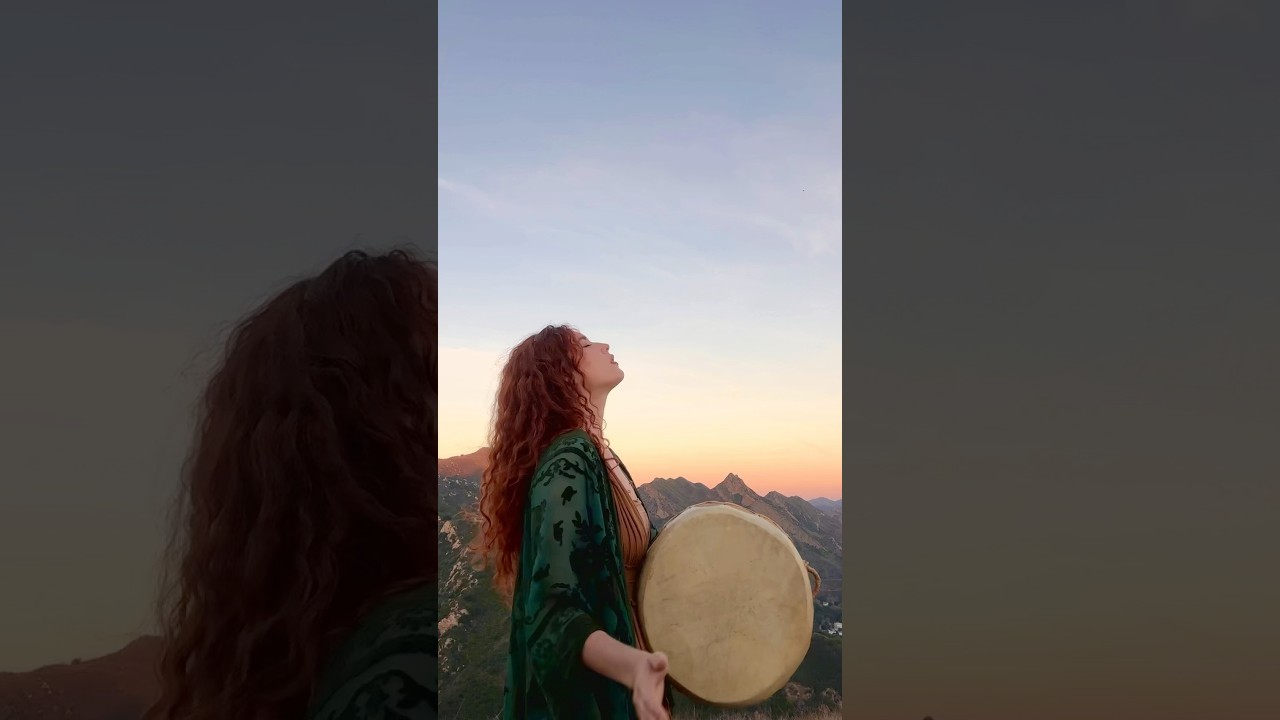
The video, directed by Jordan and Fitzpatrick, emphasizes stillness and shadow. There is no narrative arc in the traditional sense—no character arc, no plot resolution. Instead, the camera holds on the singer's face, the talharpa's body, the spaces between bodies. Colourist Mika Onnela has graded the footage in cool, desaturated tones that feel neither entirely contemporary nor entirely historical. The visual strategy mirrors the song's own refusal to locate itself in a specific era. This could be happening now or a hundred years ago; grief occupies its own temporality.

The Lineage Language of Burden

What distinguishes "Burden the Heavens" from other contemporary folk songs about death is its explicit concern with inheritance. The word "burden" in the title is crucial. To burden the heavens is not to ask for relief, forgiveness, or peace. It is to place weight on the cosmos itself—to say, This death matters so much that it should disturb the order of the universe. The song refuses the comfort narrative. There is no transcendence here, no spiritual resolution. There is only acknowledgment: red rivers, thundering bone, the deafening echo of loss.

The chorus's repeated invocation—daughter, daughter, daughter—operates as both ritual utterance and blood-magic. In many folk traditions, naming something repeatedly is understood not as redundancy but as incantation. Each repetition strengthens the call. By the fourth or fifth time "daughter" appears in succession, it has ceased to be a word and become a frequency, a vibration meant to reach across whatever boundary separates the living from the dead.

Where to go from here

Listeners drawn to "Burden the Heavens" might explore the broader lineage of Nordic and Baltic folk traditions that treat ancestor veneration not as quaint nostalgia but as active spiritual practice. The song's refusal of easy resolution connects it to contemporary artists working in what might be called "grief folk"—music that honors darkness without asking it to transform into light. The talharpa itself, once nearly extinct, has experienced a revival among musicians interested in reclaiming pre-Christian European sound traditions. Jordan's use of it here suggests not archeological recreation but living inheritance: the past singing through the present body.

Transcript

[0:07] Deep in the valley, alone [singing]

[0:11] and emerald.

[0:18] Drift

[0:19] at the ash and below

[0:22] the small

[0:29] Here in the wind and the weather

[0:33] cold.

[0:39] But in

[0:41] the heavens and wild

[0:45] emerald.

[0:55] Come [music] to

[0:56] the willow,

[0:57] the cradle of [singing] stone.

[1:05] Lay down [singing] your weapons, [music]

[1:08] the young and the old.

[1:13] >> [music]

[1:16] >> Here

[1:17] where [singing] the

[1:18] >> [music]

[1:18] >> waves meet the rippling

[1:21] flow.

[1:27] But it

[1:28] is the river

[1:29] >> [music]

[1:29] >> that carries [singing]

[1:31] home.

[1:37] Oh. [music]

[1:43] Oh.

[1:44] >> Daughter, daughter.

[1:44] >> [music]

[1:46] >> Daughter of the water.

[1:47] >> [singing]

[1:49] >> Daughter of the water.

[1:52] Daughter [music] of the water.

[1:55] Daughter.

[1:58] Daughter of the

[1:59] >> [music]

[1:59] >> Daughter.

[2:03] >> [music]

[2:08] [music]

[2:08] >> Loud is the echo

[2:11] of

[2:12] thunder

[2:12] >> [music]

[2:12] >> roar.

[2:19] Higher the deafening

[2:21] red [music]

[2:23] river grow.

[2:27] >> [music]

[2:29] >> Here

[2:30] in the wake

[2:31] >> [music and singing]

[2:32] >> of the winter wind

[2:34] grow.

[2:40] Burden

[2:41] the heavens

[2:43] to

[2:44] watch them move.

[2:54] >> [music]

[2:56] >> Oh.

[2:58] >> [singing]

[2:59] [music]

[3:03] [singing]

[3:07] [music]

[3:13] [music]

[3:16] [singing]

Sabrina Jordan
ArtistSabrina Jordan

Artist and teacher who bridges creativity and spirituality, guiding others through transformative workshops that combine traditional artistic techniques with spiritual practices fo…

View profileWebsite
Explore Topics
Ancestor-venerationFolk-ritualTalharpaGrief-musicLineage

Got Questions?

Frequently Asked Questions

The talharpa is a Nordic bowed-lyre with ancient roots in Scandinavian and Finnish culture. In 'Burden the Heavens,' it functions as a second voice that carries what lyrics cannot fully express—the sustained, lingering quality of grief itself. Its historical resonance with ancestor veneration traditions adds unspoken authenticity to the song's subject.
Rather than asking for relief or spiritual peace, the phrase places weight on the cosmos itself—asserting that this death matters so profoundly it should disturb the order of the universe. It's a refusal of comfort narratives, an insistence that loss be acknowledged as genuinely disruptive.
The repeated invocation of 'daughter' operates as ritual utterance or incantation. In folk traditions, naming something repeatedly strengthens the call and is understood as magic rather than redundancy. Each repetition transforms the word from language into frequency, a vibration meant to reach across the boundary between living and dead.
The song begins with what feels like a singular death (a body carried downriver) but expands into something genealogical and ancestral. By the end, it's mourning not one person but all death and all lineage—the accumulated weight of blood obligation across generations.
The video emphasizes stillness and shadow rather than narrative. Colourist Mika Onnela's cool, desaturated color grade places the footage outside of specific time—neither entirely contemporary nor historical. This mirrors the song's refusal to locate itself in a particular era.
'Burden the Heavens' connects to a broader tradition of music that honors darkness without demanding it transform into light. It treats grief not as something to resolve but as a lineage to carry, making it part of an emerging genre concerned with authentic rather than commodified mourning.

Continue Reading

More from Sabrina

View All
Celtic Folk Song Hazel Eyes: Scottish Imagery & Emotional Depth
Inspire

Celtic Folk Song Hazel Eyes: Scottish Imagery & Emotional Depth

A Celtic folk song weaving Scottish landscapes with intimate love imagery, using natural metaphors to express belonging and devotion.…

1 min read
Sideways Phone Audio: Full-Body Singing & Hand Drum Immersion
Inspire

Sideways Phone Audio: Full-Body Singing & Hand Drum Immersion

Sabrina Jordan demonstrates how rotating your phone horizontally transforms listening to acapella singing and hand drum performance into a s…

1 min read
Hanuman Chalisa: Ancient Mantra Clears Emotional Channels
Inspire

Hanuman Chalisa: Ancient Mantra Clears Emotional Channels

Krishna Das reveals how chanting Hanuman Chalisa unlocks prana flow through the body's subtle channels, transforming stored trauma into spir…

1 min read
Hare Krishna Mantra: Sound as a Path to Inner Awakening
Inspire

Hare Krishna Mantra: Sound as a Path to Inner Awakening

The maha-mantra awakens the heart to its divine nature through transcendental sound. A live kirtan at World Yoga Festival explores mantra as…

1 min read

Keep exploring

Continue your journey

More wisdom and gatherings from across the BrightStar directory.

More Articles

Browse the full library of teachings, interviews, and guides.

Back to all articles →

Teachers & Artists

Explore the lineages, musicians, and guides of the conscious world.

Explore artists →

Find an Event

Kirtan, retreats, sound baths, breathwork, festivals — happening soon.

Browse events →