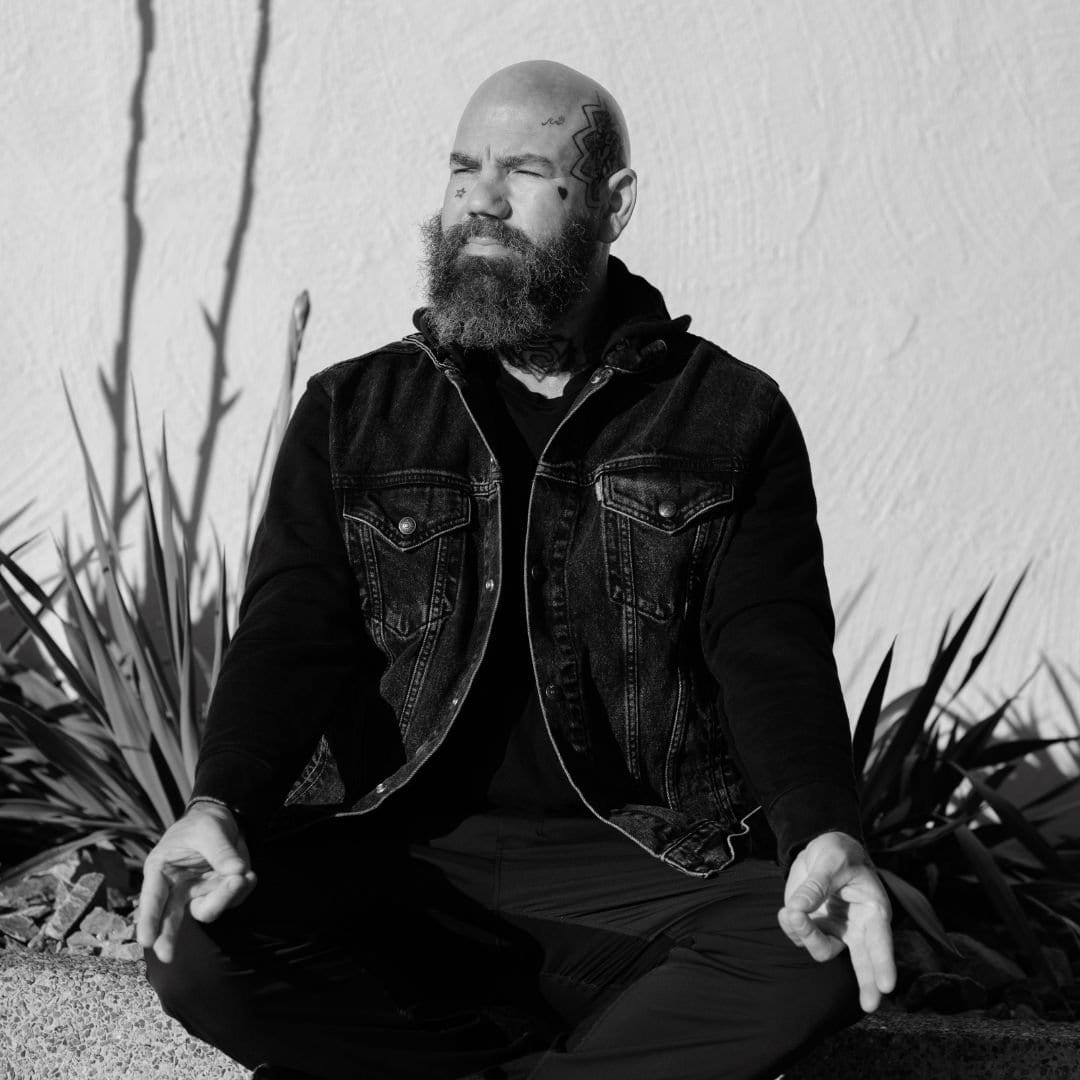

Yogi Bryan's teaching is best understood as applied relaxation delivered with a raised eyebrow. He is a certified hypnotherapist, an NLP Master Practitioner and Trainer, and an E-RYT 200 hour yoga instructor, but the thing that organizes his work is a simple observation: people who cannot quiet their minds are often trying too hard, and often taking the whole enterprise too seriously. His method is built around that problem.
The documented teaching is recorded and guided, not a formal retreat or classroom. The material available does not describe live retreats or workshops, so any claim about the in-person experience would be speculation. What can be said concerns the recordings: hypnosis scripts, meditations and yoga nidra meant to be followed at home, usually lying down with the lights low.
A typical recording pairs slow, hypnotic pacing with conversational asides. The first few minutes tend to feel less like a meditation and more like a conversation, and the listener is talked down into rest rather than drilled in posture or breath counts. Humor is present throughout but not chaotic. The effect is of a guide who is relaxed enough that the listener is permitted to be.
The format is directive. There is a voice, and the listener follows it. Students who prefer to be left alone with a cushion and a timer, or who want posture correction and formal instruction, may find it too talkative.
Relaxation as a skill rather than a mood is the most persistent thread, especially for people whose minds will not settle at night. Sleep is the practical anchor, which is why yoga nidra and hypnosis recordings occupy so much of the catalogue.
The second theme is the subconscious mind as the real lever for change. Bryan says he arrived at this through his own experience: after beginning a daily meditation practice, he listened to hypnotic recordings every night while he slept and describes slowly reprogramming his own subconscious to build the life he wanted. The third is breaking stuck patterns, where NLP supplies the vocabulary for noticing and shifting habitual responses.
Consistency runs underneath all of it. His own practice began with a challenge to meditate daily for 90 days, and he says he has not stopped since. The lesson is unglamorous: repetition matters more than inspiration.
The bio and FAQs do not record specific questions he poses, so what follows is inferred from the themes rather than quoted. The work seems to ask: Why does relaxing feel like a performance? What patterns keep you stuck, and what would it take to notice them? What happens when you stop competing at your own practice? These are questions about effort and self-seriousness more than metaphysics, and they follow directly from the origin of his work.
Humor is structural. His work began with an Instagram page made to poke fun at yoga, prompted by how competitive and solemn people had become about their practice. He wanted the community to have somewhere to laugh while practicing, and his stated view is that people need to relax and have fun on their yoga and meditation journey. His book, It's Just F\cking Meditation*, signals the same register in its title.
Silence, in the austere sense, is not the main instrument; the guiding voice is. Personal story appears mainly as his own account of the 90-day commitment and the nightly recordings. Scripture is largely absent. No classical Indian or Buddhist framework is named in his published material, and the work is better read as clinical hypnotherapy and NLP delivered through a yoga and meditation vocabulary.
It lands for overwhelmed, restless or sleep-deprived people who want practical tools and do not need a spiritual framework to take them seriously. Complete beginners are well served, since the recordings require no prior practice and no posture or breath technique. The podcast, Relax with Yogi Bryan Meditation, has over 8 million plays, which suggests the audience for this plain, lightly comic approach is large.
Several kinds of student may bounce off it. Those seeking devotional practice, scriptural study or long silent sitting will not find it. People who feel humor undercuts sincerity will likely be grated by the irreverence, since the jokes are part of the method. Anyone wanting a guru-led lineage with formal initiation will find none. Cautions apply as well: hypnosis recordings are for relaxation and sleep and should not be played while driving or operating machinery, and hypnotherapy and NLP are not substitutes for clinical mental health care. Anyone with trauma, a serious sleep disorder or a psychiatric condition should consult a qualified professional.
The approach also has a narrower lens than traditional meditation teaching. That is a deliberate choice, but it is a limit: those hoping for a broad philosophical agenda will find the themes tightly focused on relaxation, sleep and pattern change.
By the bio's account, Bryan's clearest lineage is in hypnosis and NLP. He trained as a hypnotherapist under Dr. David Snyder, and as an NLP Practitioner, Master Practitioner and Trainer under Dr. Richard Bandler. On the yoga side, the documentation is a credential rather than a lineage: he is an E-RYT 200 hour instructor and a Yoga Alliance Continuing Education Provider. No guru or traditional yoga teacher is named, and his meditation origins are personal, not inherited.
That makes him an unusual figure: a trained clinician-style practitioner who borrowed the yoga world's vocabulary and then gently mocked its pretensions. Whether that is a strength or a limitation depends entirely on what a student came looking for.