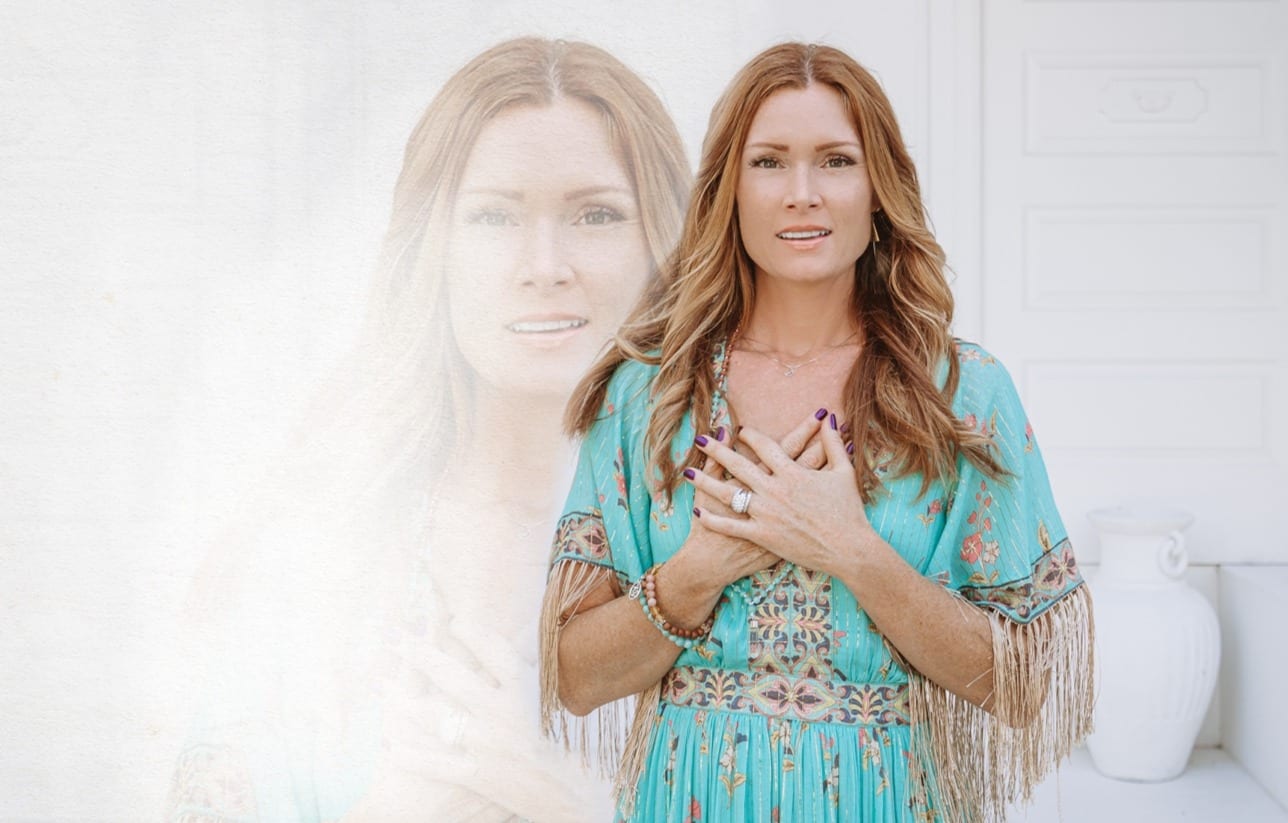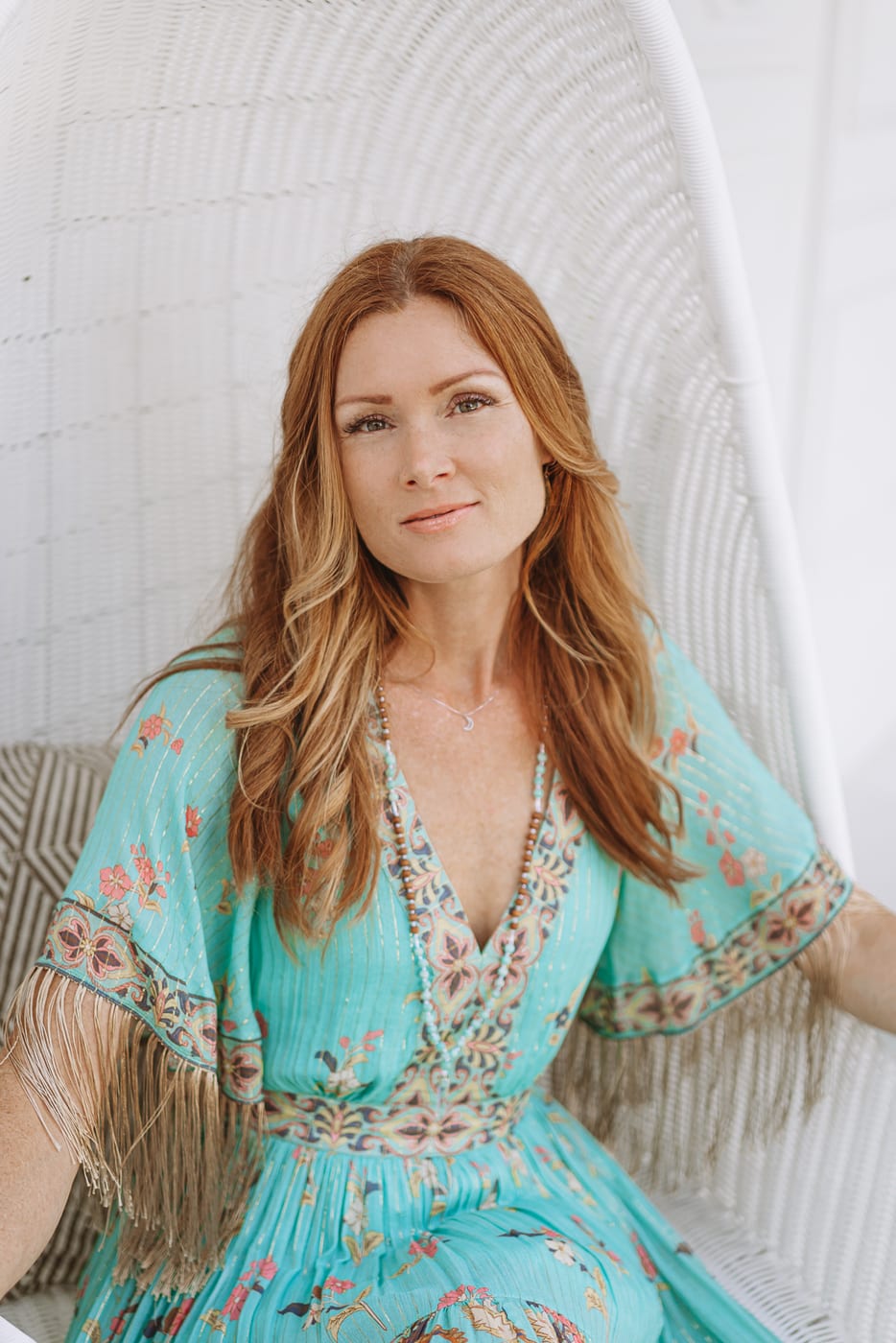

Kim Newing, who teaches as Mama Goddess, works mostly at a distance. Her primary platform is Insight Timer, where her site says more than 26,000 students listen to her guided practices, and the rest of her teaching arrives as audio and video programs, a YouTube channel, one-to-one mentoring, and a 12-week live training called Soul Expansion. The most common encounter with her is therefore a recorded voice, not a room.
Her sources describe that voice as conversational rather than ceremonial. She speaks to specific pressures, such as overwhelm in motherhood, disconnection in relationships, and the weight of carrying responsibility, instead of beginning with abstract metaphysics. The pacing is said to leave room for integration and not to rush toward transcendence. In mentoring and live work, the quality shifts from listening to inquiry. Drawing on her NLP, hypnotherapy and coaching training, she helps a woman locate the belief or nervous system pattern driving her overwhelm, then offers a tool: meditation, breathwork, an embodiment practice, or intuitive questioning. Her stated aim is to guide emotionally overloaded women out of the anxious spiral and back to their inner knowing.
This is not a stress-reduction or productivity product. Her sources say plainly that it is a longer project of reclaiming self-trust.
Self-trust is the center. She holds that women are trained to override their own knowing in favor of outside validation, whether from partners, institutions, or spiritual teachers, and her work tries to reverse that habit.
Around it sit four related threads:
- Nervous system regulation. Overwhelm is treated as dysregulation, not as a character flaw or spiritual failure. The goal, in her bio's words, is to help women feel safe in their bodies and respond instead of react.
- Feminine embodiment. She is skeptical of models built on transcendence and detachment, and treats the body, cycles, and relationship as legitimate routes to insight.
- Intuition as a skill. Soul Expansion, her 12-week training, is built around it. Intuition is framed as teachable and more reliable than the anxious thinking mind.
- Inherited stories. Much of her coaching work involves finding the narratives women absorbed from family or culture and choosing others.
Her bio also invokes "spiritual law" alongside these, though it does not spell out what that means in practice.
The sources describe a teacher who asks more than she tells. The questions that follow from her framing are fairly clear: What does your body say before your mind weighs in? Whose approval are you waiting for? Is this response regulated, or is it reaction? Which story are you operating from, and where did you get it? Her stated stance is that she is not the answer; the wisdom is already in the student. A practice that stays purely intellectual or aspirational is, by her sources' account, not one she teaches. The test is what the body registers and how the nervous system responds.
Story is the clearest element. She presents her own life as a series of initiations: a career as an airline purser in her early twenties, a diploma in life coaching, NLP and hypnosis, a first silent meditation retreat at 29, and the grief of a miscarriage at 37. She says these taught her that being truly seen and believed in can change everything. Her family life, on a small farm outside Brisbane with her husband, three daughters and many animals, is part of the same grounded register. Her children's book, Tales of the Wild Adventurer, suggests she is comfortable with narrative as a form.
Silence has a biographical weight, since a silent retreat marked her turning point, though the sources do not describe how much silence she builds into her own sessions. Nothing in the material establishes humor as a signature, and I won't assert one. Nor do the sources show her teaching from scripture. Her reference points are contemporary: she is said to have drawn on Marianne Williamson, Louise Hay, Eckhart Tolle, and Byron Katie, and to have studied with Wayne Dyer, Tolle, and Katie. The register is psychological and personal, not textual.
It lands for women who have tried therapy, breathwork, or spirituality separately and want something that holds body, nervous system, and intuition together. It assumes no prior meditation background, but it does assume readiness for self-examination. This is participatory work, not passive listening.
Several kinds of seeker may bounce off it:
- People wanting devotional, mantra-based, or ecstatic practice. Her approach is grounded and pragmatic.
- Those who want one simple technique, such as breath counting. Her method layers psychology, somatic work, and intuition.
- Men, who are not excluded but are not the intended audience, since the language and examples center feminine embodiment.
- Skeptics who want a stripped-down, evidence-only approach. Talk of intuition, feminine wisdom, and spiritual law will read as esoteric, whatever neuroscience claims accompany it.
- Anyone looking for a charismatic authority to follow. She deliberately declines that role.
She does not belong to a single lineage, and her materials do not claim one. The bio places her in a mix of practices: guided meditation and mindfulness, somatic work, life coaching, NLP, and Ericksonian hypnotherapy. The one named teacher in the bio is Michaela Boehm, who developed the Non-Linear Movement Method, a somatic practice Kim teaches. Her self-description as a certified Intuitive Guide, Master NLP Practitioner, Ericksonian Hypnotherapist, feminine embodiment coach and mentor, and professionally certified life coach is a list of credentials, not a tradition. The result is contemporary and integrative, rooted in no single Eastern or devotional school.
That breadth is both the appeal and the risk. Students who value rigor with intuition will find a coherent frame. Those who want a clear doctrine, or independent evidence for its larger claims, will have to look beyond what the available sources provide. There is also no major press coverage on record; her standing rests on her student numbers and long practice with women, over twenty years by her own account.