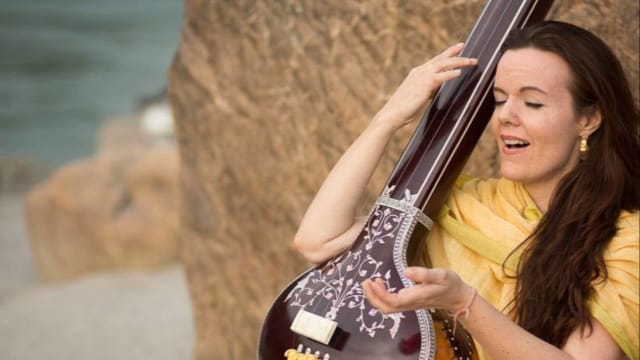

Anandra George's music is built on the voice before anything else. She sings Sanskrit mantra and kīrtan in a clear, trained delivery that puts tuned pronunciation ahead of ornament. The melodic frame comes from Indian rāga, and the pacing follows from that: phrases unfold slowly and return, shaped for sustained chanting rather than the verse-and-chorus architecture of song. Because her work is framed around nāda yoga, the sound favors resonance and held tones over percussive drive.
One thing is worth stating plainly. The public material does not specify which instruments accompany her, so no harmonium, drum or string is claimed here. What listeners consistently notice is how much room the arrangement leaves for the voice and for the space it sounds in. The texture is spare, and the attention goes to pitch, breath and the shape of each syllable.
Her work sits within bhakti, the devotional path in which sound, name and song carry the practice. Her kīrtan is rooted in the Indian musical world she has studied since 1997. She shares Sanskrit sounds, mantra meditation and Indian music at the behest of her beloved gurus, though the bio does not name them. The lineage is relational and teacher-based rather than an institutional affiliation she announces, so none is assigned here.
One teacher is named in her record: Pandit Baldev Raj Verma, a teacher of Hindustani vocal music in Delhi, with whom her musical training continues. That study anchors her singing in classical North Indian rāga rather than generic world-music kīrtan, and it shows in her melodic discipline. Classical Indian singing demands precise pitch movement and breath control, and her chanting reflects both. Her programs also include Indian rāga-based kīrtan leadership and the Sāvitrī Gāyatrī mantra meditation used at her Australian retreat.
Many kīrtan leaders are either performers or teachers. Anandra George built something that joins the two. Heart of Sound, which she describes as the world's first yoga teacher training based entirely on the transformative power of sound, offers 200-, 300- and 500-hour Yoga Alliance trainings in mantra and nāda yoga. Its curriculum treats mantra as a therapeutic practice and includes Sanskrit sounds anatomy, āyurvedic principles of sound and mental health, and vocal coaching for pleasure rather than performance.
Underlying all of it is her conviction that the voice is a skill and that vocal competence is a form of devotion. Students are expected to sing well, not merely sincerely. That stance changes how the music sounds: the pronunciation is exact, the tuning deliberate, and the chant is built so participants can sustain it. Her credentials as a C-IAYT yoga therapist and E-RYT 500 teacher lend that rigor a clinical seriousness unusual in the field.
The public record names Pandit Baldev Raj Verma as the most concrete influence on her music. It lists no accompanists or band, and her musical world is organized around the voice and classical melodic frameworks rather than a fixed lineup. Her teaching team includes a German-speaking group for German-language retreats, a collaboration in education more than performance. Her wider partnerships sit in research and festival settings: she consulted on mantra fMRI research for India's National Institute of Mental Health, developed sound-based meditation workshops for the main TED conference in Vancouver, and founded the Sacred Sound Stage at the International Yoga Festival in Rishikesh.
The best way in is the free online chant experiences, especially the Mantras for Peace Marathon, which is a low-stakes test of whether her approach suits you. The YouTube channel at youtube.com/@heartofsound holds introductory videos recorded from her tiny house on wheels in Kaua'i, where she speaks plainly about sound rather than performing a persona.
Several things may surprise a newcomer. The music is meant to be practiced, not simply played, so the instructional framing is part of the experience. The pace is unhurried and the energy deliberately even; anyone expecting high-energy, call-and-response kīrtan built on crowd momentum will find something quieter and more exacting. Expect attention to pronunciation to matter more than atmosphere. And streaming is not an option: her Spotify and Apple Music profiles are not listed, so the channel and heartofsound.in are the places to listen. Those who want structure can move on to Sacred Sanskrit Sounds, the online course on the anatomy of tuned mantra chanting. Her programs are built for non-musicians too, so the bar is willingness, not training.
Conscious music is crowded with devotional performers on one side and wellness-oriented sound practitioners on the other. Anandra George sits between them. She is a devotional musician grounded in classical rāga, a clinically informed teacher, and a festival organizer who has taught and sung at some of the world's largest yoga gatherings, including Yoga Fest Yokohama, Hanuman Festival, Bhaktifest, Wanderlust and True Nature.
She has also pushed the field's ethics, creating an open-source code of conduct against sexual harassment and guru abuse for yoga and spiritual festivals, and her teaching deliberately avoids dogma and spiritual bypassing. The result is a sound defined less by spectacle than by precision, one that treats listening and craft as the substance of devotion. For those drawn to chant as a discipline rather than a backdrop, her work offers a rare combination of Indian classical grounding and a modern teaching method.