




What is Budokon Yoga?
Budokon Yoga is a physically demanding contemporary yoga style that integrates classical yoga asana with martial arts movements, animal locomotion patterns, calisthenics, and mobility training. Created by martial artist and movement innovator Cameron Shayne in 2001, it was originally designed as conditioning work for mixed martial arts fighters and grapplers, but has since evolved into a distinct movement practice with a global following. The practice is structured around the Budokon Yoga Primary Series—a demanding sequence of seven sections emphasizing continuous transitions between postures rather than static holds, incorporating spinal undulations, spiral transitions, and martial arts stances uncommon in traditional yoga.
The name derives from Japanese: bu (warrior), do (way/path), and kon (spirit)—collectively meaning “the way of the warrior spirit.” Unlike purely combative martial systems or devotional yoga traditions, Budokon Yoga positions itself as a “mixed movement art” that seeks to unify the discipline of the warrior with the introspection of the yogi. It draws philosophical inspiration from Zen Buddhism, particularly the koan “If you meet the Buddha on the road, kill him” (attributed to Lin Chi), emphasizing anti-dogmatism and self-reliance over guru worship—embodied in Budokon University’s mascot, the “Guru Killer.”
Origins & Lineage
Cameron Shayne founded Budokon Yoga in 2001 while based in Los Angeles, California, then the epicenter of Western yoga culture. Born in 1971 in Charlotte, North Carolina, Shayne began training in martial arts and Zen meditation at age 12, earning black belts in Olympic-style Taekwondo (1992, 5th degree) and Yoshukai Karate-do (2003, 3rd degree). He later received his black belt in Brazilian Jiu-Jitsu in 2022 from Xande Ribeiro and Rafael Lovato Jr. Shayne began practicing postural yoga at age 25, initially to complement his martial arts conditioning.
Influenced by his first Brazilian Jiu-Jitsu instructor, legendary fighter Rickson Gracie, and the movement patterns of his mentor Orlando Canni, Shayne developed an interest in quadrupedal locomotion and animal-inspired movement. He studied the works of primatologist Frans de Waal and movement educator Moshé Feldenkrais to deepen his understanding of human biomechanics and evolutionary movement patterns. In the late 1990s and early 2000s, while working as a personal trainer and bodyguard to Hollywood actors including Jennifer Aniston, Sean Penn, and Courtney Cox, Shayne refined what would become the Budokon system. Celebrity endorsements—particularly Courtney Cox’s support of his first DVD series—helped bring Budokon to mainstream attention, though Shayne grew increasingly uncomfortable with its portrayal as a fitness trend.
In 2004, Shayne left Los Angeles and founded Budokon University in Miami Beach to focus on deeper transmission of the practice. The system expanded beyond yoga to include a full black belt martial arts curriculum. Budokon University now operates from Montana, where Shayne resides with his wife and co-director Melayne Shayne. The system has trained hundreds of certified teachers globally and influenced contemporary movement culture—techniques used in popular programs like “Animal Flow,” “Yoga for BJJ,” and “Phase Six” are traced back to Budokon’s innovations in crawling patterns and animal-based transitions.
How It’s Practiced
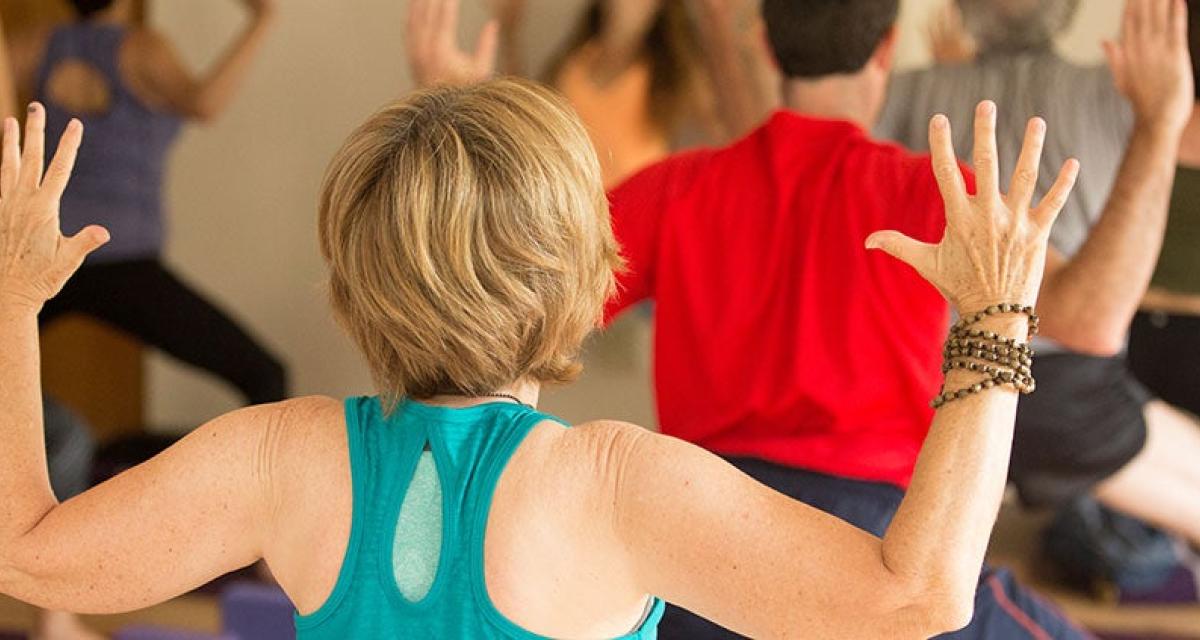
A typical Budokon Yoga class lasts 60–80 minutes and follows a three-part structure: the session begins with yoga-based sun salutations (approximately 20–40 minutes) to open the body and establish breath-movement integration; transitions into martial arts-inspired sequences featuring explosive yet controlled movements drawn from karate, kung fu, taekwondo, and Brazilian Jiu-Jitsu (approximately 20–40 minutes); and concludes with guided meditation or savasana for integration.
The foundational practice is the Budokon Yoga Primary Series, consisting of seven precisely sequenced sections of slow, controlled movements designed to improve mobility, agility, flexibility, and strength. Unlike traditional yoga lineages such as Ashtanga or Iyengar, which emphasize holding postures, Budokon prioritizes fluid transitions—continuous, circular movement patterns executed with precision and repetition. There is no breath count (as in Vinyasa), no prescribed rest periods, and movements are deliberately slow and precise, resembling tai chi in their measured quality. The practice incorporates spinal undulations, spiral transitions, animal locomotion (crawling patterns mimicking feline and primate movement), and martial arts stances that challenge both strength and coordination.
Budokon differs from conventional yoga in its rejection of spiritual or religious framing. It is taught explicitly as a secular movement science without emphasis on yoga as religious theology. The broader Budokon system (beyond the yoga component) operates on a six-pillar framework—movement, intelligence (thoughts), emotions, relationships, nutrition, and environment—with advancement through a colored belt system (white, red, blue, purple, brown, black) similar to martial arts ranking. Practitioners learn and create unique movement patterns (kata or forms) that synthesize yoga, martial arts, animal locomotion, and calisthenics. However, many practitioners engage only with the Budokon Yoga modality rather than pursuing full martial certification.
Budokon Yoga Today
Budokon Yoga is taught globally through certified instructors trained at Budokon University and regional workshops. The system offers tiered training programs: 5-day/50-hour intensives in Budokon Yoga or Budokon Mobility serve as introductions, while longer immersions (10-day, 3-week, or month-long training camps) provide comprehensive teacher certification. Students can customize their training by selecting from modules including BDK Yoga, BDK Mobility, BDK Calisthenics, Brazilian Jiu-Jitsu, and martial arts. Training is available at Budokon’s headquarters (previously Miami Beach, now Montana), at international retreat centers, and through certified teachers in cities worldwide.
Contemporary Budokon classes are found primarily in urban yoga studios, martial arts gyms, and specialized movement centers. The practice appeals particularly to experienced yoga practitioners seeking greater physical challenge, martial artists looking to improve flexibility and mobility, and athletes interested in cross-training. While traditional yoga demographics skew heavily female, Budokon attracts a more balanced gender ratio due to its martial arts components and athletic demands. Cameron Shayne currently serves as mobility and performance coach for Major League Baseball’s Philadelphia Phillies, illustrating Budokon’s evolution beyond yoga studios into professional athletics.
Online resources include instructional videos, recorded classes, and the Budokon University podcast. The community identifies as “Guru Killers,” reflecting the system’s anti-authoritarian ethos and emphasis on critical thinking over blind adherence to tradition.
Common Misconceptions
Budokon Yoga is not a traditional yoga lineage. It has no roots in ancient Indian scriptures, guru-shishya parampara (teacher-student lineage), or devotional practice. It is a 21st-century Western hybrid created by a martial artist, not a transmission from a yogic master.
Budokon is not suitable for absolute beginners. Due to its physically demanding nature and blending of disciplines, instructors commonly recommend students first establish foundational competency in both yoga and martial arts before attempting Budokon classes. The practice requires existing strength, mobility, and body awareness.
It is not a fitness fad or weight-loss program, despite early media coverage framing it as “celebrity yoga.” Shayne has explicitly rejected this characterization, emphasizing Budokon as a holistic movement art and philosophical practice focused on developing physical and mental resilience, not aesthetic outcomes.
Budokon is not inherently spiritual or meditative in the devotional sense. While it incorporates Zen meditation principles and emphasizes mindfulness, it does not involve chanting, mantra, pranayama breath retention techniques, or deity worship. Its philosophical framework centers on phenomenology—the examination of subjective experience—and the Buddhist concept that all mental activity is temporary and conditioned.
Finally, Budokon Yoga is distinct from the broader Budokon Mixed Movement Arts system. While the yoga component can be practiced independently, the full Budokon curriculum includes striking, grappling, weapons training, character development, and advancement through a martial arts belt ranking.
How to Begin
Prospective students should first assess their current fitness level and movement experience. Budokon Yoga is best suited for those with prior yoga or martial arts training; absolute beginners should consider foundational classes in Vinyasa yoga, Hatha yoga, or introductory martial arts before attempting Budokon.
To explore Budokon Yoga, search for certified Budokon instructors in your region through the Budokon University website (budokon.com), which maintains a teacher directory. Many instructors offer introductory workshops or drop-in classes at yoga studios and movement centers. Online, instructional videos of the Budokon Yoga Primary Series are available for home practice, though in-person instruction is recommended for learning proper alignment and transitions.
For serious study, consider attending a 5-day/50-hour Budokon Yoga intensive, which provides immersion in the Primary Series and foundational philosophy. These are offered periodically at Budokon University’s headquarters and at international retreat locations. Longer certification programs (3-4 weeks) are available for those pursuing teaching credentials.
Approach the practice with patience and curiosity. Cameron Shayne himself has noted that people tend to “either hate it or love it”—the intensity, hybrid nature, and philosophical framework do not appeal to everyone. If you seek a gentle, meditative, or spiritually devotional yoga practice, Budokon is likely not the right fit. If you desire a rigorous, athletic, movement-focused practice that challenges both body and mind without dogma, Budokon offers a distinct path.