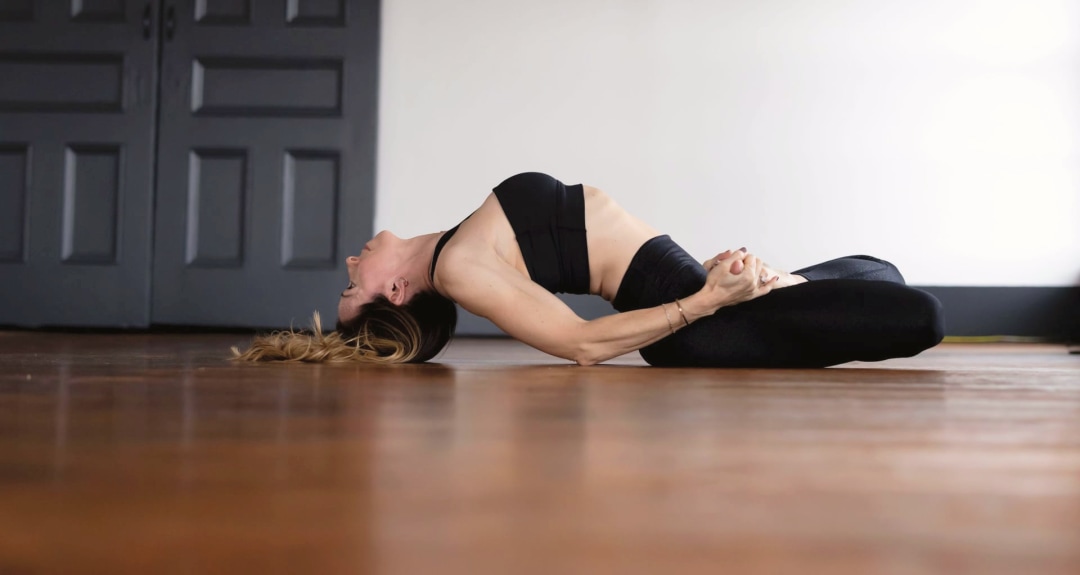
Rebecca Cohen
Yoga Therapist
About
Rebecca Cohen is a yoga therapist with more than 30 years of personal practice and over two decades of teaching experience. She is a registered yoga teacher at the experienced advanced level (ERYT500) and a certified yoga therapist registered with the International Association of Yoga Therapists (C-IAYT). Her work focuses on helping people reduce pain, build strength and move better. She is known for challenging students while building their confidence.
Rebecca Cohen is a yoga therapist with more than 30 years of personal practice and over two decades of teaching experience. She is a registered yoga teacher at the experienced advanced level (ERYT500) and a certified yoga therapist registered with the International Association of Yoga Therapists (C-IAYT). Her work focuses on helping people reduce pain, build strength and move better. She is known for challenging students while building their confidence.
Rebecca came to yoga in 1996. As a collegiate springboard diver she suffered spinal fractures and degenerative disk disease at the age of 19, and lived with severe chronic pain until a friend introduced her to yoga. After one class she was hooked. In her words, yoga became her medicine, her sanity and her saving grace. She received her teaching certification at the Sivananda Ashram in Kerala, India, in 2007, completed advanced certification with Integrative Yoga Therapy in 2009, and received her IAYT accreditation in 2017. She has been training yoga teachers since 2012.
She became a yoga therapist because, as she describes it, every student who walked through her door needed something more than a vinyasa class. Her most cherished moments as a teacher come when people regain a sense of normalcy through a regular therapeutic yoga and meditation practice, and discover the connection between mind, spirit and body.
Rebecca is the creator of the Applied Vayu Method, a system built on the five prana vayus that integrates strength, breath mechanics and structural balance. Her practices aim to restore coordination between breath, core stability and spinal movement, so that a practice feels both strong and intelligent. She works one-on-one with clients in studio and leads group programs for neck, upper back and lower back pain. She also shares classes, meditations and educational videos for home practice.
She is also a certified medical intuitive (Meridian Energetics), is trained in traditional Thai Yoga Therapy (Nuat Thai), and holds a Master's Degree in Urban and Regional Planning from the University at Buffalo, New York.
FAQ
Questions
Rebecca Cohen is a yoga therapist with the credentials of an ERYT500 (experienced registered yoga teacher at the highest level) and C-IAYT (certified yoga therapist through the International Association of Yoga Therapists), bringing three decades of personal practice and over twenty years of teaching experience to a highly specific mandate: helping people recover function and reduce chronic pain through yoga therapy and meditation. What distinguishes her in the field is both her rigor—she's trained across multiple traditions including Sivananda yoga, Integrative Yoga Therapy, and Thai Yoga Therapy—and her personal stakes: at nineteen, as a collegiate springboard diver, she suffered spinal fractures and degenerative disk disease that left her living with severe chronic pain until yoga became her recovery path. Students come to her because she combines therapeutic sophistication with an unusual ability to build confidence; she doesn't just modulate poses for injury, she challenges students while they rebuild strength and proprioception. Her Applied Vayu Method, a system she developed around the five prana vayus, has become a signature offering for anyone with structural dysfunction or lingering spinal pain who wants to move intelligently and powerfully again. She's respected among serious practitioners because she refuses the spiritual platitude route—her work is grounded in biomechanics, breath coordination, and the measurable restoration of function.
Rebecca Cohen draws from multiple lineages rather than one single tradition, which is itself revealing about her approach: she received her foundational teaching certification at the Sivananda Ashram in Kerala, India (2007), where the emphasis is classical hatha yoga and the holistic path. She then pursued advanced certification through Integrative Yoga Therapy (2009), a methodology that explicitly weaves yoga science into therapeutic applications for pain, injuries, and chronic conditions. Her formal IAYT accreditation came in 2017, positioning her within the evidence-based yoga therapy movement that has grown substantially in the past decade. She is additionally trained in traditional Thai Yoga Therapy (Nuat Thai), an ancient massage-and-movement system that complements yoga's approach to structural rebalancing, and holds certification as a medical intuitive through Meridian Energetics. This multi-tradition approach—Sivananda foundations plus therapeutic specialization plus Thai bodywork plus energetic training—gives her work a breadth that appeals to students seeking both spiritual depth and clinical effectiveness.
The most accessible entry point is Rebecca Cohen's YouTube channel (@RebeccaCohenYoga), where she offers free classes, meditations, and educational videos that demonstrate her teaching approach and the Applied Vayu Method without requiring commitment or payment. For anyone with a specific pain issue—neck tension, upper back restriction, lower back dysfunction—starting with her educational content on that area of the body makes sense; she explains the biomechanical reasoning behind the practice, which helps newcomers understand that this isn't generic yoga but targeted therapeutic work. If you're drawn to one-on-one attention, her website (rebeccacohen.yoga) describes her studio practice and how to book sessions; this direct format is particularly valuable for people who are injury-sensitive or need modifications at the level of individual attention. For those who prefer group dynamics, she leads group programs organized by pain location and body region, offering the benefits of community without the overwhelming energy of a general vinyasa class. A reasonable first move is to watch one or two YouTube videos on whatever area of the body is causing you trouble, and then decide whether you want to deepen with a class series, group program, or one-on-one work.
Most yoga therapists inherit a teaching lineage and adapt it therapeutically; Rebecca Cohen created her own system, the Applied Vayu Method, which reorganizes yoga around the five prana vayus (the five directional flows of energy in classical yoga theory) and integrates them explicitly with breath mechanics and structural balance. This is not a minor distinction—it means her classes are engineered around the specific ways breath coordinates with core stability and spinal movement, rather than simply offering modified poses in a traditional sequence. Her personal history as a chronic pain survivor who lived through the efficacy of yoga creates a kind of earned credibility that many teachers lack; she didn't come to yoga through spiritual seeking first and then become a therapist, but rather recovered her life through yoga and then formalized the knowledge. She works simultaneously at three scales—one-on-one assessment and retraining, small group programs broken down by body region and pain type, and educational content for independent study—which reflects an understanding that different students need different modalities. What surprises newcomers is her directness about the work: she doesn't frame pain relief as spiritual transformation or promise that meditation will cure everything; instead, she addresses the practical mechanics of how breath, strength, and alignment restore function.
Rebecca Cohen's work is not suited to students seeking a flowing, dynamic, high-energy yoga experience—her therapeutic approach prioritizes precision and rest over aerobic intensity, and her pace is deliberate. If you're drawn to yoga primarily for spiritual transcendence or seeking a guru who will guide your consciousness, her rigorously functional approach may feel clinical by comparison; she emphasizes the mind-body-spirit connection as an outcome of restored function, not as a goal in itself. Beginners with no injury history or chronic pain who simply want a general fitness class will likely find her offerings too specialized and detailed—her teaching assumes your body has a specific problem that needs solving, and she calibrates everything toward that. Students attached to a single yoga lineage (say, strict Ashtanga or Kundalini devotion) may bristle at her willingness to draw from multiple traditions; she's a tool-builder, not a lineage guardian. Additionally, if you need a low-barrier, low-cost option, her specialized training and small-group or one-on-one format means her work is typically priced higher than a drop-in vinyasa class at a commercial studio. Her work is, by design, for people who have tried other approaches to managing their pain or dysfunction and are ready to engage seriously with therapeutic yoga—not for casual practitioners.
Rebecca Cohen's primary platform is her website (rebeccacohen.yoga), where she lists all current offerings, teaching schedules, and updates to her practice formats. Her YouTube channel (@RebeccaCohenYoga) is the place to find newly released classes and meditations; she regularly shares educational videos that explain the biomechanical or breath-mechanics foundations behind her work, offering ongoing learning for students of all levels. Since she doesn't release albums, books, or have a major touring schedule with announced dates, the website and YouTube are the two reliable channels for tracking her work. She appears to focus primarily on studio-based practice (one-on-one and group programs) and digital content rather than retreat-circuit teaching or touring, so expectations should be calibrated around that model. For anyone interested in her evolution, following her YouTube channel offers the clearest window into her current teaching emphases and the breadth of what she's offering.
Rebecca Cohen's teaching combines challenge with reassurance—she's known for pushing students to build real strength and proprioceptive awareness while simultaneously building their confidence that their body can handle the work. Her approach in both one-on-one and group settings is highly personal; she listens carefully to what students need and refuses the one-size-fits-all model that dominates yoga studios. A session with Rebecca focuses on precision and coordination: she will often spend significant time teaching how to breathe into a particular area of the body, how to engage the core in relation to spinal movement, and how to sense what's happening beneath the surface—this is not a yoga class where you simply follow along and sweat. Her use of the Applied Vayu Method means she's thinking about directional energy flows alongside muscular mechanics, so there's often a subtle, intelligent quality to the work that appeals to analytical students as much as to intuitive ones. One-on-one sessions are customized entirely around your injury history and current limitations, and she will often teach you exercises or sequences to practice at home, turning her studio time into an ongoing partnership rather than a passive receiving of instruction. What distinguishes her teaching from generic pain-management classes is her commitment to restoring not just relief but normalcy—her goal is for students to move through their lives without constant accommodations or fear of reinjury.
The most persistent theme is the inseparability of breath, core stability, and spinal movement—Rebecca frames this connection not as spiritual metaphor but as mechanical reality, and almost every practice she designs aims to restore coordination between these three elements. Another core theme is the distinction between symptomatic pain relief and functional restoration: she's interested in helping students not just feel better but actually move better, rebuild strength, and regain the confidence to use their bodies without fear or limitation. The mind-body-spirit connection appears throughout her work, but for Rebecca it's a consequence of restored function, not a precondition—when breath and structure align and pain recedes, students naturally experience a sense of psychological and spiritual calm. She emphasizes that yoga became her personal medicine, her sanity, her saving grace, and this lived experience shapes how she teaches: there's no fluff, no platitudes, just the transmission of genuine recovery. The Applied Vayu Method, her signature system, recurs through all her offerings as a framework for understanding how energy (prana) moves through the body in five primary directions, and how aligning with those flows transforms both how we breathe and how we stabilize ourselves. Finally, there's a consistent theme of intelligent movement over aggressive forcing—she wants students to feel powerful and coordinated, not pushed or injured.
Rebecca Cohen has not published books or long-form talks in the traditional sense, but her YouTube channel (@RebeccaCohenYoga) functions as her primary archive of independent study material and includes meditations, instructional classes, and educational videos that students can access anytime. These recordings offer significant value for someone seeking to understand her approach to yoga therapy and the Applied Vayu Method without being in a live class; she narrates the reasoning behind the practice, which helps viewers make sense of why she's cueing them to move in a particular way. The educational videos are especially useful for anyone curious about the theoretical foundations of her work—she explains breath mechanics, prana vayu theory, and structural biomechanics in ways that are accessible without being oversimplified. For students who are already working with her one-on-one or in a group program, these recordings serve as reinforcement and deepening tools; she often develops themes or sequences in video form that deepen what's being practiced in live sessions. Her lack of a published book or formal podcast series reflects her primary commitment to direct teaching and personalized work, rather than broad dissemination; her energy goes into studio practice and the quality of her digital recordings.
No prior yoga experience is required to work with Rebecca Cohen—in fact, her therapeutic approach often appeals most to people who have never done yoga before, or who tried yoga and found it physically overwhelming or emotionally unhelpful. Her teaching is specifically designed for people with pain, injury, or structural dysfunction, so if you come to her with a concrete physical problem (a herniated disk, chronic neck tension, post-surgical recovery), she has a direct pathway to help you without requiring you to learn yoga philosophy or Sanskrit terminology first. That said, familiarity with basic yoga concepts—understanding what a downward dog is, or having a sense of what breath-aware movement feels like—does make her more advanced classes more accessible; for complete yoga novices, starting with her YouTube educational content or one-on-one sessions makes the most sense. Her training as a yoga therapist means she's accustomed to working with medical patients, people in physical therapy transitions, and injury survivors who have no yoga background whatsoever. The barrier to entry with Rebecca is not yoga knowledge but rather a genuine need to address pain or dysfunction; she meets students there and doesn't require them to prove they're spiritually or philosophically aligned with yoga as a path.




Is this you? Claim this page ›
There's more where this came from.
BrightStar is the global directory of artists, teachers, and healers in the wellness and spiritual movement. Find your next experience — or add yourself.
Discover More Artists
Browse 14,000+ curated profiles across kirtan, yoga, meditation, and beyond.
Explore directory →Find an Event Near You
Kirtan, retreats, sound baths, breathwork, ceremonies — happening this week.
Browse events →Add Your Profile
Are you an artist, teacher, or healer? Get listed — free, AI-assisted, live in minutes.
Get started →