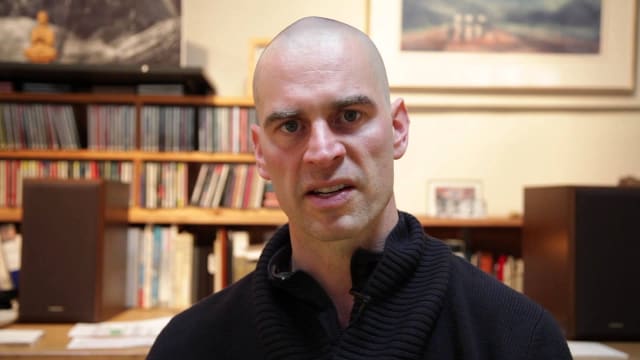
The difference between mindfulness and concentration is not obvious from the outside—both involve sitting quietly, following the breath. But the mechanics of what happens inside the mind are fundamentally different, and understanding that difference changes everything about how you practice. Michael Stone, a Zen teacher and longtime meditation instructor, uses a deceptively simple prop—a bowl and his hand—to show exactly how attention behaves as it matures.
Begin with a basic image: your hand is your attention, and the inside surface of a bowl is your breathing. When you sit to meditate, your attention—your hand—rests on the smooth curve of the bowl. It is connected. You are with the breath, following the inhale and exhale. This is the starting point.
But the mind is restless. A sound arrives, and your attention jumps toward it. Or you begin planning your day, or you remember a conversation from that morning and get caught in a chain of thinking about how that moment relates to something you're feeling now. Your hand slides off the bowl. You have drifted. This is not failure. This is the actual work of meditation.
What Stone calls "mindfulness practice" is the act of noticing the drift and returning. You fall away; you come back. You fall away; you come back. As Stone describes it: "This practice is something you'll be doing the rest of your life—constantly during the day you're having a conversation, you fall off, you come back to the breath over and over." The technique is simple, but the repetition is the point. You are training the mind to recognize distraction and gently redirect itself.
In casual daily mindfulness, you are always catching yourself mid-drift. But in formal sitting meditation—disciplined practice over weeks—something shifts. Your repeated returns to the breath begin to change the architecture of attention itself.
When you train yourself to come back, again and again, you notice over time that you don't drift as far anymore. You start staying closer to the breathing. Stone describes a subtle but crucial transformation: "You become intimate with the breath. There's no you anymore that's breathing—there's just breathing happening." The object and the observer begin to collapse into a single experience.
And then, without deliberate effort, the bowl flips. The pattern reverses. Instead of your attention sliding off the bowl and requiring you to fetch it back, something else happens: the attention is with the breath, but now it gently slides up the side of the bowl and comes back on its own. The breath itself is holding your attention. The breath is doing the work. This shift from "you correcting yourself" to "the object automatically returning your focus" is the threshold where concentration begins.
What does concentration feel like from the inside? After a few weeks of consistent practice, you notice changes in the texture of your meditation. The gaze is open, the eyes relaxed and uninterested in the visual field. The breath becomes very subtle, almost shallow. And then—distinctly—your thoughts move far back into the periphery, like ticker tape running in the distance.
This is crucial: your thoughts do not stop. This is not thoughtlessness. As Stone emphasizes: "It's important to know your thoughts don't stop—they just go really far back." The mind is still producing thinking, but it has lost its grip on your primary attention. The breath is happening in the foreground, vivid and immediate. The thinking is there, but distant, harmless.
When concentration deepens further, distractions don't even approach the center of your awareness. Stone uses the bowl metaphor again: "It's almost like the sides of the bowl are preventing the distractions from coming in because we're so involved in the breathing." Your focus has become so stable and self-reinforcing that disturbance simply doesn't penetrate. This is not suppression; it is a natural consequence of genuine intimacy with the object of meditation.
At a certain point—and this is subtle enough to miss—the technique itself becomes an obstacle. When concentration has stabilized and the breathing has become very shallow, very simple, very quiet, you can let go of the deliberate focus. Stone's instruction is direct: "Stop focusing on your breath and just be in the spaciousness. Just be in the awareness."
This is a threshold most practitioners will encounter but many misunderstand. It is not laziness or spacing out. It is a refinement. You step back from directing attention and instead rest in the field of awareness itself. The experience becomes one of open spaciousness, undisturbed presence, the breath happening almost imperceptibly within a vast, settled awareness.
But there is a trap here, and Stone names it with humor and honesty. Every time your attention comes in and thinks, "Wow, this is really cool," the entire construction collapses. The moment of self-consciousness—the "you" recognizing how good the meditation is—breaks the spell. Everything flips back. You get distracted, pulled out of the spaciousness, and you have to return to the breath. You have to come back to technique. And that is exactly right. That is the practice continuing, in a new phase.
The journey from mindfulness to concentration is not a leap but a continuous deepening. It begins with simple noticing—falling away, coming back. It proceeds through formal practice, where repetition rewires how attention behaves. It arrives at a natural stability where the object itself holds your focus. And it invites a final surrender into spaciousness that is itself a kind of practice, one that teaches you, again and again, the limits of grasping and the power of gentle returning. The work is the same throughout: notice, return, deepen. That is the architecture of a maturing meditation life.