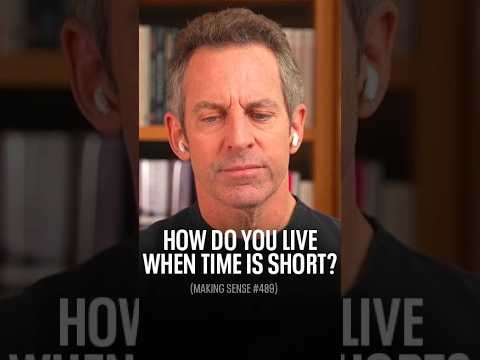
Everyone gets angry. The question isn't whether anger arises—it's how long it stays. When a wasp stings you, the initial recoil is neurological reflex, not failure. When you receive a scary diagnosis, an adrenaline spike is understandable. But here's the gap that separates a human hostage to their own mind from one who has learned to notice thought itself: the difference between five seconds of anger and five days. That gap, according to meditation teacher and neuroscience commentator Sam Harris, is where the real work happens. Not in chasing a myth of perpetual bliss, but in recognizing how the mind perpetuates suffering through a single mechanism—identification with thought.
The Attainable Versus the Mythical
Harris draws a crucial distinction between two spiritual endpoints. The first is what he calls mythical and unattainable: perfect enlightenment, in which a human being never experiences anger, fear, judgment, or shame again. "All that the bad side of the menu has been wiped clean," he describes it. "All you have is rapture and bliss and compassion and good vibes." It sounds like freedom. It sounds like the goal.
It's also, in his experience, not something he's ever observed in a living person. Harris has spent decades in close contact with some of the greatest meditators of the 20th and 21st centuries—practitioners who spent twelve years in a cave, who emerged radiant and transformed. "I still don't think those are guys who never had a negative mind state again," he says. "You know, they get stung by a wasp, they're going to have that 'I got stung by a wasp' feeling and they're going to wince just like a normal neurologically intact person."
The second endpoint—the one that matters—is radically different because it's radically available. It's not about erasing anger. It's about changing the relationship to anger once it arises. Specifically, it's about cutting the half-life of negative mind states "way way way down" by recognizing how they get perpetuated. The mechanism is simple but usually invisible: every moment you believe your thoughts about what happened, you're re-igniting the fire.
Getting the Information Without the Fire
Harris uses a concrete example: a scary diagnosis, followed by a wait. The doctor orders an MRI, but it's Friday afternoon. Results won't come until Monday at the earliest. You now have 72 hours to fill. The question isn't whether you'll feel anxious—the question is how anxious you need to feel.
"The real superpower of meditative insight," Harris explains, "is to recognize that you will simply not be anxious unless you are lost in thought about this thing that worries you." The initial anxiety spike—the adrenaline dump—carries information. It tells you something has changed and requires attention. But the perpetuation of that anxiety for the next three days is not serving you. It's not helping you get better results on the MRI. It's not making you more prepared for Monday's call. It's just suffering.
He applies the same logic to any reactive moment: anger at injustice, fear at uncertainty, moral outrage at wrongdoing. "You understand, okay, something just broke and somebody just broke it and perhaps on purpose. Now what?" The initial reaction gives you data. The perpetuation through thought-identification gives you only suffering. The question then becomes strategic: "Is fear or anger or outrage the best state of mind to be in as you respond to that change in the world?" Almost always, the answer is no. "You want to be in a cooler state of mind and a more rational one," he says, "one where you have all of your wits about you so as to figure out what to do next."
Breaking Identification With Thought
The mechanism that keeps the half-life long is what Harris calls identification with thought. It's the basic human mistake: treating the thought that arises in consciousness as if it were true, as if it were you, as if it demands your attention in perpetuity. Most people live their entire waking lives "lost in thought"—not noticing thought as a phenomenon, but caught inside it like someone in a dream who doesn't know they're dreaming.
The meditation practice he describes is not a relaxation technique or a stress-reduction hack. It's waking up from that dream. He offers a nested analogy: a bad dream where you don't know you're dreaming (total identification); a lucid dream where you recognize it's a dream and you know you're safe in bed (recognition of thought); and waking up entirely, so the dream subsides (freedom from thought-driven suffering). "Those are increments of freedom that really matter," he says. "It's a totally different way of being in your life and in the world."
The recognition itself is the shift. "It's like you suddenly notice you're making a fist and you know how to relax your hand." Once you see that you've been clenching—that the discomfort you attributed to the world was actually the grip of identification with thought—the relaxation becomes possible. The person who doesn't know they have a hand will clench it until it aches and believe there's something trapped inside. "That's what it's like to not know how to meditate," Harris says. "You're just helplessly borne away by thought all the time to whatever end it's going to take you. You're just a mere hostage."
Meditation Isn't Over There
One widespread misunderstanding deserves correction: the idea that meditation is a practice you do on a cushion, a separate domain from the rest of your life. Harris is direct about this. The practice isn't compartmentalized. It's not something you do "over there" and then leave behind when you step into the world. "The thing that you're doing right now with me"—that capacity to notice thought and return attention—"is meditation."
The real work is bringing that noticing into the moments that matter: when you're about to explode at someone, when you're spiraling in anxiety, when you're righteously angry at the state of the world. The difference between the meditator and the non-meditator isn't that one never gets angry and the other does. It's that one can feel anger, notice it, and consciously choose their response—often before five seconds have passed. The other is hijacked for five minutes, five hours, or five days.
This reframes why Harris talks about meditation rarely, at least directly, in his public work. He focuses on world problems, on ethics, on neuroscience and philosophy. But beneath nearly everything he says is an assumption that people can pay attention to the world's problems and not be overwhelmed by them. They can feel upset and then turn it off. They can engage their rational faculties without drowning in emotion. That capacity—to "be upset in the moment and then turn it off and then walk into the room"—is the actual skill. It's not transcendence. It's not supernatural. It's recognizing how your mind works and using that recognition to shorten the half-life of suffering.
The Skeptic's Problem
Harris acknowledges the resistance he encounters when he mentions meditation in conversation. People roll their eyes. They say they can't sit still, they can't clear their mind, they're not the type. He recognizes the objection because he held it once too. "I always gave you the eye roll when you talked about it," a conversation partner admits. Harris's response is patient: "Everyone who's doing that is just still somebody who doesn't understand what it is you're talking about. Guaranteed 100%. They just don't know."
The misunderstanding is usually the same: meditation is assumed to be about calming, about achieving a blank mind, about becoming a certain kind of person. The actual practice is about noticing how the mind works right now—how thoughts arise and disappear on their own, how identification with those thoughts creates the sense of a solid, suffering self. "You can't persuade everyone," Harris acknowledges. But he also notes the paradox: "Everyone is at bottom interested in it whether they know it or not because everyone is suffering the consequences of being lost in thought every moment of their waking life."
The catch is that you can't know this intellectually. You have to notice it for yourself. "They can't know that until they do it," he admits. But the moment someone sits and actually watches their own mind—sees a thought arise unbidden, watches it disappear, notices the gap between thoughts—the entire frame shifts. The skepticism doesn't vanish; the understanding does. And with it, the half-life of anger begins to contract.
Where to go from here
The practical endpoint Harris offers is the Waking Up app, which translates these insights into guided meditations that don't require religious belief, philosophical background, or a particular kind of mind. The practice is accessible. The results—the ability to feel five seconds of anger instead of five days of it, to receive bad news and respond with clarity instead of reactivity, to stay present with whatever arises—are measurable in your own direct experience.
The attainable goal isn't enlightenment. It's freedom. Not the freedom to never feel anger, but the freedom to not be imprisoned by it. That freedom, Harris suggests, is already within reach. It just requires noticing what's already true: that you're not your thoughts, and the moment you see that, the half-life changes.