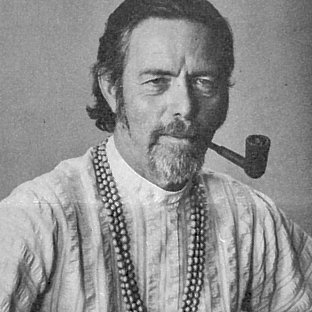
Alan Watts was standing at his window looking out at a landscape he owned but did not control. Across the water from his ferry boat home lay hills—elegant, contoured by millennia of geological patience—and he was watching them disappear. Not into shadow or weather, but under the blade of a developer's ambition: scraped flat, terraced, subdivided into suburban lots, the kind you'd find on Texas plains imposed upon California ridges like a cookie-cutter pressed into flesh. Within a generation, the houses would slide down the ruined slopes. The payments, though, would have long since cleared.
This was not a complaint about developers. It was a window into madness—and the cure for it.
The problem, Watts explained, was not that the builder lacked skill or even taste. It was that the builder did not feel the hill as part of himself. He approached the land as a material to be conquered, a problem to be solved on *his* terms, according to a preconceived blueprint. He had a prejudice about what a house should be, and the hill had to submit. "An intelligent architect," Watts said, "goes up to the hill and says, 'Good afternoon. I very much want to live here and I would want to like to know what kind of house you would like to have built on you.'" The architect listens. He lets the hill speak through contour and exposure and the grain of the stone. He builds *with* the land, not *against* it.
The difference between these two approaches hinges on a single perceptual shift, one that Watts called foundational to sanity itself: the external world is your own body extended.
What Do We Mean by "Body"?
In the modern West, we've learned to think of the body as a bag of skin—a bounded, portable thing that ends where air begins. Your body is you. Everything outside it is "the environment," a separate realm to be observed, managed, exploited, or protected (depending on your politics). This boundary feels obvious, natural, given. We stake our entire sense of individual identity on it.
But Watts was suggesting something older and more radical: that this boundary is not metaphysically real, only a convention of attention. Your body is not a thing contained by skin. Your body is the entire field in which you arise—the food chain you eat and that eats you, the air you breathe and that breathes through you, the light you see by and that requires your eye to manifest. The body, in this view, is not your possession. You are its local expression.
When you eat an apple, the apple becomes you. When you exhale, you become the atmosphere. The cycling never stops. Over seven years, nearly every atom in your physical body is replaced. Over longer still, every element in your skeleton has been part of stars, mountains, soil. The skin is real but not final. It is a membrane, not a wall. And a membrane is precisely where a system meets its environment and finds itself *in* that meeting.
Why Do We Build As If the World Is Alien?
If the hills are your body, why do we treat them like obstacles? Watts's diagnosis was clear: we don't *feel* them as ourselves. We have been educated into a fragmented consciousness that experiences a gap between self and world. This is not inevitable. It is a learned disability.
The developer scraping California hills flat does so with the same assumptions that have shaped industrial civilization: maximize efficiency, impose order, extract value, move on. The hill is not a neighbor to be consulted. It is not a relative. It is not sacred. It is material—dead stuff waiting to be reorganized according to human preference. And the result, inevitably, is that the houses fall down, the ecology collapses, and the landscape is left scarred in ways that will take centuries to heal, if they heal at all.
But notice something crucial: the builder is not succeeding even by his own materialist calculus. The houses *fall*. The ecology he disrupted was holding the hill together. He was not being irrational in a practical sense; he was being irrational in a cosmic sense. He had severed himself from the intelligence that made the hill possible in the first place. And separated from that intelligence, he could not build anything that would last.
"He's absolutely out of his mind," Watts said. "And he's out of his mind because he doesn't realize that the external world is his body. When he realizes that, he'll get his mind back."
What Changes When You Shift This Perception?
The move from seeing the world as separate to seeing it as your body is not sentimental. It is neurological. It rewires how you perceive possibility and constraint. When you realize the hills are your body, you stop asking, "How can I use this?" and start asking, "What does this want?" The questions are not the same, and they lead to radically different actions.
An intelligent architect doesn't impose a predetermined form on the landscape. He reads it. He listens to it. He understands that a house built *with* the contour of a hill, rather than against it, will be more beautiful, more durable, and more likely to endure. Not because he is being noble or spiritual, but because he is working with the grain of reality instead of against it. He has aligned himself with the intelligence that sculpted the terrain.
This is not mysticism. This is physics. The hill has been shaped by water, wind, gravity, and geology over epochs. To ignore that is to ignore information. A architect who takes that information seriously will build better houses. A person who recognizes the world as their own body will live less destructively, less frantically, less at war with the very matrix that sustains them. They will, as Watts said, "get their mind back."
Where to Go from Here
Watts never advocated for a return to an imagined past or a rejection of technology. The point was not nostalgia. It was a call to recover a consciousness we have fractured through centuries of subject-object dualism—a consciousness in which the thinker and the world are recognized as one continuous field. Once that recognition dawns, you cannot unsee it. And once you cannot unsee it, you cannot build, consume, or move through the world in the old unconscious way.
Start by noticing what happens when you genuinely listen to a place—when you ask a hill or a forest or even a room what it wants, rather than dictating what you will impose upon it. Notice what emerges when you slow down enough to let the intelligence of your surroundings speak back. Notice, in other words, that the world is not dead material awaiting your direction. It is alive, responsive, and—when you finally realize it—it is you.