BrightStar
BlogMeus ingressos
BlogMeus ingressos
Saved events
Ajuda e contatoCadastrarEntrar
Eventos
  • Ver todos os Eventos
  • Para buscadores
  • Yoga
  • Meditação
  • Respiração consciente
  • Qigong
  • Música sagrada
  • World music
  • Música de medicina
  • Terapia sonora
  • Dança extática
  • Cerimônia
  • Medicina das plantas
  • Cura energética
  • Satsang e sabedoria
  • Tantra
  • Retiros
  • Todas as categorias →
Destinos
  • Bali
  • Sedona
  • Los Angeles
  • Costa Rica
  • Tulum
  • Byron Bay
  • San Francisco
  • Austin
  • New York
  • San Diego
  • Seattle
  • Portland
  • Miami
  • London
  • Maui
  • Boulder
  • Oakland
  • Todas as cidades →
Plataforma
  • Para organizadores
  • Junte-se ao movimento
  • Sell Globally
  • Para criadores
  • Para equipes
  • Para escritores
  • Para professores
  • Para artistas de kirtan
  • Para estúdios
  • Para festivais
  • Para centros de retiro
  • Para organizações sem fins lucrativos
  • Embaixador da marca
  • Ingressos grátis
  • Elevate
  • Amplify
  • O ecossistema
Recursos

Bilheteira e compra

  • Ticket categories
  • Assigned seating
  • Custom questions
  • Coupon codes
  • Smart pricing
  • Ticket sharing
  • Waitlist
  • Flexible refunds
  • Digital waivers
  • Tip jar
  • Donations and sliding scale
  • Embed widget
  • Mindful checkout
  • Recurring events
  • Private sessions
  • Online courses
  • Summits
  • Rooms and stays
  • Ticket scanner

Marketing e crescimento

  • Abandoned cart recovery
  • Visitor recovery
  • Upsells and add-ons
  • Affiliate engine
  • Upsell affiliate network
  • Brand ambassador
  • Meta retargeting
  • Verified buyer network
  • Outbound email marketing
  • Email sequences
  • SMS and WhatsApp
  • Event upsell network
  • Direct mail campaigns
  • SEO engine
  • Syndication
  • Event sharing
  • Custom event pages
  • Artist profiles
  • Link in bio
  • Event blog
  • Blog newsletter

Pagamentos

  • Payments, powered by Stripe
  • Buy now, pay later
  • Apple Wallet
  • Multi currency

Dados e operações

  • Team access
  • Message center
  • Reports
  • Analytics reporting
  • Performance reporting
  • Customer data
  • Integrations
  • Switch from another platform

IA

  • Assistant
  • AI FAQ assistant
  • Todos os recursos →
Empresa
  • Sobre
  • Perguntas frequentes
  • Contato
  • Blog
  • Glossário
  • Guides
  • Inspiração
  • Central de ajuda
  • Documentação da API
  • Recursos da marca
  • Imprensa
  • Termos de Serviço
  • Política de Privacidade

Eventos

  • Ver todos os Eventos
  • Para buscadores
  • Yoga
  • Meditação
  • Respiração consciente
  • Qigong
  • Música sagrada
  • World music

Destinos

  • Bali
  • Sedona
  • Los Angeles
  • Costa Rica
  • Tulum
  • Byron Bay
  • San Francisco
  • Austin

Plataforma

  • Para organizadores
  • Junte-se ao movimento
  • Sell Globally
  • Para criadores
  • Para equipes
  • Para escritores
  • Para professores
  • Para artistas de kirtan

Recursos

  • Rede da comunidade
  • Recuperação de carrinho abandonado
  • Categorias de ingressos
  • Eventos recorrentes
  • Lugares marcados
  • Sistema de afiliados
  • Lista de espera / Notificar
  • Todos os recursos →

Empresa

  • Sobre
  • Perguntas frequentes
  • Contato
  • Blog
  • Glossário
  • Guides
  • Termos de Serviço
  • Política de Privacidade
Leia mais

Eventos

  • Música de medicina
  • Terapia sonora
  • Dança extática
  • Cerimônia
  • Medicina das plantas
  • Cura energética
  • Satsang e sabedoria
  • Tantra
  • Retiros
  • Todas as categorias →

Destinos

  • New York
  • San Diego
  • Seattle
  • Portland
  • Miami
  • London
  • Maui
  • Boulder
  • Oakland
  • Todas as cidades →

Plataforma

  • Para estúdios
  • Para festivais
  • Para centros de retiro
  • Para organizações sem fins lucrativos
  • Embaixador da marca
  • Ingressos grátis
  • Elevate
  • Amplify
  • O ecossistema

Empresa

  • Inspiração
  • Central de ajuda
  • Documentação da API
  • Recursos da marca
  • Imprensa

Bilheteira e compra

  • Ticket categories
  • Assigned seating
  • Custom questions
  • Coupon codes
  • Smart pricing
  • Ticket sharing
  • Waitlist
  • Flexible refunds
  • Digital waivers
  • Tip jar
  • Donations and sliding scale
  • Embed widget
  • Mindful checkout
  • Recurring events
  • Private sessions
  • Online courses
  • Summits
  • Rooms and stays
  • Ticket scanner

Marketing e crescimento

  • Abandoned cart recovery
  • Visitor recovery
  • Upsells and add-ons
  • Affiliate engine
  • Upsell affiliate network
  • Brand ambassador
  • Meta retargeting
  • Verified buyer network
  • Outbound email marketing
  • Email sequences
  • SMS and WhatsApp
  • Event upsell network
  • Direct mail campaigns
  • SEO engine
  • Syndication
  • Event sharing
  • Custom event pages
  • Artist profiles
  • Link in bio
  • Event blog
  • Blog newsletter

Pagamentos

  • Payments, powered by Stripe
  • Buy now, pay later
  • Apple Wallet
  • Multi currency

Dados e operações

  • Team access
  • Message center
  • Reports
  • Analytics reporting
  • Performance reporting
  • Customer data
  • Integrations
  • Switch from another platform

IA

  • Assistant
  • AI FAQ assistant
Baixe o app
Baixar naApp StoreDisponível noGoogle Play
© 2026 BrightStar. Todos os direitos reservados. BrightStar Selection · Créditos das fotos · Histórico de alterações ·
Inspiration

The Only Thing You Can Know for Certain

Eckhart Tolle
Eckhart Tolle
Nov 25, 2025
8 min de leitura

De Eckhart Tolle

Eckhart Tolle examines the epistemological crisis at the heart of human consciousness—what can actually be known with absolute certainty? Drawing on Descartes' famous dictum and the lived reality of present-moment awareness, he argues that the one thing you can never doubt is the immediate fact of consciousness itself: the present moment, your awareness happening now. Everything else—memory, thought, belief, identity—is mediated through mind and subject to doubt. But the present moment, direct experience, and the awareness that registers it cannot be dismissed without paradox. This talk dismantles false certainties and points toward the ground of being that requires no proof.

Leitura · 7 seções

What Does It Mean to Know Something for Certain?

Most people conflate knowing with thinking. We assume that if we can think about something clearly, articulate it, or believe it strongly, then we know it. But Tolle invites us to distinguish between the mental map and the territory—between conceptual knowledge and direct, non-conceptual knowledge. Philosophical skeptics have long posed the problem: How do you know you are not dreaming right now? How do you know the world exists as you perceive it? How do you know your memories are accurate, or that your senses report truthfully?

These questions paralyze conventional knowledge claims. If you base certainty on what the mind can verify—on thought, logic, evidence, or belief—you enter an infinite regress. Every claim requires justification; every justification requires another claim to back it up. The mind alone cannot provide absolute certainty because the mind is always one step removed from direct reality. It is a tool that filters, interprets, judges, and constructs narratives.

Tolle's radical move is to step outside this mental hall of mirrors. The question is not what can be thought with certainty, but what is directly knowable without thought. What is the irreducible ground upon which all thinking stands?

Why the Present Moment Is Undeniable

The present moment—right now, this instant—cannot be doubted without self-refutation. To doubt the present moment, you would have to be aware of something other than the present moment, which is impossible. Any doubt, any thought, any experience of doubt must occur now. The present moment is not a belief. It is not a concept. It is the only place where life actually happens.

This is not mysticism; it is simple logic. When you try to think about the past, you do so in the present. When you anticipate the future, you do so in the present. Memory and imagination are mental constructs that exist as present-moment experiences. You cannot escape the present moment, because to escape it you would have to do so from within some other moment, which cannot exist.

Tolle points to this as the threshold between the conditioned mind and consciousness itself. The conditioned mind lives primarily in time—in memory, habit, fear about the future, regret about the past. It uses the present moment instrumentally, as a means to reach the next moment, the next goal, the next experience. But consciousness, in its pure form, is here now. Awareness itself is always present.

What Is the Relationship Between Awareness and the Present Moment?

Awareness is not something you possess; it is what you are. And awareness is always, necessarily, present. You cannot be aware of something that is not happening now. You can think about past events or imagine future ones, but that thinking-about and imagining are present-moment events. The contents of consciousness change constantly, but the fact of consciousness—the bare light of awareness itself—is eternal and unchanging.

This is where Tolle's teaching diverges from materialism. A materialist worldview privileges the objective, physical world "out there" and treats consciousness as secondary—a mere epiphenomenon generated by the brain. But Tolle inverts this: consciousness is primary. It is the ground. Matter, time, causality, and all the structures we use to understand the world are structures within consciousness, not outside it.

The only certainty available to you is immediate. It is the fact that you are aware. Not the thought "I am aware," but the direct, non-conceptual knowing that is already happening. This is what cannot be doubted. This is what remains when all else falls away.

How Does This Dismantle False Certainties?

Once you locate the only true certainty—the present moment and the consciousness that inhabits it—everything else reveals itself as provisional, constructed, and subject to error. Your identity, for instance, seems solid and certain. You know who you are: your name, your history, your personality, your beliefs. But all of this is a story told by the mind, assembled from memory and social conditioning. The actual "you"—the aware presence reading these words—has no name and no history. It is prior to all content.

Your thoughts feel certain when you are lost in them, but as soon as you observe a thought, you realize it is an object passing through awareness, not the awareness itself. The same applies to emotions, sensations, and perceptions. All of these are experienced; none of them are the experiencer. Most people spend their entire lives identified with these passing phenomena, mistaking the contents of consciousness for consciousness itself.

Beliefs are perhaps the most insidious false certainties. A belief is a thought to which you have given emotional weight and repetition. It feels true because it is familiar, not because it is actually certain. Nations wage war based on incompatible beliefs. People suffer lifelong psychological pain defending beliefs that are simply mental constructs. Yet none of these can be known with the certainty of the present moment and awareness itself.

What Remains When You Release the Need for Mental Certainty?

Paradoxically, releasing the demand that the mind provide absolute certainty is liberating. It does not mean descending into nihilism or skepticism. Rather, it means recognizing that the mind is a tool—a magnificent one—but a tool nonetheless. Tools are useful within their proper domain. The mind is excellent at solving problems, analyzing patterns, planning, and creating. But it is a terrible tool for finding ultimate truth or lasting peace.

When you rest in the direct certainty of presence—the simple fact of being aware now—the mind can be used wisely, without domination. Thoughts arise, but you are not lost in them. Plans are made, but you are not enslaved by them. The past and future have their place, but they do not colonize the present moment. You live from the ground of being rather than from the surface of thought.

This shift has practical consequences. Anxiety, which is always about an imagined future, loses its grip when you return to what is actually happening now. Guilt and regret, which are always about the past, cannot touch you when your attention is anchored in presence. The psychological suffering that humans experience is almost entirely rooted in time-based thinking—in the mind's preoccupation with what has been and what might be.

Tolle is not suggesting you should never think about the past or plan for the future. Rather, he is suggesting that you use these capacities from a place of presence, not from compulsive identification with thought. When you do, thought becomes creative and responsive rather than anxious and repetitive.

How Does This Relate to Eastern and Western Philosophy?

Tolle's insight echoes throughout philosophical and spiritual traditions. Descartes' famous formulation—"I think, therefore I am"—is actually incomplete. The more fundamental truth is: "I am aware, therefore I am." Awareness does not require thought. Thought requires awareness. A more accurate formulation would be: "I am aware of the present moment, therefore I am."

In Eastern philosophy, particularly Advaita Vedanta, the insight that consciousness is the only undeniable reality has been central for centuries. Ramakrishna, Nisargadatta, and Ramana Maharshi all pointed to this same recognition: that beyond all phenomena and all thought, pure consciousness—which is your true nature—remains untouched and eternal.

The Stoics emphasized the importance of distinguishing what is within your control from what is not. Epictetus taught that what is truly yours is your faculty of choice, your ability to direct your attention and will. Tolle extends this: what is truly yours, what cannot be taken or lost, is the bare fact of awareness itself.

Where to Go From Here

The recognition that the present moment is the only undeniable reality is not merely intellectual. It must be lived. The practice is simple: return your attention to what is here now, repeatedly. Notice the sights, sounds, and sensations available to your awareness this instant. Notice the aliveness that registers these phenomena. Do not try to make this into an experience; it is not separate from ordinary experience. It is already happening. You are already aware.

When you notice yourself lost in thought about past or future, gently return to the present. This is not a technique for stress relief—though it may have that effect. It is a recognition of where you actually are, always. The present moment is not a special state to achieve; it is the only place you have ever been or could ever be.

As you deepen in this recognition, the need to know everything—to have certainty about outcomes, to control the future, to get your identity completely figured out—naturally relaxes. You trust the intelligence that is operating moment to moment, which is far vaster than the thinking mind. You live with open awareness rather than closed certainty, and paradoxically, this is far more secure.
Comentários

Carregando a conversa…

O artista desta história

Eckhart Tolle

Eckhart Tolle

Spiritual Teacher

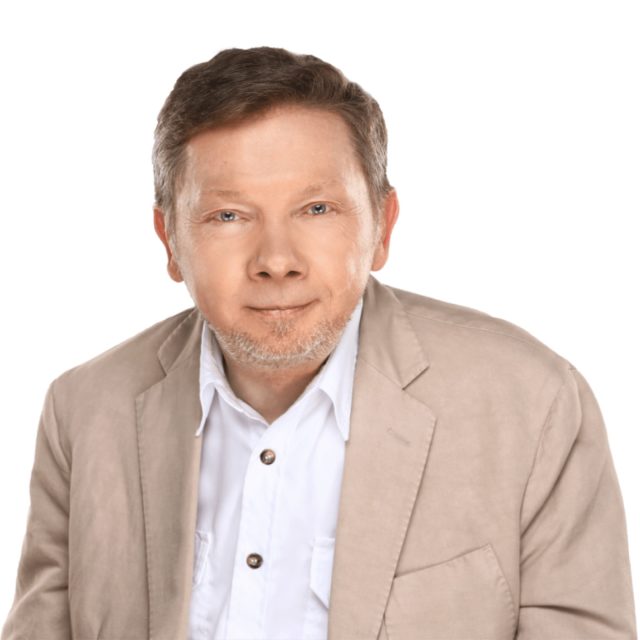
Eckhart Tolle is a spiritual teacher and author whose bestsellers The Power of Now and A New Earth have introduced millions to living in the present moment, and who sees awakened Presence as the essential next step in human evolution.

Ver perfil
Explorar temas
Present momentConsciousnessCertaintyAwarenessEgo
Perguntas frequentes

Perguntas frequentes

According to Tolle, the only undeniable certainty is the present moment and your direct awareness of it happening now. Every thought, memory, and belief can be questioned, but the fact that you are aware right now cannot be doubted without self-refutation—any doubt itself occurs in the present moment.

The present moment is immediate and non-conceptual—it simply is. Thinking about things is a mental process that always happens within the present, but it creates a layer of interpretation. The present moment needs no interpretation or belief; it is directly accessible to awareness.

No. To doubt your awareness, you would have to be aware of something other than the present moment, which is impossible. Any doubt, any experience of doubt, occurs as a present-moment event. This makes awareness the one certainty that cannot logically be dismissed.

Anxiety is always about an imagined future that is not actually happening now. When you anchor your attention in the present moment, where only what is actually occurring exists, anxiety loses its trigger. You are dealing with reality instead of mental projections.

Thoughts are objects that appear within awareness, like clouds in the sky. Awareness is the space in which thoughts occur. You can observe your thoughts, which means you are not identical to them. Your true nature is the aware presence that witnesses everything, not the changing contents of mind.

Materialism treats the physical world as primary and consciousness as secondary. Tolle inverts this: consciousness is primary and undeniable, while the material world is a structure perceived within consciousness. Matter and time are knowable only through conscious awareness.

It is related but not identical. Meditation or mindfulness may be practices that help you return to the present moment, but Tolle is pointing to something even simpler: the direct recognition that you are aware right now, without needing to do anything special. The awareness is already here.

Yes. You can use memory, thought, and planning as tools when needed, but from an anchored place of presence rather than compulsive identification with thought. This actually improves decision-making because you are not dominated by anxiety or repetitive mental patterns.

Você também pode gostar

Ver Tudo
God Beyond the Sky: Rethinking Divine Nature
Inspire

God Beyond the Sky: Rethinking Divine Nature

God is not an external judge deciding human suffering. Suffering itself becomes the mechanism through which consciousness awakens to itself.…

6 min read
God, Suffering, and the One Life Across Traditions
Inspire

God, Suffering, and the One Life Across Traditions

Eckhart Tolle explores how Islam, Buddhism, and Greek philosophy all point to the same ultimate reality—and why the problem of suffering dis…

7 min read
Sacred Feminine Power: Chanting Devi Beyond the Mat
Inspire

Sacred Feminine Power: Chanting Devi Beyond the Mat

An in-person gathering in Bengaluru merges ancient devotional chanting with modern psychotherapy to explore how the Goddess archetype illumi…

8 min read
Zâhid Bizi Ta'n Eyleme: 400 Years of Turkish Devotion Reborn
Inspire

Zâhid Bizi Ta'n Eyleme: 400 Years of Turkish Devotion Reborn

Sami Yusuf performs a 16th-century Turkish spiritual masterpiece with a 50-piece ensemble, honoring four centuries of tradition while forgin…

6 min read
Ver tudoVocê também pode gostar→

Continue sua jornada

Mais sabedoria e mais encontros de todo o diretório BrightStar.

Mais artigos

Explore a biblioteca completa de ensinamentos, entrevistas e guias.

Voltar a todos os artigos →

Professores e artistas

Conheça as linhagens, os músicos e os guias do mundo consciente.

Explorar artistas →

Encontre um evento

Kirtan, retiros, banhos de som, breathwork, festivais — acontecendo em breve.

Ver eventos →