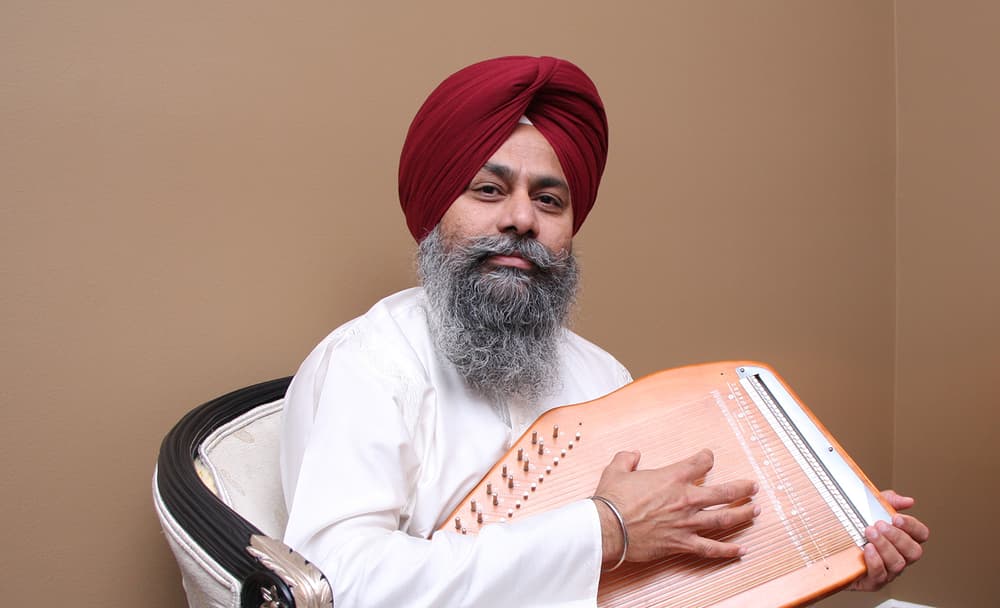
Sikh musicology rests on a fundamental principle: ragas are not ends in themselves, but tools for spiritual elevation and connection to the divine. In Guru Granth Sahib, every raga carries a specific emotional and spiritual quality designed to assist practitioners in reaching a higher consciousness. Each raga possesses its own mood and character—some ragas are most effective during morning hours, others during afternoon or evening, reflecting the natural rhythms of human consciousness throughout the day. This deliberate pairing of raga to time and circumstance reflects what Professor Paramjeet Singh calls the systematic nature of Sikh musical tradition: unlike entertainment music, every choice in gurbani sangeet (Sikh sacred singing) serves a precise spiritual function.
The ragas found in Guru Granth Sahib derive from folk traditions rather than individual invention. According to Professor Singh, folklore ragas emerged from the collective experience of humanity—sounds created by natural phenomena such as rain, fire, and wind, which early peoples gradually shaped into structured musical forms. Because these ragas originated from the creative experience of all human beings, not from a single individual, they carry universal resonance. This is why ragas like Asa—one of the most popular ragas in Guru Granth Sahib—are recognized and appreciated across Afghanistan, Pakistan, India, and Sri Lanka. The raga's emotional and spiritual truth touches every human being because it was born from common human experience.
Folk ragas are distinguished from purely classical creations by their origin in systematic, communal expression. Folklore, as Professor Singh explains, represents systematic types of raga used by common people to signify important events and emotional states. Over time, these folk forms became defined and codified as complete ragas. Within Sikh scripture, these ragas were deliberately chosen and compiled by Guru Nanak and the successive Gurus to make spiritual connection more accessible to all people.
Consider the raga Asa, which remains the most important raga in the whole discipline of Sikh musicology. Its folklore origins make it deeply soothing and calming—qualities essential to the devotional practice. Similarly, ragas like Gujri, Sarang, and others used in Sikh devotional music carry folk qualities that produce a cooling, calming effect on the listener. This is not accidental. The Gurus selected ragas that would naturally predispose practitioners toward the mental and spiritual states necessary for genuine worship and meditation. As Professor Singh states, raagas are more effective for the human beings when they emerge from folklore, because they carry the imprint of collective human consciousness rather than the specialized technical inventions of trained musicians.
This distinction represents perhaps the most critical misunderstanding in how Sikh sacred music is sometimes taught and performed. Classical Indian music prioritizes technical mastery of a specific raga. A student of classical music trains intensively to develop command over the notes, phrases, and emotional depth available within a single raga. Two students learning the same raga from the same teacher may practice very differently—one student may practice one hour weekly, another five hours daily. The depth they achieve, the phrases they create, and the technical sophistication they develop depend entirely on individual effort and skill. In classical music, the raga itself is the ultimate goal.
In Sikh gurbani sangeet, the relationship is inverted. The raga serves as a tool to express and embody gurbani—the sacred teachings and hymns of Guru Granth Sahib. Professor Singh uses a powerful metaphor: "In classical Indian music, the raag is a king, and music is a chair. In Gurbani sangeet, the Guru is the king, and music is a chair. The Guru has to sit on the chair, and that chair should be well properly decorated." The technical excellence of the musical performance matters only insofar as it honors and uplifts the spiritual content. The complete philosophy, the complete wisdom contained in each hymn, must remain central. One cannot perfect the gurbani by dominating the raga. Rather, one must serve the gurbani by using the raga to illuminate its meaning and facilitate the listener's access to it.
This represents a fundamentally different training methodology. In classical music, an individual's years of personal practice determine their mastery. In gurbani sangeet, respect for the complete Guru—both as spiritual authority and as the source of the hymns—must guide every musical choice. The shepherd (the singer) cannot impose personal virtuosity upon the Guru's words. The Guru remains sovereign; music is merely the decorated throne upon which the Guru's wisdom is presented.
Historically, ragas held deep spiritual significance across Indian musical tradition. In earlier periods—before the medieval era—ragas were understood as tools for salvation and spiritual transcendence. They were used exclusively in temples and sacred contexts, and only by musicians who had achieved genuine spiritual insight. Master singers like Tansen, the legendary classical musician of the Mughal court, initially received instruction from his guru Swami Haridasi, a saint who used music only when receiving divine intuition—not for entertainment or patronage.
During the medieval period, a critical shift occurred. As kingdoms developed courts and patronage systems, classical musicians began performing for kings and nobility as entertainment. The raga, originally a spiritual technology, gradually became divided into two functions: one for salvation, one for entertainment. The specialized technical tradition of classical music flourished, producing ever more refined and complex ragas. However, the original understanding—that ragas exist to facilitate communion with ultimate consciousness—became secondary to the demonstration of musical skill.
By the modern era, this separation had become nearly complete. Classical Indian musicians and scholars came to view ragas primarily as vehicles for individual artistry and technical demonstration. The Gurus, by contrast, compiled Guru Granth Sahib with explicit intention to preserve ragas' spiritual function. They selected folk ragas—forms that carried direct resonance with human consciousness—rather than purely classical innovations. This was a deliberate preservation of ragas' original purpose: to make us more easy to get in touch with the ultimate goal.
Professor Singh identifies a troubling trend in contemporary Sikh music practice: singers trained in classical Indian music traditions sometimes approach gurbani sangeet as if it were classical music. They focus on displaying technical mastery, on perfecting the raga, on achieving vocal virtuosity. Some perform gurbani with excessive ornamentation and showmanship, creating spectacle rather than facilitating spiritual connection. This represents a fundamental confusion about the art form's purpose.
The misunderstanding has deepened in recent decades, according to Professor Singh, as academic study of gurbani has become separated from its devotional and spiritual context. Scholars approach the music as folklore or musicological artifact, rather than as a living spiritual practice. Performers learn the technical aspects without receiving education in the philosophy and purpose that should guide their singing. The result is music that sounds like gurbani but lacks its essential spiritual direction—what is the correct word? It's gur-mukh, as Professor Singh emphasizes. Gur-mukh means oriented toward the Guru, centered in the Guru's consciousness and teachings, rather than centered in the individual performer's ego or skill.
The distinction matters profoundly. When gurbani is sung in proper ragas, with proper gur-mukh orientation, the listener can understand that philosophy from the body—not merely from intellectually grasping words, but from receiving the spiritual vibration directly. This requires that the singer subordinate technical display to spiritual transmission, that the raga serve the Guru's words rather than the performer's ambition.
The Gurus did not choose ragas arbitrarily. Each raga included in Guru Granth Sahib was selected because its emotional and spiritual character directly supports the meaning of the hymns set to it. A hymn about calm devotion appears in a raga known for its cooling, meditative qualities. A hymn expressing dynamic spiritual energy appears in a raga that supports that vibration. This integration of word and raga—of gurbani and sangeet—creates a unified vehicle for spiritual transformation.
Professor Singh emphasizes that when singers understand and honor this relationship, thousand times effective becomes the gurbani's power to transform consciousness. The folk origins of these ragas ensure that they work directly on human emotion and consciousness—they have been tested across centuries and cultures. They do not require years of specialized training to affect the listener. A person hearing Asa sung properly, for instance, experiences immediately the raga's cooling, devotional quality—the same quality that has moved human hearts from Afghanistan to Sri Lanka.
Conversely, when gurbani is sung without proper understanding of its ragas, or when technical display overshadows spiritual content, that thousand-fold effectiveness is diminished or lost entirely. The Guru's words are still present, but the musical vehicle no longer serves them. The listener may be entertained but not transformed, may hear beauty but not experience the direct transmission of spiritual truth that represents gurbani sangeet's true purpose.
Understanding Sikh musicology requires stepping outside the framework of classical music analysis. The questions to ask are not "How well has the performer mastered this raga?" but "Does this singing serve the Guru's wisdom? Does it connect the listener to ultimate consciousness? Is the musical vehicle transparent to the spiritual message?" Serious students of gurbani sangeet must study the philosophy embedded in Guru Granth Sahib itself, not merely the technical aspects of raga. They must learn from gur-mukh teachers—those oriented toward the Guru's consciousness—rather than from classical music instructors who approach ragas as ends in themselves. Most importantly, practitioners must restore the understanding that in gurbani sangeet, the Guru is sovereign and music is subordinate. When that hierarchy is honored, the ancient power of folk ragas to elevate and transform human consciousness becomes fully available.


