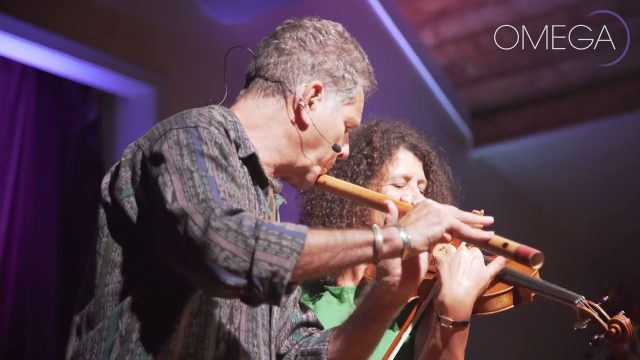
What happens when a single held note starts to organize everything around it? Over the course of a roughly 24-minute talk at Rensselaer Polytechnic Institute in Troy, New York, the Indian bamboo flute player Steve Gorn sets out to answer that question, moving from Krishna's flute in the Hindu tradition to Victorian-era parlor assumptions about the arts, from Iranian passion theater to Australian song lines, and finally to a live performance built on a single sustained tone. His thesis is that music is a transformative modality, a portal between the visible and invisible worlds, and that its deepest function is to synchronize. Read as a teaching rather than a lecture, the talk asks listeners to take sound seriously as a practice of integration, and it gives a clear map for why music has always been bound up with ritual, danger, healing, and land.
Gorn opens with a run of images that would be familiar to anyone who has felt a song land in the chest. A song can instantly recall a time, a place, or a person. Rhythm invites the body to move. He ran through the examples quickly: the gopis in Hindu devotional stories who heard Krishna's flute and abandoned their husbands and their world to lean as close as they could to the divine; the body-moving pulse of Afro-Cuban salsa and James Brown; John Coltrane, where one note brings on goosebumps; a phrase of a Brahms symphony on the radio that opens a childhood emotion. The point of the catalog was not nostalgia. It was to establish that music's pull is physical, emotional, and social all at once.
From there he pushes toward the edge. "Music is really a transformative modality," he says, and he lists its range: it can sweep us away, shift moods, settle us, excite us, awaken us, or alter the mind. "It's a portal," he continues, "it's crossing boundaries into ecstasy, intoxication, possession." He is not romanticizing this. He points to nationalist and patriotic fervor that has run amok to music, to Elvis Presley's movements alarming white American parents in the 1950s, and to the tritone, the "devil in music," which early church authorities forbade and which later became central to jazz and blues. The same interval that once looked dangerous turns out to be the engine of an entire vocabulary. That reversal is one of the talk's quiet arguments: the things that unsettle us are often the things that carry energy.
This is the most striking strand of the talk, and it grows out of Gorn's own history. Years ago, he recounts, he became fascinated with Indian music and began playing the shehnai, a double-reed instrument, in Banaras. That led him to the low social status of the professional musicians who play it, and to a doctoral project on what he called the subject of "you wouldn't want your daughter to marry a musician." He draws on the anthropologist Victor Turner, who identified musicians as often liminal, meaning kept separate, held at the threshold of ordinary social life.
The paradox he describes is precise. In India, shehnai players traditionally came from communities considered untouchable, yet their music was indispensable to any auspicious occasion. Weddings, births, and circumcisions had to be accompanied by these musicians, as if they held a power or potency that also had to be kept at a distance. In West Africa, he describes the griot, the singer and genealogist who sang the praise of kings. Kings needed that praise, but if they underpaid, the same singers would sing about their family in ways they did not want to hear.
"It's really the wild untamable live energy of the Dionysian which is always threatening the Apollonian stability and order."
Steve Gorn, talk at Rensselaer Polytechnic Institute, Troy, NY (published on YouTube, 2017)
Gorn's Dionysian-Apollonian framing gives the tension a name. Order, form, and stability need something live and unruly to keep them vital, and that unruly thing has to be managed, placed on the threshold, or it breaks the frame. This is why, in his account, music so often sits at the edge of rites of passage. He calls it a bardo, "something between two worlds." Musicians are powerful because they stand in that between-space, and that is also why societies both honor and fence them in.
The center of the talk is a claim he attributes to a samurai-era Japanese source, which he came across while thinking about the arts. In his words: "the function of the arts is to synchronize the mind and body in individual and society and society in nature." He then stops to note how different this is from the Western default. "On Sunday I get my New York Times and you open section 2 and it's called arts and leisure." Leisure is fine, he says, but calling music's function leisure misses something. The function he describes is integration.
He breaks that integration into three relationships. The first is between mind and body, which he illustrates with meditation, yoga, musical practice, and both Hindu Vedic and Native American chanting. The second is between the individual and society, where music enlivens or placates the gods of a culture, carries mythology forward, passes on tradition, or provides catharsis. The third is between society and nature, where a people's relationship to the land is itself sung.
His examples for that last one are vivid. In present-day Iran, he describes a form of passion theater in which audience members effectively join the family of Hussain Ali, whose family was slain at Karbala, and where crowds wail, grieve, and whip themselves in shared suffering. He treats this as cathartic and even healing: music, he says, "can be a cure," lifting people out of despair. He also links music to what a Buddhist perspective might call our basic goodness, a sense of balancing good and evil. Then he turns to the Aboriginal people of Australia, whose song lines function as road maps that honor the natural world and show a way through it. And he describes the Hopi twins who sing a song down the spine of the earth, activating the land, and Kokopelli-style fertility figures keeping the land alive. Whatever one makes of the specific mythologies, the argument is consistent: song is how a people keeps its relationship to place in motion.
Gorn then shifts from ideas to practice, which is where the talk earns its title. He first studied the bamboo flute in India, and he calls Indian music in many ways a yoga, which he describes as nada yoga, the yoga of sound. The practice he offers is contemplative. It begins with a drone, an ostinato, a fundamental tone that is the ground out of which the music arises. He notes the traditional instrument is a tambora, and that in the modern age he used an electronic drone. When he sits down, he says, he hears that ground and lets the flute join it.
What follows is a demonstration of how melody forms in relation to a fixed point. Over time, he says, shapes begin to emerge: notes that resolve back to the fundamental. He plays a few notes in a way that gives them real shape, and he describes beginning to hear the relationship of every tone to the fundamental, which in Indian music is the sa (his word is rendered as "Psalm" in the transcript, and the scale is the basic reference). Later he returns to the flat fifth, the note he calls too unstable, which has to be resolved somewhere. The principle is familiar to any musician: tension wants release, and the listener's ear knows where it is going before the phrase gets there.
For a reader who has never sat with a drone, the most useful takeaway is the method itself. You do not start by trying to play something interesting. You start by listening until the ground is audible, then let each note answer the ground. The meditative quality Gorn describes comes from that listening, not from any particular scale. The music is literally the ear and body settling into a relationship.
The talk ends where it began, with the question of why music holds us. Gorn's answer does not reduce music to a mood-setting background. It treats sound as a tool for alignment: between breath and body, between a person and their community, between a community and the land it lives on. The dangers he names are real, and so are the healing claims. What unites them is a sense that music is powerful precisely because it stands at a threshold, and that taking it seriously means respecting both its pull and its potential to overwhelm.
If this talk has you curious, the most productive next step is to listen differently rather than to read more about it. Pick one recording you love and try to hear its fundamental tone before you hear its melody. Notice where tension gathers and where it resolves. Then, if you want the historical context, look for the threads Gorn names: Victor Turner's work on liminality, the social history of hereditary musicians in South Asia and West Africa, and the ethnographic literature on Australian song lines. You can also watch the full talk on YouTube, where Gorn plays the live demonstration that the transcript only partly captures. The argument is best heard, not just summarized.