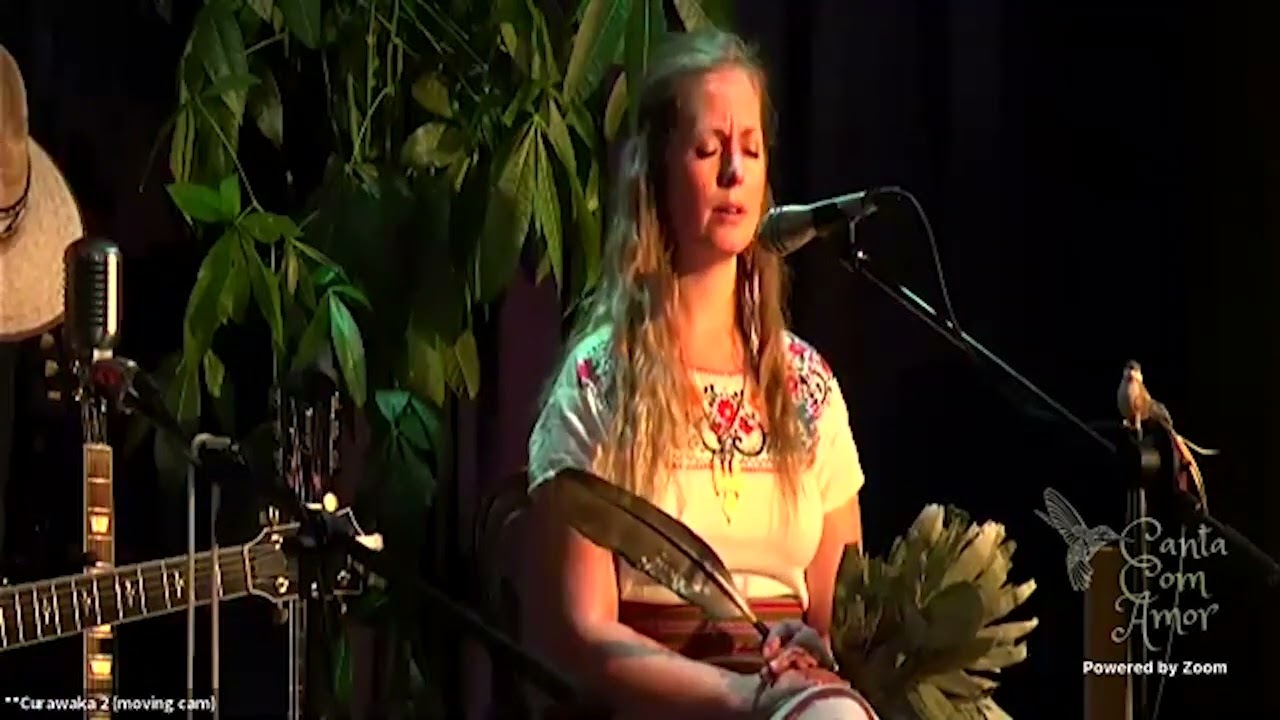
Shamboriri is the first single from Curawaka's second album, Dreamtime, slated for release on Nixi Music in summer 2022, and it is built on a deliberate meeting of two worlds: a band's original song and a sung prayer from the Wixarika people of Mexico. The voice at the center belongs to Muwieri Xaure Don Eusebio López, who performs a canto del marakame, a sacred medicine song that calls in the spirits of the Wirikuta desert so they may hear and support the message being carried. The band's own description ties the track to the teachings of the Blue Deer and to the whispers of Wirikuta's sacred winds, and frames the whole piece as a vision of uniting all hearts and a prayer for humanity to return to its essence, which the description calls goodness. At five minutes and twenty-nine seconds, the track asks more of a listener than most singles do, because it treats the act of collaboration as part of its argument.
The credits name Anna Bariyani and Alberto Arroyo as the song's writers. Bariyani sings and plays guitar, Arroyo plays bass, and Tavo Vazquez contributes charango and quena flute. Percussion is shared among Richard Sanchez, Juan Carlos Weishapt and Txai Fernando, and Bariyani and Fernando co-produced the record. The recording took place at Nixi Studios in Oslo, and mastering was handled by Jock Loveband at Urban Sounds Studios, also in Oslo. The release is on Nixi Music, and the artwork is by Delfina Mun. The upload, published on February 4, 2022, lists 557,259 views.
The material does not document how the collaboration with López first came together, or how the band's sound moved from its earlier work to this one. What it does establish is the sequence: a single presented ahead of a full album, with Dreamtime as the larger project it belongs to. The description does not explain the album's title, so any reading of that name would be ours rather than the band's.
The most important credit on Shamboriri is not a band member. The description identifies Muwieri Xaure Don Eusebio López as a member of the indigenous Wixarika people of Mexico, and says he supports the track with his canto del marakame. The description defines the form as "a powerful and sacred medicine song, which calls in the spirits of the desert Wirikuta in order to hear and support the song's message."
That definition changes how the track should be heard. A featured guest adds a verse or a color to a song that already exists. A canto del marakame, as the description frames it, is an invocation, a request addressed to a place and to the presences believed to inhabit it. López's prayer is not decoration on top of the band's arrangement. It is the point the arrangement exists to hold.
López also plays the canari and a Wixarika violin on the track. The credits list the prayer as a separate piece: "Canto del Marakame, prayer in Wixárika by Muwieri Xaure Eusebio Lopez." That line matters. It keeps the sung prayer in its original language and gives it its own authorship, rather than folding it into a generic "featuring" tag. In an industry that often lifts indigenous sound and sells it as atmosphere, naming the singer, his people, his instruments and his language in the credits is a small but deliberate act of accountability.
The description states that Shamboriri is "inspired by the teachings of the Blue Deer and the whispers of the sacred winds of the Wirikuta desert." The sentence does not present these teachings as a backdrop or a mood. It names them as the origin of the song's idea, and it places the whisper, a sound that is barely audible, at the center of the concept.
The published lyric carries the same image. The opening lines, in Spanish, run: "Magia pura de la tierra / alumbra mi corazón / el espíritu del viento / me susurra su canción." In our rendering: pure magic of the earth lights up my heart; the spirit of the wind whispers its song to me. The lyric's stance is receptive. The singer is not the author of the wind's song but its listener, and that posture is what allows a song written by two people in a European studio to share space with a prayer sung in Wixárika without either one swallowing the other. The published excerpt breaks off mid-line at "el retorno a," so the full text is not available in the material.
The description is unusually explicit about intention. It calls the song "the vision of uniting all hearts, bringing a thousand songs together in union, and the prayer for humanity to return to its essence, the goodness." It then states the purpose plainly:
"This is the dream we believe lies within the hearts of us all. This is the purpose of Shamboriri - to summon this dream into reality."
Read closely, the dream has four connected strands, and each one moves outward from the individual.
- Unity. The image of "a thousand songs together in union" casts the record as a gathering rather than a solo statement.
- Return. The description asks that humanity "again align ourselves with our true purpose," returning to goodness as a natural state rather than a moral project.
- Stewardship. It describes the planet as "the beautiful garden we call our home planet," and asks that we live "in harmony with nature, who provides for us and gives us everything."
- Legacy. The song asks that this understanding be passed to "our children and grandchildren, for all coming time," because, in the description's words, that is "how we can protect the miracle of life."
The sequence runs from the heart outward to the garden and forward to the grandchildren. The description calls this legacy "simple yet profound," and the phrase is a fair summary of the song's ambition. It is not an argument for a complicated worldview. It is a request to remember something most people already sense.
A song about uniting a thousand songs is easy to write and hard to demonstrate. Shamboriri does the harder thing: its credits enact the thesis. A Wixarika prayer, a Wixarika violin, Andean instruments, a bass line, guitar, vocals and three percussionists share one recording. The description's language about "uniting all hearts" becomes, in the credits, a literal list of different traditions and roles.
The question, then, is not whether such a collaboration is possible. The question is whether it is done with respect. The track's answer lies in its structure. López is credited by name, his language is kept, and his prayer is presented as a prayer rather than a texture. The band's description does not explain how the partnership was arranged or what it involved, so readers should be careful not to read more into the credits than they show. What the credits do show is a clear decision to keep the origin of the sacred material visible.
Start with the voice that the band itself put first. Before the instruments, before the lyric, the description puts López's canto del marakame at the head of the song's meaning. Listen for it as an invocation, not an accent. Then return to the lyric, and notice how the whispering wind in the Spanish lines and the Wirikuta desert in the description describe the same kind of listening: attention to something larger than the self.
After that, the description's dream becomes a useful frame. Listen for unity in the layering of different traditions, for return in the song's calm sense of purpose, and for legacy in the idea of a song meant to travel from one generation to the next. A reader who knows only the description will already hear the track differently, and a listener who knows the track will read the description as a set of instructions for listening.
To go deeper, start with the band's official website at www.curawaka.com, which the description lists as the home for Curawaka's work. The label, Nixi Music, is at www.niximusic.com, and the cover artwork is by Delfina Mun, whose site is www.delfinamt.com. For the full lyric, look for the complete published text, since the excerpt in the description ends mid-line. And if you want to understand the Wixarika tradition the song draws from, seek out sources written or voiced by Wixarika people themselves; that is the most respectful place to begin, and it is the spirit the song asks us to bring.