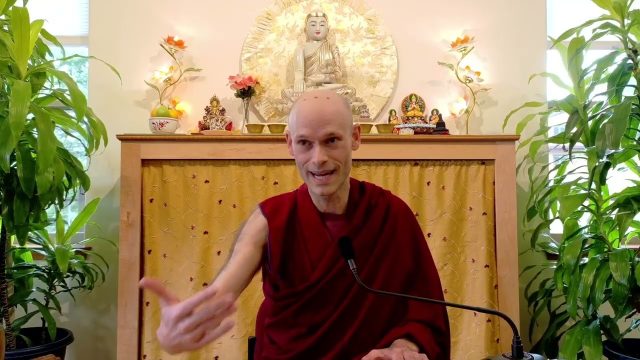
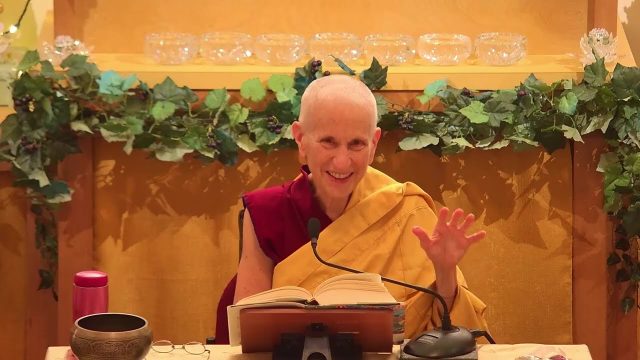
The Buddha taught a discourse just before his parinirvana—his final passing—on a deceptively simple subject: eleven thoughts the mind should turn toward at the time of death. It's an urgent teaching, one that might seem to belong only to the dying. But Venerable Thubten Jigme, a Buddhist nun and practitioner at Sravasti Abbey, has spent months working with these thoughts in a radically different way: not waiting for death to arrive, but practicing them now, every day, so that when the final moment comes, the mind will already know the territory.
The logic is elegant. If we want our mind to turn toward something helpful at death—clarity, compassion, freedom from regret—we have to practice turning it there now, when the stakes feel lower and the work is still possible. "To be able to think about what is helpful at the time of death we have to have it pretty strongly planted in the mind," Thubten Jigme explains. "So we have to practice now, this very day." The 11 thoughts come from a teaching she received from Song Rinpoche in Long Beach in September, and they have become her daily touchstones for training the mind.
The traditional list reads like a bridge between the small self and the infinite: bring to mind non-attachment to this life; love for all beings; the giving up of all resentments; acknowledgment of faulty moral discipline; undertaking the entirety of moral discipline; the insignificance of great harms caused to oneself by others; the significance of small acts of virtue; lack of fright with respect to the next world; the impermanence of all conditioned things; the absence of a self in all phenomena; and finally, that Nirvana is peace—the state of freedom from suffering.
They are not meant as abstract philosophy. Thubten Jigme's practice reveals why: each thought addresses a specific way the mind can get stuck. Each one is an antidote. And the antidote works only if you've practiced using it.
Thubten Jigme's method is born from hard-won experience. She begins each day by noticing what mind she wakes up with. "I wake up with a different mind every day," she says, and paying attention to that quality—whether it arrives colored by discouragement, agitation, or openness—becomes the entry point for the work. Rather than impose a practice, she meets the mind where it is and chooses from the 11 thoughts whichever one is most needed.
She practices off the cushion, during transitions and breaks throughout the day. This matters. The thoughts are not a retreat-only luxury; they are tools for the merchant's day, the parent's afternoon, the moment before bed. "If we don't apply it, then when we have content that we hear it just becomes a list. It's just intellectual and it doesn't come in anywhere," she reflects. The gap between knowing and embodying is precisely where this practice lives.
The first thought became her practice the morning she was struggling with how her body was feeling. "I'm thinking about not letting my body feelings guide my thoughts," she explains, "because if I do that then the mind follows that and what can follow is discouragement, irritation, not accepting what is."
Instead of becoming fused with the sensation, she leans on the impermanence teaching. Whatever she is experiencing in this moment will change. The tightness will ease. The dull ache will pass. "I'm just not going to let my mind get stuck in something that changes all the time. That's kind of silly." And with that recognition comes a kind of lightness—the ability to observe discomfort without letting it orchestrate the day's emotional score.
The second thought asks the mind to open toward love for all beings. For Thubten Jigme, this begins with something that might seem trivial: puppies and baby kittens. "I bring to mind something that brings me joy," she says. "And so I visit the images in my mind about baby kitties and puppies and see how I just smile." The practice is not sentimental; it is mechanical and deliberate. She generates the smile, feels the opening of the heart, and then practices keeping that openness even as the day brings irritation, confusion, or difficulty.
She also uses gratitude for the people who maintain the community. During times when her own capacity is diminished and she cannot contribute as she wishes, the mind can turn self-critical. By consciously directing attention to the work others are doing, she circumvents that trap. "It helps to direct my thought in the right place," she says. The practice is not about denying limitation; it is about where the mind goes when limitation is present.
The third thought—giving up all resentments—carries urgency because Thubten Jigme has observed what happens at the deathbed. "At the time of death, resentments come up immediately in all the people that I have been around that have died," she says. "I don't want to go into that place. That is a very painful place." If resentment is left unchecked in life, it will bloom in full at death, possibly coloring the entire transition.
When she notices resentment arising, she works with it directly. First, she checks the story she is telling: is she viewing the other person as an enemy, as someone who did something to her? If so, the resentment will grow. Instead, she shifts the lens. "I just like me wants happiness and doesn't want suffering. I have irritated them many times and they have irritated me and we are still can be okay and this is just what the afflicted mind does. Not a big deal."
This is not forgiveness as a lofty virtue. It is pragmatism. "If I don't, then I make myself miserable. Why would I want to do that?" She has lived enough to know the answer: she has done that many times, and she is finished with it. The practice offers not a moral commandment but a simple bargain: release the resentment and be at peace, or hold it and suffer.
What distinguishes Thubten Jigme's approach is her insistence on continuity. These thoughts cannot be practiced once during a meditation retreat and left to gather dust. They must be alive in the ordinary moments—on the stairs, in the garden, waiting for the kettle to boil. "Especially during retreat I do that a lot but at any time to make it usable for this mind that's so helpful," she says.
She is also remarkably open to surprise. "I'm very open to whatever comes up because sometimes it's shocking to me," she admits. The mind is vast and sometimes strange. The work is not to force a particular outcome but to show up and work with whatever arises. "I'm an ordinary being," she says simply. "So I just work with it and try to accept it."
In a culture that largely avoids the subject of death, the 11 thoughts offer something radical: permission to contemplate mortality not from a place of fear, but from a place of practice and preparation. They assume that the mind can be trained, that patterns can be changed, and that the work of a lifetime is not wasted at the threshold.
Thubten Jigme's honesty about her own struggles—the body sensations, the moments of self-criticism, the resentments that arise—makes this teaching accessible. She is not describing a finished state; she is describing a living practice. And in doing so, she suggests that preparing for death is not morbid; it is the same as preparing for life: it requires attention, intention, and the willingness to show up each day and work with the mind as it actually is.
To explore the 11 thoughts more deeply, visit Sravasti Abbey and Thubten Chodron's online teachings, where recordings of these practices are available. Consider beginning with a single thought—perhaps non-attachment or the releasing of resentments—and working with it for a week at regular intervals throughout your day. Notice which of the 11 speaks most urgently to your own mind, and let that be your entry point. The goal is not perfection; it is presence, and the willingness to tend to the mind as the most precious work of a human life.