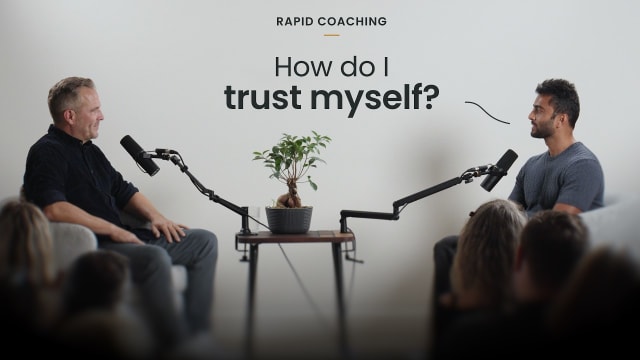
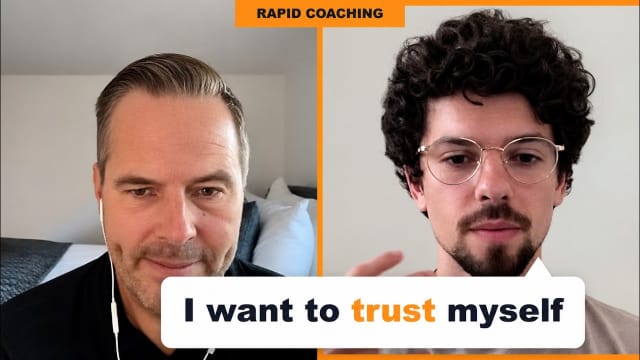
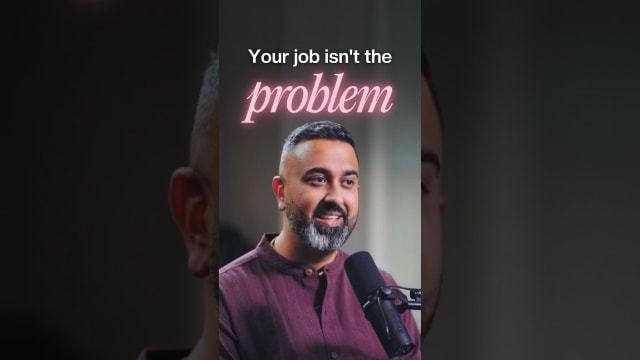
Joe Hudson made what he calls "the absolute worst marketing mistake of my life" when he named his foundational course The Connection Course. The reason? Nobody walks around saying they wish they had more connection. They say their biggest problem is overeating, or money stress, or that their marriage is on the rocks. Yet Hudson's central thesis—proven across thousands of coaching sessions with executives, venture capital boards, and families—is that every single one of those problems traces back to the same root: disconnection. What would shift if we approached our struggles not as discrete issues requiring discrete solutions, but as symptoms pointing to where we've lost connection to ourselves, others, and something larger than ourselves?
Hudson's framework emerges from a simple thought experiment: "What would your life look like if you felt deeply connected to yourself, your emotions, your thoughts, your nervous system?" He's not speaking about a vague spirituality. He means the embodied sense of groundedness you feel after a meditation retreat—a feeling of deep care directed at yourself. Then layer on deep connection to your community, and to something greater than yourself, whether that's society, God, or nature. Now, he asks, "tell me how many of your problems would still exist?"
The resistance comes immediately. A person says, "Well, I would still need to get money." Hudson meets this with a question: "What if you felt deeply connected to money? How would your money problems change?" Take politics. Yes, the political divisions remain—but what if we could feel deeply connected to people with opposing views? What shifts in the quality of the conversation, the willingness to listen, the possibility of finding common ground?
The insight is not that connection erases material reality. It's that "if it isn't the solution, it is the avenue to the solution of all of the problems that we have." Connection doesn't make your bills disappear. It changes your relationship to solving them. It shifts you from reactive panic to resourced problem-solving. It opens doors to collaboration that scarcity-minded isolation keeps shut.
Hudson didn't arrive at this principle through abstract reasoning. He stumbled into it through lived experience, first as a parent. His wife handed him a book called Listenparenting by connection (from HandInHand Parenting), and something clicked. "As long as my daughters are feeling connected everything's fine," he recalls, "and as long as they're feeling disconnected something is happening. They're having big emotions. They're having temper tantrums and they're trying to get back into connection." Every disconnected experience brought behavioral turbulence. Every return to connection dissolved the crisis.
Then, working as a venture capitalist, Hudson began watching boards and executive teams through the same lens. "When a board felt connected, there was no problems. No problems that they couldn't handle. And when a board felt disconnected, it was just constant drama, trials and tribulations, fights." He saw the same pattern inside companies: connected teams moved in sync, solved problems fluidly, and created momentum. Disconnected teams fragmented into factions, meetings devolved into theater, and simple decisions became byzantine.
What struck Hudson was the invisibility of the pattern. People aren't conscious of chasing connection. They chase money, status, safety, meaning—and what they're really after, underneath all that seeking, is the felt sense of belonging that connection provides. "I want money so that I can feel meaning so that I can have connection with myself. Or I want money so that I can feel safe so that I can feel connected to myself. Like it just everywhere I looked, I started to see this connection being the key to it."
Hudson moved from intellectual observation to deliberate practice. Every time a problem arose—a difficult decision looming, a conflict with his wife, an impasse at work—he began asking a single question: "What do I need to feel more connected here? What do I need to feel more connected to myself, more connected to others, more connected to something greater than myself?"
This simple pivot transformed how he made decisions. Facing a major choice, instead of spinning through options and pros-and-cons, he would connect deeply with himself and ask: "What would be the decision I'd be proud to make?" The answer came immediately. Not from logic, but from alignment—from a place where his values, instincts, and deeper self were no longer in conflict. As he puts it, connection gave him access to his own wisdom.
The same move works in relationships. When conflict with his wife arose, the question became: "What do I need to do to feel connected again?" Not to win, not to prove a point, but to restore the baseline of safety and understanding that makes genuine dialogue possible. The problem itself may not disappear instantly, but the relationship to the problem changes. You're no longer adversaries. You're collaborators trying to solve something together.
This is where Hudson's approach diverges sharply from most self-help frameworks. You cannot teach connection as a set of techniques, because connection is not primarily a technique—it's a state of mind. He calls this state of mind VIEW: Vulnerability, Impartiality, Empathy, and Wonder.
The Connection Course does include tools. There are practices for connecting with yourself immediately after being triggered. There are frameworks for difficult conversations and for listening from a place of connection rather than defensiveness. There's even an exercise that seems almost counterintuitive: when facing a problem, don't jump to solutions. Instead, sit with it in wonder. Just wonder.
"Nobody talks about a solution," Hudson explains. "All you do is just sit and wonder about a problem. And so many people just walk out going, 'Oh, I see the solution.' Because they've just deeply connected because wonder is one of those access points that gets you to connection." Wonder bypasses the anxious, solution-seeking mind and drops you into a state of genuine curiosity—and from that state, possibilities emerge that the panicked mind could never generate.
There's an elegant consistency to how Hudson teaches connection: he teaches it in connection. Most online courses follow a disconnected model—lectures at you, homework you don't want to do, passive consumption followed by friction. The Connection Course inverts this entirely. Students don't learn about connection abstractly; they practice it immediately. They do experiments in real time, often with other people. They have repeated one-on-one conversations that allow them to explore themselves in a deeply connected way.
The numbers speak to the power of this approach. Hudson mentions a 96-97% completion rate for the course—unheard of in the online education industry. Most courses bleed participants. The Connection Course keeps people engaged because from the very first day, they're experiencing connection, not studying it. They're having conversations, not listening to lectures. They're exploring their own interior in a held, witnessed space, which is precisely what human beings crave and what most of modern life denies them.
Hudson has heard countless testimonials. "The Connection Course saved my marriage," people tell him. Others report: "It's fixed my sex life." These aren't poetic exaggerations. Intimacy—sexual and emotional—is perhaps the most direct expression of connection. Couples come in fractured, disconnected, locked in patterns of blame and defense. When they learn to access connection with themselves and each other, the entire dynamic shifts. They're no longer performing. They're not managing an image. They're present.
The course has also created unexpected social containers. Couples who go through it together often become part of an ongoing community of people who are learning to connect not just with each other, but with many others—widening circles of genuine relationship in a culture starved for it.
Hudson offers an experiment anyone can try right now. Think about your biggest problem—the thing that's been on your mind. Hold it lightly. Now release it, and sit with the question: "What do I need to connect to in order to move through this more easily?" You're not looking for a rational three-step solution. You're inviting yourself into a different relationship with the problem.
Often, people notice something shifts immediately. The problem becomes softer. Less intractable. The emotional charge around it drops. Not because the problem went away, but because you're no longer alone with it. You've brought yourself into a state of presence where you can meet it with resourcefulness instead of fear.
If Hudson's framework resonates, the next step is not to analyze it further, but to test it. Take your recurring frustrations—the ones you've been trying to solve with willpower, money, or better strategies—and ask where you're disconnected. Not rhetorically. Actually sit with it. What would it feel like to reconnect there? Hudson has created a free 14-day connection challenge that walks you through this systematically. The point is not to add another task to your life, but to recognize that beneath nearly every problem you're carrying is an invitation: to yourself, to others, or to something larger. Connection is not a luxury. It's the root system from which every solution grows.