Transcript
[0:00] I sang here last year as in benefit for
[0:04] tigers and then over the last 12 months
[0:09] I started hearing Nha speaking about
[0:12] things
[0:13] and we contacted each other and thought
[0:18] it would be a really wonderful thing to
[0:20] create this space for us to be together
[0:23] and explore
[0:26] um what happens outside and inside when
[0:31] we are engaged in these practices of
[0:34] chanting the sacred names whether it's
[0:36] feminine, masculine or both or in
[0:39] between or anything. And then what
[0:42] happens inside of us as we move through
[0:45] our day? How does it affect us on the
[0:47] inside? How does it affect us in our
[0:49] relationships with others? Um and so we
[0:53] don't really it's not instructional this
[0:55] this workshop. Um, it's really an
[0:59] exploration, would you say?
[1:00] >> Absolutely.
[1:03] >> I am Niha. I am honored to be here with
[1:06] Nina G//Nina.
[1:10] >> I know I I'm very bad at G's, you know.
[1:13] So, she said, I'm going to call you Nina
[1:15] G. And I said, does that mean I have to
[1:16] call you Nha G?
[1:17] >> No.
[1:18] >> And she [laughter] said, no. So, forgive
[1:20] me.
[1:22] Um as you know this is this space is as
[1:26] Naji said this is really to explore the
[1:29] inner world with music and sound but
[1:33] also inner sound. There is so much noise
[1:36] outside today. There's polarization.
[1:38] There's a sense of just exhaustion.
[1:41] Every day relating is getting harder and
[1:44] harder for all of us wherever we sit
[1:47] whether in therapy in music in arts in
[1:50] sport wherever. And I can see a lot of
[1:51] you nodding right. It's resonates so
[1:54] much today. So this was our offering to
[1:59] kind of reduce the noise outside to
[2:02] focus a bit more on what is speaking
[2:05] inside through the archetype of the
[2:08] sacred feminine. And of course we'll
[2:10] speak more about that and chant all
[2:12] about that. So you you know it'll be a
[2:14] collective experience with everyone's
[2:16] energy. But I'm essentially a sex
[2:18] therapist as well as an author and I am
[2:22] surrounded by musicians all the time. I
[2:24] am not into music but I really enjoy all
[2:27] forms of creative expression as an art
[2:30] therapist. So thank you so much for
[2:32] being here from the both of us. Nha, do
[2:35] you mind
[2:37] just uh expanding a little bit on
[2:41] what it means to be a sex therapist just
[2:44] as a introduction?
[2:47] >> Sure. Um not
[2:51] what it shows on pornhub.com.
[2:55] No.
[2:56] >> Yes.
[2:57] >> So this is what it means to be a sex
[2:59] therapist. To me it means to be direct.
[3:02] Sex is a direct experience. Sex is an
[3:05] essential experience of birth.
[3:07] Everybody's born through sex.
[3:10] Sexuality is not to do for me with any
[3:13] kind of sensation or sensationalism. It
[3:15] is really the power of life. It's a life
[3:18] force. And from that life force comes
[3:22] other form comes all forms of art. So
[3:25] for me being a sex therapist is to be
[3:27] directly connected to my life force and
[3:31] to offer that life source as a spring of
[3:34] healing for others for who may be for
[3:37] who may have been impacted specifically
[3:40] in people who may have been impacted by
[3:43] a con this connection to that life force
[3:47] in any for any reason.
[3:50] >> Yeah. And could that happen just by the
[3:54] course of living daytoday?
[3:55] >> Yes. And it's also happened to me. You
[3:58] know, a lot of us have been disconnected
[4:00] from our sexual life force
[4:03] also. We all we all in some man, woman,
[4:07] transgender, whoever we are, we we we we
[4:09] cut off. We get disconnected from that
[4:11] life force pretty simply, pretty easily.
[4:13] Culture, sociology, what our parents
[4:16] teach us, etc., etc. And so yes,
[4:19] connection to the self through that
[4:21] source of power.
[4:22] >> Right. And Manas,
[4:26] can we we should unlock this door
[4:28] because people are going to come late
[4:29] and they should be able to come in. I
[4:31] think he went out that way. Um, can you
[4:33] can you just unlock this? Honey,
[4:36] >> there's a door.
[4:37] >> Will they know to come in from there?
[4:39] They will. Okay, then. Don't worry. He
[4:42] says there's a back door for as long as
[4:44] people know, it's okay.
[4:47] Omar can maybe stand outside for maybe
[4:49] 10 minutes and help or something.
[4:51] >> Shri is there. Is shri still outside the
[4:54] She is okay. So she'll she'll be she'll
[4:56] tell them.
[4:58] Um I just want to connect what Nha is
[5:03] saying
[5:04] to why I thought we should do this
[5:07] workshop together.
[5:09] And it mostly has to do with the
[5:12] disconnect
[5:14] between
[5:16] the presentation
[5:18] of chanting of sacred mantra
[5:22] the environment in which it happens
[5:26] and the way in which it's disconnected
[5:29] from
[5:31] as we praise the goddess how it is that
[5:35] it's not reflected in our daily lives in
[5:38] a relationship with each our own selves
[5:41] and also maybe with others. And believe
[5:44] me, this is not any bashing situation at
[5:47] all. It's just acknowledging that
[5:50] sometimes it's hard to imagine how
[5:53] there's no there's no God or goddess
[5:57] outside of us in the sky.
[6:00] She's here. She's right here in this
[6:05] space inside of each one of us. whatever
[6:08] body we might be in. And I found
[6:13] that very little is spoken about this as
[6:16] we move through the practicing of the
[6:19] traditions
[6:21] in the culture. Would you agree?
[6:24] >> Absolutely.
[6:24] >> Yeah.
[6:25] >> And so for me, growing up in this
[6:28] tradition and not being able to speak
[6:30] about it has been it's kind of stifling
[6:35] in a certain way. And when I heard Niha
[6:38] starting to speak about these things so
[6:40] that we can integrate all these things
[6:43] in our lives, I thought how wonderful if
[6:46] we can sit together and do this. And
[6:50] like I said, there's no there's no
[6:52] blame. There's none of that is happening
[6:54] here. This is just an acknowledgment of
[6:58] who we are and our qualities and where
[7:02] we might have blocks and where we might
[7:05] want to open up into a certain way. Does
[7:08] that make sense?
[7:10] Taking that forward in a jagalandi
[7:12] style, I find that Nina G's voice is
[7:15] very connected directly because it's a
[7:17] very specific quality of voice when you
[7:19] listen to it, right? And it's as in the
[7:22] feminine archetype to be connected to
[7:24] that quality to me to me speaks of a
[7:28] source of internal power.
[7:31] Yeah. And I can see that there's
[7:33] agreement around that.
[7:35] Yeah. I do wish I could sing like a bird
[7:38] a lot of the times, but that's not my
[7:40] voice. [laughter]
[7:42] Maybe a crow.
[7:46] >> Before you chant, can we do a somatic?
[7:48] >> Yeah. Yeah. No, I'm not I'm not
[7:49] chanting. I was just looking for
[7:51] something. You go right ahead. Okay. I
[7:54] would like everyone to please close
[7:56] their eyes.
[8:00] Relax your lower body and take space in
[8:04] the chair that you are sitting or on the
[8:06] floor. Open up your thighs. Put your
[8:10] butt directly on the floor. Like land
[8:13] here.
[8:15] Try to close your eyes so that I'm not
[8:18] there just like instructing you. If my
[8:22] voice is not helpful, just let it go and
[8:25] focus on your own somatic.
[8:29] Okay,
[8:31] relaxing. Now, we're going to start from
[8:33] the toes. So, relaxing the toes first.
[8:40] Go upward
[8:42] to the ankle. Relax the ankles.
[8:48] Go upward
[8:50] to the calves. Relax the calves.
[8:57] Go upward towards your thighs.
[9:03] If you're not used to this, you're going
[9:05] to be feeling pretty irritated by now,
[9:07] which is the point.
[9:09] So just relax. Take your right hand, put
[9:13] it on the center of your heart.
[9:16] I like to make skin-to-skin contact. So
[9:19] I like to touch my heart center with my
[9:21] own skin. If you would like to do that,
[9:24] welcome to do that now. If not, let it
[9:27] be.
[9:29] Reminding you to close your eyes. Let's
[9:32] do a deep breath in on six. You'll see
[9:36] how slowly the somatics go, which is a
[9:40] technique to just tune in. 1
[9:44] 2 3
[9:47] 4
[9:49] 5 6 Hold it. Hold it. Hold it. Hold it.
[9:57] Let it go. 5 4 3 2 1
[10:06] Beautiful.
[10:08] Direct your energy towards your navl.
[10:10] Now
[10:13] relax the navl. Keep your hand on the
[10:16] heart. Relax the navl. Feel yourself
[10:19] settling in with each body part that I
[10:22] bring up.
[10:24] Keep the fight with the wife at the
[10:26] door. Keep the traffic at the door.
[10:32] Keep the whatever happened before this
[10:34] at the door.
[10:37] Go upwards towards your chest.
[10:41] For the feminine identified the breasts
[10:45] for others whatever the chest means to
[10:48] you your chest
[10:53] upwards
[10:56] towards your voice your throat. Focus on
[11:00] that. Let's do a breath here. Deep
[11:03] breath in. 1 2 3 4 5 6
[11:11] Hold it. Hold it. Hold it. Hold it.
[11:16] Let it go. 6 5 4 3 2 1.
[11:26] Beautiful. A silence in the room. Tune
[11:29] into that silence.
[11:33] It's much more silent than it was when
[11:34] we all came in.
[11:39] Last part. Now direct your focus towards
[11:42] your face. Do you know how to relax your
[11:45] face?
[11:46] Try it.
[11:49] Release your jaw.
[11:53] Let your ears drop.
[11:59] Now let's do a breath here.
[12:01] 1 2 3 4 5 6 Hold it. Hold it. Hold it.
[12:09] Hold it. Let it go.
[12:12] 6 5 4 3 2 and one.
[12:20] With that, gently allow yourself to
[12:24] release your hands from the heart.
[12:28] Extremely gently open your eyes when you
[12:31] feel comfortable. There is no rush.
[12:51] Over
[13:13] to you, Lina G.
[13:17] So I thought since we're in this space
[13:21] um I'll just share with you
[13:26] something that I love to go back to
[13:31] as every navaratri and all the times in
[13:36] between as well. So as you know we just
[13:39] completed the celebration of the fall
[13:43] navaratri the autumn navatri
[13:46] and in my guru's temple some of you were
[13:48] asking me you know how did I come in
[13:51] contact with nim karoli baba and
[13:55] how did I even get on this path
[13:58] and what happened was I I started
[14:00] chanting with Krishnadas about 30 years
[14:03] ago and in his chanting I felt the
[14:08] presence of his guru
[14:10] and in feeling the presence of his guru
[14:13] I wanted to meet the guru who was not in
[14:17] the body for 23 years. It was 23 years
[14:20] after that.
[14:23] And what ended up happening was that I
[14:25] went to Kenchi to the temple where
[14:27] Maharaji used to be and I met my my guru
[14:32] who served Maharaji for 40 years.
[14:36] And in her
[14:39] I found the inspiration
[14:42] to move through my life in the way that
[14:45] she indirectly and very subtly
[14:50] um showed me how.
[14:53] And one of the things is through
[14:55] practice. She always said to us how
[14:58] important it was for us to do some form
[15:01] of practice for our own selves [snorts]
[15:04] just to calm the minds, open the heart,
[15:07] help to move through things that are
[15:09] blocking us in a way.
[15:12] And one of those was to sit through the
[15:15] navatri puja for the goddess.
[15:18] And for those of you I mean I'm speaking
[15:20] to all of you from here in this country.
[15:23] you've you've had some experience of it
[15:25] in some way or the other. But I started
[15:28] to read through the prayers myself and
[15:31] rather than just listening to the
[15:33] through to through to the Sanskrit which
[15:35] is very healing in and of itself. But I
[15:38] recognized that contact was being made
[15:44] with Davyi
[15:45] >> through these prayers, through the
[15:48] utterance of her names, through the
[15:50] singing of her qualities, through making
[15:54] [clears throat] offerings to her and
[15:56] asking for her blessings. It's all a
[15:58] process of connecting
[16:02] um to that place actually which is
[16:05] inside of us. But we have to go move to
[16:07] the outside to come back in sometimes.
[16:09] Right? So I wanted to just share this. I
[16:13] found I find this very powerful. It's
[16:16] right in the beginning of these 700
[16:19] verses in praise of the goddess. And
[16:23] we're the stages of the chandi part of
[16:26] the Dvi Mahatma are that you are
[16:30] inviting the goddess in from out there.
[16:33] And the first goddess we we talk to is
[16:36] Da. Then comes Lakshmi and then comes
[16:39] Sarwati. This is the easy way that it's
[16:41] divided up. And then the other names for
[16:43] the Dvi over each of the nine days as
[16:46] well.
[16:48] But just if you could just stay into
[16:50] that tuned place that you are now and
[16:53] just listen to how it's presented in
[16:56] these prayers. It's I find it super
[17:00] helpful.
[17:02] Protect me, oh goddess, difficult to
[17:05] perceive.
[17:07] You who increase the fear in our
[17:10] enemies,
[17:12] may the energy of the rule of the pure
[17:15] protect me in the east.
[17:18] In the southeast,
[17:20] the God who is the light of meditation.
[17:24] In the south, the most excellent desire
[17:27] of union
[17:29] in the southwest. She who wields the
[17:32] sword of worship
[17:35] in the west. May the energy of the Lord
[17:38] of equilibrium
[17:40] give protection
[17:42] in the northwest. She who is carried by
[17:45] the deer of enthusiasm
[17:49] in the north. May the ever pure one
[17:52] protect.
[17:54] In [snorts] the northeast, the wielder
[17:56] of the pike of concentration
[18:00] above may the creative energy protect
[18:03] me. And then below, the energy which
[18:07] pervades all.
[18:10] And these names are all like bashnavi,
[18:12] you know, names that you're familiar
[18:13] with. I'm just going to say it in the
[18:16] English for now.
[18:18] And all 10 directions may be protected
[18:22] by the slayer
[18:24] of passion and anger. That's chundi
[18:28] mounted upon the corpse of inert
[18:31] consciousness
[18:33] in front. May victory protect me and may
[18:38] conquest protect me in the rear.
[18:42] On the left side, may she stand the
[18:46] undefeated one and on the right the
[18:50] unconquerable.
[18:52] May the luminous one guard the crown of
[18:55] the head and [snorts] may the mother of
[18:58] protective energy safeguard
[19:02] residing on the head.
[19:05] May the one who wears the garland
[19:08] protect in the forehead
[19:11] and in the eyebrows the bearer of
[19:15] welfare.
[19:17] The threeeyed one between the eyebrows
[19:22] and restrained sound in the nose.
[19:27] The bearer of the constant vibration
[19:30] between the eyes.
[19:33] In the ears, the dweller at the doors.
[19:38] In the cheeks, may the goddess of time
[19:41] protect.
[19:43] And behind the ears, the energy which
[19:46] causes peace. Shankari.
[19:51] In the nostrils, excellent scent. And on
[19:55] the upper lip the sweet taste.
[19:59] On the lower lip a drop of nectar. And
[20:03] in the tongue the spirit of all
[20:06] knowledge. Saraswati.
[20:10] May the ever pure one protect the teeth
[20:14] and in the throat she who tears apart
[20:18] thought. Chandika.
[20:21] In the uvala, the one of varied sound
[20:27] gantiga
[20:28] and the great measurement of
[20:31] consciousness in the pallet.
[20:35] May the goddess who causes love protect
[20:38] the chin,
[20:40] all welfare protect my speech,
[20:44] the excellent remover of darkness, the
[20:47] neck,
[20:48] the wielder of the bow of determination,
[20:52] the backbone.
[20:56] In the outer neck, the blue necked one.
[21:00] In the throat pipe, the goddess who
[21:02] inspired songs.
[21:05] In [snorts] the shoulders, may the
[21:07] wielder of the sword of worship protect.
[21:11] In my arms, she who bears the
[21:14] thunderbolt of illumination.
[21:18] May the energy which bears the staff of
[21:21] discipline
[21:23] protect my hands and the mother of the
[21:26] universe the fingers.
[21:30] May the ruler of the trident of harmony
[21:33] protect the nails
[21:36] and in the abdomen the ruler of the
[21:39] family.
[21:42] May the great goddess protect my
[21:44] breasts.
[21:46] She who destroys all sorrow in the mind
[21:50] be in the heart the desired goddess and
[21:54] in the stomach the bearer of the pike of
[21:57] concentration.
[22:00] May the goddess of love protect the
[22:02] navl.
[22:05] May she also protect our sacred parts of
[22:09] the vulva,
[22:11] the ruler of mystical secrets.
[22:14] May purity of desire protect the penis.
[22:18] And she who rides the buffalo of
[22:21] perseverance, the anus.
[22:25] May the supreme goddess protect the hips
[22:29] in the knees. She who resides in
[22:32] knowledge
[22:34] and in the shanks may the great strength
[22:37] protect.
[22:39] The granter of all desires. May she be
[22:43] in the ankles. The goddess of courageous
[22:46] fortitude. Narasimhi
[22:50] on the top of the feet. She who is heat
[22:53] and light.
[22:55] In the toes may prosperity protect
[23:00] and in the soles she who dwells in
[23:03] support.
[23:06] on the nails she with great tusks and
[23:09] she with great hairs the hair in the
[23:13] pores of the skin the energy of wealth
[23:17] and the skin the energy which rules
[23:21] vibrations.
[23:23] May the daughter of spiritual discipline
[23:26] protect my blood, marrow, fat, flesh,
[23:31] bones and lymph.
[23:34] The endrails be protected by the dark
[23:37] night of overcoming egotism. Kala
[23:41] ratishta
[23:43] and the bile the crowned sovereign.
[23:47] May the goddess of the lotus of peace
[23:50] protect the lungs and she with the crest
[23:53] jewel the flem
[23:56] and she with the radiant face the luster
[23:59] of the nails and the unbreakable.
[24:03] May the creative energy protect my semen
[24:07] and my eggs and the goddess with the
[24:11] supreme umbrella my shadow.
[24:14] May my ego, mind and intellect be
[24:18] protected by she who supports the way of
[24:23] truth to wisdom.
[24:26] May she who holds the thunderbolt of
[24:29] illumination in her hands protect my
[24:32] life, welfare, and five vital breaths.
[24:37] Inhaling, exhaling, diffusing,
[24:42] rising, and equalizing.
[24:50] How profoundly synchronous with what we
[24:52] just did.
[24:53] >> That's why
[24:55] You know, you naturally shared that and
[24:57] that's naturally what's in here.
[25:00] >> Amazing. Huh?
[25:01] >> Amazing. Amazing.
[25:03] >> Have any of you ever heard this before?
[25:07] >> No. Right. It's amazing to to kind of
[25:10] explore these things. So beautiful.
[25:17] So with that, shall we begin the first
[25:21] 20 minutes of chanting and then go into
[25:24] talking?
[25:24] >> Okay, sure. We could do that. Would you
[25:26] like to chant a little bit?
[25:28] >> Yeah. Okay, come.
[25:42] So I like to start with some invocations
[25:46] while Kaye and Umar join us.
[25:50] Let's start by chanting three ohms
[25:52] together.
[26:06] [music]
[26:09] Yeah.
[26:11] Heat.
[26:17] [singing]
[26:26] Heat. Heat.
[26:41] So this first chant we'll do
[26:45] is called bumi dvi
[26:48] and niha asked me to chant this which
[26:56] I was going to do anyway. So I'm happy
[26:58] she asked me.
[27:01] Bhumi Dvi as you know is earth goddess
[27:05] and the words for this which we'll do as
[27:08] common response
[27:11] are
[27:11] >> amma
[27:14] ananda
[27:16] anandi
[27:22] jma
[27:24] >> jagati jagati jani jani [music]
[27:29] Then Shrimi
[27:36] Di
[27:38] that's it.
[27:44] So these are this is my daughter Uma and
[27:47] my very best friend from New York Kay
[27:50] Lanita. [music]
[27:57] Oh,
[28:01] [singing]
[28:07] heat, heat. [singing]
[28:21] Among [music and singing]
[28:23] the
[28:26] [music]
[28:34] Son [singing]
[28:35] [music]
[28:43] sh
[28:50] [singing]
[28:56] [singing]
[28:56] I
[28:58] me
[29:02] now [singing]
[29:04] today
[29:06] [music]
[29:09] not [singing]
[29:16] [singing]
[29:17] today
[29:22] [music]
[29:26] >> [singing]
[29:29] >> Heat. Heat.
[29:34] [singing]
[29:39] [music]
[29:45] Not I [singing]
[29:51] no [singing and music]
[29:59] [music] she
[30:02] [singing]
[30:05] >> [music]
[30:12] [music]
[30:13] >> Heat
[30:16] up here.
[30:24] [music]
[30:34] Heat. Heat.
[30:46] Oh
[30:48] [singing]
[30:48] [music]
[30:51] thal. [singing]
[30:59] [music and singing]
[31:07] [singing]
[31:12] Wondering [music]
[31:21] [singing]
[31:28] [music]
[31:30] [singing]
[31:36] [singing]
[31:37] [music]
[31:43] She
[31:49] need [singing]
[31:52] [music]
[31:55] [singing]
[32:02] [singing]
[32:05] more [music]
[32:07] [singing]
[32:09] than
[32:11] >> [music]
[32:13] >> Jing.
[32:18] [singing]
[32:21] [music]
[32:23] [singing]
[32:27] [music]
[32:31] [singing]
[32:33] [music]
[32:37] [singing]
[32:38] Oh
[32:40] [music]
[32:44] [singing]
[32:46] [music]
[32:51] sh.
[32:56] [singing]
[32:59] [music]
[33:02] [singing]
[33:09] >> [singing]
[33:12] [music]
[33:13] [bell]
[33:16] [singing]
[33:16] [music]
[33:17] >> Sh
[33:22] >> [singing]
[33:25] >> Maj
[33:28] [music]
[33:35] [singing]
[33:38] [music]
[33:41] [singing]
[33:50] >> [music]
[33:50] >> M
[33:54] [singing]
[33:58] J
[34:02] [singing]
[34:04] [music]
[34:07] Mo
[34:10] [singing]
[34:11] J
[34:13] Mo
[34:16] [music] Jama
[34:19] [singing]
[34:27] [music]
[34:30] [singing]
[34:38] [music]
[34:38] [singing]
[34:44] [music]
[34:46] Ding. [singing]
[34:49] >> [music]
[34:50] >> I da
[34:53] [singing]
[34:59] [music]
[35:06] da [singing]
[35:09] [music]
[35:10] shani.
[35:12] [singing]
[35:16] [singing]
[35:20] >> [music]
[35:22] [singing]
[35:24] >> She
[35:27] me [singing]
[35:32] [music]
[35:34] [singing]
[35:38] baby [music]
[35:44] [singing]
[35:48] J Mo
[35:51] [music and singing]
[35:53] J.
[36:03] [music]
[36:03] [singing]
[36:09] [singing]
[36:11] [music]
[36:15] [music]
[36:20] She
[36:22] [singing] J.
[36:26] [music]
[36:30] She
[36:33] J.
[36:36] [music]
[36:40] J. [singing]
[36:46] [music]
[36:49] [singing]
[36:50] My j [music]
[36:55] [singing]
[37:00] [singing]
[37:00] [music]
[37:08] [music and singing]
[37:12] day j day j day j day j day j day j day
[37:12] j day j day j day j
[37:14] [music and singing]
[37:14] my
[37:16] j day j day j day j day j day j day j
[37:17] day j day j day j day j J.
[37:19] J
[37:20] my J day J day J day J day J day J day J
[37:21] day J day J day J day J my [singing]
[37:24] [music]
[37:26] J
[37:29] my day my [singing]
[37:30] J [music] day J day J day J day J day J
[37:31] day J day J day J day J day J
[37:34] my
[37:36] [music] J
[37:41] J day J day J day J day J day J day J
[37:42] day J day J day J day J
[37:44] [singing]
[37:47] My Jama
[37:51] day J day J day J day J day J day J day
[37:51] J day J day J day J my [singing]
[38:07] [music]
[38:12] Heat.
[38:23] [music]
[38:24] Heat.
[38:36] Namasti [music]
[38:43] sati [music]
[38:45] shi baby
[38:49] [music]
[38:50] nay.
[38:53] Oh, [music]
[39:01] [music]
[39:06] [music]
[39:08] mother
[39:10] [singing]
[39:15] >> [singing]
[39:16] >> D
[39:20] [music]
[39:21] [singing]
[39:27] [singing]
[39:27] [music] shing.
[39:38] [music]
[39:40] [singing]
[39:43] Heat. Heat.
[39:49] [music and singing]
[39:57] >> [music]
[39:58] >> must
[40:01] [singing]
[40:03] [music]
[40:06] be Heat. Heat.
[40:08] [singing]
[40:12] [music]
[40:18] Say
[40:20] [singing]
[40:20] [music]
[40:25] [music] your mother
[40:30] sat.
[40:34] [singing]
[40:37] [music]
[40:40] [singing]
[40:44] [music]
[40:46] [singing]
[40:50] No more
[40:52] [music] Sh.
[40:58] [music]
[41:03] [singing]
[41:05] [music]
[41:10] [music and singing]
[41:16] Numb
[41:18] [music] Sh. [singing]
[41:26] [singing]
[41:30] [music]
[41:38] [music and singing]
[41:41] Must
[41:43] [singing]
[41:45] [music]
[41:48] be Heat. Heat. Heat. [singing]
[41:52] [music]
[41:58] [singing]
[41:59] Sh. [music]
[42:07] [music]
[42:12] [music]
[42:16] [singing]
[42:19] >> [music]
[42:24] >> Not I [singing]
[42:27] I
[42:30] [music]
[42:32] My god. [singing]
[42:37] [music] I
[42:42] [music]
[42:44] not
[42:47] [singing]
[42:50] [music]
[42:52] my [singing] God.
[42:57] [music]
[42:59] I [singing]
[43:03] not
[43:05] [singing]
[43:09] I
[43:11] [music] mother [singing]
[43:17] [music]
[43:18] [singing]
[43:24] [singing]
[43:25] I
[43:27] not I
[43:30] love
[43:32] [singing] I
[43:35] [music]
[43:37] [singing]
[43:47] [music]
[43:49] [singing]
[43:52] [music]
[43:55] not I [singing]
[43:57] M
[43:59] I
[44:02] [music]
[44:04] [singing]
[44:10] [singing and music]
[44:12] I
[44:14] ma.
[44:17] [singing]
[44:22] [music]
[44:29] [music and singing]
[44:36] [singing and music]
[44:45] Last time [music]
[44:47] [singing]
[44:50] I [music]
[44:55] I [singing and music]
[44:57] my
[45:03] [singing]
[45:05] [music]
[45:16] heat.
[45:34] Thank you.
[45:37] Words are interesting after this kind of
[45:40] an immersion in sound. Words feel so
[45:43] cheap
[45:46] because words always cut concepts into
[45:48] small small bits, right? And sound is
[45:52] huge. Existence is huge. Nature is huge.
[45:56] Sexuality, life, consciousness, these
[45:59] are big concepts. They cannot be
[46:02] cheapened through words.
[46:04] So as I'm saying that, I want you to
[46:07] just tune into what's happening with
[46:08] you.
[46:12] We're going to slowly come out of
[46:14] chanting and move into conversation,
[46:16] then go back into chanting. Okay.
[46:19] And there's also the evening. So, don't
[46:21] worry. There's a lot of time.
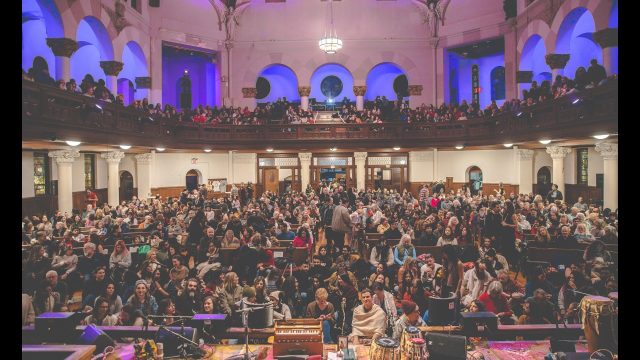
[46:26] Could we have a mic for the audience,
[46:29] please? Yeah, I'll wait for that. And as
[46:31] that is happening, the ones who were on
[46:34] time got a special benefit by choosing
[46:37] getting to choose a card. So, I would
[46:39] just like you to look at your card.
[46:46] There's a little illustration, there's a
[46:49] question, and there's a sub question.
[46:55] Yeah.
[46:57] Okay. So, those who don't have a card,
[46:59] don't worry about it. We're going to be
[47:01] talking deeply, so don't worry about it.
[47:04] Just make make just be with your
[47:06] experience.
[47:09] So, as you see in the room, there are
[47:13] feminine archetypes and energies of
[47:15] different ages, right? Look around,
[47:18] please. What else do you see? Who else
[47:21] do you see?
[47:23] Look back. Look back. We're so used to
[47:26] only looking one direction. Look all
[47:28] directions. See? Yeah. [laughter]
[47:35] Yeah. Who do you see? Can anyone Can
[47:38] anyone speak just in a word that's
[47:41] intentional?
[47:43] Not a random just an intentional. Use
[47:46] this to speak. What do you see around
[47:49] you? Who's in the room?
[47:53] You can use your hand. He's just going
[47:54] to give you the mic so everyone can hear
[48:01] and then you can pass it amongst each
[48:02] other. Okay. Yeah.
[48:04] >> Seekers.
[48:05] >> Seekers. Beautiful. Thank you. Pass the
[48:08] mic. Just keep passing it in the same.
[48:09] Yeah. Who else?
[48:13] I think connectors. Connectors.
[48:15] Beautiful. Seekers. Connectors.
[48:18] Go deeper into Actually, don't go so
[48:21] deep. Go shallow. What do you see? Who's
[48:23] in the room?
[48:30] >> People. What kind of people?
[48:33] >> Feminine energy. feminine energy and
[48:39] divine energy.
[48:40] >> Okay, then that's beautiful.
[48:44] Men,
[48:46] >> please [laughter]
[48:50] men as well. Men, there are lots of men
[48:52] with us.
[48:53] >> Yeah. Amazing actually.
[48:56] >> So glad you're here.
[48:58] >> Yeah.
[49:00] The question is, what does the sacred
[49:04] feminine archetype? I'll explain this,
[49:07] but what does the sacred feminine
[49:09] archetype mean to me?
[49:13] Okay, that's the question. So, think of
[49:14] what I asked you. Who's in the room? So,
[49:17] we said big words, divine energy, you
[49:20] know, connectors, seekers, all that.
[49:23] Simple.
[49:26] Men,
[49:27] women, who else?
[49:33] Daughters.
[49:34] >> Daughters.
[49:35] >> Sisters.
[49:36] >> Exactly. Beautiful mother.
[49:39] >> Brothers. Brothers.
[49:44] >> Mothers.
[49:46] >> Brides.
[49:48] Brides.
[49:49] >> Friends.
[49:49] >> Friends. I heard brides. True.
[49:52] >> Brides.
[49:54] >> At some time.
[49:57] >> Allies. Yes. Mhm.
[50:00] >> Did you be too presumptuous to say I see
[50:02] myself?
[50:03] >> You see yourself. Okay. No. Not at all
[50:06] presumptuous. Yeah. Yeah.
[50:11] So, sacred feminine archetype
[50:15] has nothing to do with your gender.
[50:20] It's an interesting way to think about
[50:22] it. We think Davey as women, somebody
[50:25] else as men and then the men and women
[50:27] never talk. And today the men hate the
[50:29] women, the women hate the men. At least
[50:31] if you if you believe online discourses,
[50:35] you'll think, my god, the world is, you
[50:37] know, this is the external noise
[50:39] constantly pulsating through our veins.
[50:40] It's just everywhere there. So sit with
[50:43] that, please. What is the sacred
[50:46] feminine archetype to you? And we have
[50:48] many opinions in the room, many
[50:50] reflections. So let's let's have let's
[50:53] welcome some. Okay. Anybody who would
[50:56] like to go with intention? Why don't you
[50:57] start? Yeah.
[50:59] Yeah. What is the sacred feminine
[51:02] archetype to you? You want to just use a
[51:04] mic?
[51:10] >> Thank you.
[51:11] >> So I think for me it's about being more
[51:15] sensitive.
[51:17] >> Mhm.
[51:17] >> Okay. It has a lot to do with being
[51:19] receptive and very sensitive. Something
[51:23] that to me feels
[51:25] very nurturing.
[51:27] >> Mhm.
[51:28] >> And tender.
[51:29] >> Mhm.
[51:30] >> Um I don't know if it's with if I
[51:33] believe it's the same that people feel
[51:35] that masculine has more to do with being
[51:39] more
[51:41] not so tender like a mother does. And I
[51:44] actually have that same feeling towards
[51:48] Siddhima as well. I love Ma very much.
[51:50] So I see her in that light. Lots of love
[51:53] and respect for her. So I think it's
[51:56] about being sensitive, being very tender
[51:59] and nurturing.
[52:01] >> Okay. Thank you. So as each person
[52:03] shares, it's like imagine this a shared
[52:05] pot and we're cooking together, right?
[52:06] So one ingredient is already gone. So
[52:08] the say other ingredients, let's add
[52:10] more. So thank you. tender and connected
[52:13] and you're saying more nurturing is what
[52:16] your reflection is.
[52:18] >> I think I'd like to add on to that for
[52:20] me as you were speaking it felt like to
[52:23] me sacred feminine energy is and
[52:26] probably something that I want to tap
[52:28] into a bit more is a combination of not
[52:30] just being nurturing and soft but also
[52:34] being strong in my power. M
[52:36] [clears throat]
[52:36] >> uh so it's a combination of nurturing
[52:38] plus strength for me and that's what I'd
[52:41] like to seek more of or be more of.
[52:45] >> Nurturing with power.
[52:46] >> Mhm.
[52:48] >> Thank you. So we have two ingredients.
[52:51] >> Yeah. For sorry uh for me I think it is
[52:55] more about staying rooted to my truth
[52:58] and that in turn is very healing.
[53:02] So yeah, truth and healing
[53:03] >> and that's specific to sacred feminine
[53:05] for you guys. Okay, beautiful.
[53:09] >> Yeah, please. One and two. Yep. After
[53:12] you. M uh for me I would just say one
[53:16] word creation and anything else comes
[53:20] attached to it that is nurturing
[53:23] protecting power all of it. Creation
[53:28] power. Okay. Thank you.
[53:32] Hi. Uh, for me, I feel like
[53:35] traditionally feminine was associated
[53:37] with giving, but I'm learning that it's
[53:40] equally about receiving and being open
[53:43] to receiving. And that's been my new
[53:46] light on feminine energy.
[53:48] >> Beautiful feminine energy. Okay. Okay.
[53:52] Okay.
[53:54] Uh for me it's like sacred feminine is
[53:57] seeing the DI in everyone around me and
[54:00] my mother is very nice but she's also
[54:02] not always nurturing. She's also very
[54:04] strict on me.
[54:05] >> Yeah.
[54:06] >> So sacred feminine represents the
[54:07] strictness and the softness that are two
[54:10] sides of a coin.
[54:11] >> Mhm.
[54:13] The mother's listening. [laughter]
[54:16] >> Well, we all have mothers. You know, we
[54:19] may not know, not everyone knows their
[54:21] mother, but we have had a mother. We've
[54:24] come from somewhere, right?
[54:25] >> Mhm. Mhm. Thank you. Let's do one more
[54:30] ingredient.
[54:37] Anyone else? Yeah. She There's one. One
[54:40] here.
[54:40] >> Okay.
[54:46] >> Yeah. Thank you. It's easier for
[54:47] everyone to hear that.
[54:49] >> So for me, the sacred feminine always
[54:51] brings up an imagery of a womb,
[54:57] you know, which is like so mysterious
[55:00] and deep and has creation, has all of
[55:05] the ingredients that have been put in
[55:07] there and is also fiery and destructive.
[55:12] >> So a womb now a womb is that beautiful.
[55:15] Thank you.
[55:16] One more.
[55:17] >> Oh yeah, sure, sure. Two more. Yeah,
[55:19] please. Yeah, keep going. Um, hello. Uh,
[55:22] to me, sacred feminine
[55:25] feels like the nature of possibility
[55:28] itself
[55:30] and kind of like the
[55:32] infinite darkness and the void from
[55:35] which all emanations appear.
[55:41] The womb, the void.
[55:47] I don't know whether I will put it like
[55:49] this. It's ardanarishwara concept.
[55:52] >> Sure.
[55:54] >> Because [snorts] the sensibility
[55:57] >> and the power
[55:59] >> that's what called the same time di as
[56:01] well as the matru.
[56:03] >> So it's very near to the nature and the
[56:06] earth.
[56:07] >> Mhm.
[56:08] >> That's haunted me a lot. So I believe in
[56:12] that kind of ardanarish concept.
[56:15] >> Beautiful.
[56:16] I I want to pause here because you see
[56:18] the words and the words and the words
[56:20] are building and we are moving away from
[56:22] internal sound to external sound. Do you
[56:24] see that?
[56:25] >> Yeah. It becomes mental. The concept
[56:28] becomes mental the more you talk about
[56:30] it. Which is what I meant by words are
[56:32] cheap. I mean my profession is words.
[56:33] Huh? I write. I speak. It's all words.
[56:38] But words are cheap.
[56:40] Sound is not cheap. Sound is very
[56:42] expensive. Real true sound is very it's
[56:45] it's full of wealth. So I want you to
[56:47] close your eyes
[56:51] and I want you to tune into these words
[56:53] that came up in your room in your
[56:56] connection in this community. Power.
[57:00] Womb.
[57:03] Womb.
[57:07] Void.
[57:10] Void.
[57:16] Tender.
[57:21] Tender.
[57:25] Strict
[57:29] strict
[57:33] creation
[57:37] creation
[57:42] creation. So as I'm saying these words,
[57:45] use your somatics. Somatics is the body.
[57:49] Use your body to absorb the word and see
[57:53] where it lands for you.
[57:58] When I say creation, I feel my vulva.
[58:03] See, I say the word vulva very often so
[58:06] it doesn't bring up shame or fear for
[58:09] me.
[58:11] You may not say it so often. You may
[58:13] have never said it in your life. You may
[58:16] have not had permission to say it in
[58:18] your family.
[58:21] So see where it lands for you. The word
[58:24] I'll just go through some words again.
[58:26] Just do this in your own mind. Okay.
[58:30] Power.
[58:34] Power.
[58:39] Tender.
[58:43] Tender.
[58:47] Womb
[58:54] connect to the wealth of the sound
[58:57] inside you, not the cheap words of the
[59:00] mind.
[59:04] Womb.
[59:08] Void.
[59:12] Void.
[59:16] Strict.
[59:19] Strict.
[59:24] Last one. Creation.
[59:30] Creation.
[59:34] Creation.
[59:42] No rush. Just open your eyes very gently
[59:48] and see where it landed for you.
[59:54] Now an archetype is something that is
[59:58] the most dominant in you. Okay, that's
[1:00:02] called that's the definition of an
[1:00:03] archetype.
[1:00:05] So when I for example vulva is very
[1:00:07] dominant in me word I'm that's my word.
[1:00:11] So my archetype is connected to that.
[1:00:13] Sexuality, intimacy, power, those are
[1:00:16] where I live, right? For you, your body
[1:00:19] may be speaking to you differently.
[1:00:22] There may be some other sacred archetype
[1:00:24] coming up for you. So think about it.
[1:00:27] It's a little difficult question. Think
[1:00:28] about it. We'll come with mics. Tell us
[1:00:31] what came up for you and think tell us
[1:00:34] just reflect. Is there an archetype that
[1:00:36] you picked up for yourself
[1:00:40] through the word that most resonated for
[1:00:42] you? Does it make sense? Am I making
[1:00:45] sense? I'll say it again. There was a
[1:00:48] list of words and you meditated.
[1:00:52] Some words may have landed on you more
[1:00:55] strongly
[1:00:57] and some words don't mean much. Like for
[1:00:59] me, strict doesn't bring up much. I'm
[1:01:01] like how some school teacher some film
[1:01:03] image comes in my it's a it's not a word
[1:01:05] I associate with it doesn't trigger me
[1:01:09] it doesn't empower me it's just I'm just
[1:01:11] neutral to it but you say void or womb
[1:01:15] it's very exciting in my body I feel huh
[1:01:19] this is this is part of me
[1:01:22] so see
[1:01:24] interesting it's actually part of
[1:01:26] connecting to inner sound
[1:01:28] >> and you know it's very normal to get
[1:01:30] some nose in the beginning. You don't
[1:01:32] know what I'm talking about because that
[1:01:34] inner sound is disconnected. You're
[1:01:35] disconnected from it.
[1:01:38] >> H
[1:01:40] see. See if something comes up.
[1:01:51] It's interesting because my mind is now
[1:01:53] trying to decide on one of the things.
[1:01:56] >> I can't have to think about what that
[1:01:58] is. I think you hit the nail on the head
[1:02:00] of what happens when we do this the
[1:02:01] first time. So just close your eyes and
[1:02:04] pick the pick again. I so go through the
[1:02:06] list. I'll go for everybody if just
[1:02:08] close your eyes. Just don't do don't
[1:02:10] meditate at all. Just close your eyes
[1:02:11] and see. Power
[1:02:15] creation
[1:02:19] tender.
[1:02:22] Strict
[1:02:28] womb.
[1:02:30] Womb.
[1:02:34] Void.
[1:02:37] Void.
[1:02:40] Nurturing.
[1:02:43] Nurturing.
[1:02:46] That's it.
[1:02:49] You want me to go?
[1:02:50] >> Yeah.
[1:02:50] >> Okay. I didn't know. Um
[1:02:55] I think it's
[1:02:58] I think about womb. I think is where it
[1:03:00] it starts for me.
[1:03:03] And the idea of potentiality,
[1:03:07] you know, before even creation, but the
[1:03:09] potentiality that arises from there.
[1:03:13] >> Beautiful.
[1:03:14] >> Yeah.
[1:03:14] >> Did you Did you Did you hear that
[1:03:16] everybody? Yeah. Did Yeah. potentiality.
[1:03:20] The thing that comes before the womb.
[1:03:22] >> Before creation.
[1:03:23] >> Before creation.
[1:03:24] >> Womb is the container of that
[1:03:26] potentiality.
[1:03:27] >> True.
[1:03:27] >> Yeah.
[1:03:30] >> Let's do one more,
[1:03:32] please. Yeah. Uh a mic here. Some Yeah,
[1:03:34] please. Yeah.
[1:03:53] Just talk. It's not working.
[1:03:56] I think is the switch on?
[1:04:07] Ju can you try saying something?
[1:04:09] >> You say it and she'll repeat.
[1:04:11] >> Yeah.
[1:04:13] >> Just to say. Yeah. Use your voice,
[1:04:14] please. Yeah.
[1:04:26] what came to my mind was
[1:04:31] a baby.
[1:04:32] >> A baby holding a baby.
[1:04:36] [clears throat]
[1:04:41] >> Yes.
[1:04:43] >> Just give him the mic so that he can
[1:04:44] >> Yes.
[1:04:45] >> Okay. There we go. Okay. So the words
[1:04:48] warm, tender and nurturing
[1:04:52] >> both the three words collectively to me
[1:04:56] uh just I just got this image of holding
[1:04:59] a baby very close to my chest
[1:05:02] >> and as if I'm protecting it
[1:05:05] >> I'm making sure it's nice and tender for
[1:05:08] the baby whereas I'm not doing my best
[1:05:12] to keep it protected. So that's what
[1:05:15] came to my mind.
[1:05:16] >> Lovely to hear a man speaking about the
[1:05:19] image of holding a baby.
[1:05:21] >> And that's what actually came to my mind
[1:05:23] when we first did the relaxation. When
[1:05:25] it came to the chest, it felt like
[1:05:28] >> Yeah.
[1:05:28] >> something that's going to receive.
[1:05:30] >> Yeah.
[1:05:31] >> Thank you. Yeah. Thank you.
[1:05:33] >> Thank you.
[1:05:35] >> Anyone else?
[1:05:37] The sacred feminine is not restricted to
[1:05:40] feminine. Please
[1:05:43] speech. I'll just pass it back. There
[1:05:45] she is.
[1:05:48] >> Hi. Um,
[1:05:49] >> hi.
[1:05:50] >> So, what came up was I wouldn't call it
[1:05:52] an archetype, but I really like it was a
[1:05:55] thought that came across was beauty.
[1:05:58] Um I think as sacred feminine we
[1:06:02] sometimes forget about it but uh it is
[1:06:05] an integral part of
[1:06:08] uh the sacred feminine which perhaps the
[1:06:11] masculine we kind of miss it because of
[1:06:14] you know our perceptions towards being
[1:06:16] logical practical
[1:06:18] >> and running the show more than adding
[1:06:21] beauty to it.
[1:06:23] >> So I would just yeah like to add beauty
[1:06:25] to this.
[1:06:26] >> That's nice. Thank you.
[1:06:30] >> I think behind you. Yeah.
[1:06:34] Uh so uh when you mentioned the word
[1:06:37] nurturing, what came up for me is a
[1:06:40] feeling of complete warmth, a lot of
[1:06:43] warmth, deep warmth and um just a lot of
[1:06:48] love
[1:06:50] >> and tenderness.
[1:06:52] Yeah.
[1:06:53] >> You felt connected to that in your own
[1:06:55] body, right? Yes. And while the same at
[1:06:58] the same time when womb came up, there
[1:07:01] was indeed a little pain that I felt for
[1:07:05] some reason. Yes.
[1:07:06] >> Mhm.
[1:07:07] >> Did you say pain?
[1:07:08] >> Yes.
[1:07:08] >> Uhhuh.
[1:07:09] >> Yeah.
[1:07:10] >> Okay.
[1:07:11] >> And uh strict of course there was no
[1:07:14] emotion. There was a distant
[1:07:17] >> possibly a little bit of resentment but
[1:07:20] distance was what I felt.
[1:07:23] >> Yeah.
[1:07:24] >> Thank you. Thank you.
[1:07:27] That site I think. No, here please.
[1:07:29] Yeah,
[1:07:32] I had a very visceral response to the
[1:07:35] words.
[1:07:36] >> Okay. So womb, I felt like it landed in
[1:07:39] my pelvis and I did feel some
[1:07:44] movement in my ulva and I felt an inner
[1:07:48] spiral kind of movement in the pelvis
[1:07:51] like I felt like I could take turns
[1:07:53] >> and I did have a micro movement that I
[1:07:55] could feel and power landed. I felt I
[1:08:00] sat on my sitbones
[1:08:03] >> just a bit more. I could feel the chair
[1:08:05] a bit more. you seen practiced in
[1:08:07] somatics. So that's really cool. I do
[1:08:10] >> I'm a therapist so I do work with the
[1:08:12] body. Beautiful. Beautiful. Thank you
[1:08:14] for sharing that. Beautiful.
[1:08:18] >> Hi. Uh for some strange reason I just
[1:08:21] got stuck on one of the words
[1:08:23] >> which is power. H
[1:08:26] >> and uh power I associated it with my
[1:08:30] mind and I feel so because the mind uh
[1:08:34] you know is such a strange uh organ uh
[1:08:38] which wherein you know from the same
[1:08:41] thing I can derive a lot of joy.
[1:08:44] >> The same thing can also make me so sad.
[1:08:47] the same person can give me a lot of uh
[1:08:50] love or make me feel a lot of love or uh
[1:08:54] a lot of anger
[1:08:56] >> at the same time. You know, the same
[1:08:58] mind can uh make me feel strong about a
[1:09:02] certain thing or if overanalyzed also
[1:09:05] bring the best of my insecurities out.
[1:09:09] Uh yeah, I can go on. So I feel the mind
[1:09:13] is uh so strange
[1:09:15] >> and it has so much power and I think at
[1:09:17] some level we need to be uh I mean if
[1:09:22] you can step out of your mind and look
[1:09:25] at your mind just be aware to give it
[1:09:28] enough power to make you do what you
[1:09:30] want to do if that makes sense.
[1:09:32] >> So much sense.
[1:09:33] >> Yeah. So I somehow couldn't get past
[1:09:36] power but yeah nurturing is another term
[1:09:38] but uh yeah I think I spent a lot of
[1:09:42] time on power of the mind I think back
[1:09:45] there you want to raise your hand again
[1:09:47] yeah there he is
[1:09:50] thank you
[1:09:52] yeah for me out of this the creation so
[1:09:56] when I hear that creation in my brain I
[1:09:59] I could feel some triggering tingling
[1:10:03] kind feeling
[1:10:04] >> and uh it's about ideas like I I mean I
[1:10:07] do this probably that intellectual
[1:10:09] masturbation kind of thing keep on
[1:10:11] thinking so that's something I could
[1:10:14] feel
[1:10:15] >> the second one is uh void
[1:10:19] >> the void I feel like blank
[1:10:23] like that kind of feeling I mean I don't
[1:10:26] know how to explain that clearly but
[1:10:28] these two words were found more close to
[1:10:32] me rather
[1:10:33] when I hear power like on the chest side
[1:10:35] some
[1:10:37] uh muscle is contrasting kind of
[1:10:40] feeling.
[1:10:40] >> Yeah.
[1:10:41] >> Yeah.
[1:10:42] >> Thank you. I want to connect what both
[1:10:43] of you brought up because it's also very
[1:10:45] core to what we're talking about. One is
[1:10:48] talking about one one ingredient of the
[1:10:50] pot today is about the double-edged
[1:10:53] sword of the mind. The same word can
[1:10:56] make us feel triggered. The same word
[1:10:58] can make us feel joy and pleasure.
[1:11:01] And there is no healing in that cycle if
[1:11:04] we only believe that. So then you are
[1:11:07] actually connecting to intellectual
[1:11:09] masturbation that just came up right
[1:11:11] that word. Thank you for saying that
[1:11:13] word without shame.
[1:11:15] It is a kind of self itching. Self
[1:11:20] pleasure is different but intellectual
[1:11:21] masturation is like self itching.
[1:11:22] [laughter]
[1:11:23] Just constantly going at it you know
[1:11:26] right? versus sound. Sound of the
[1:11:30] goddess, the archetype of somebody
[1:11:33] bigger than just the mind. The archetype
[1:11:37] is much bigger. The goddess archetype,
[1:11:38] we're going to talk about it a little
[1:11:40] bit later, but it's a much bigger thing
[1:11:42] than just the mind. And then sound that
[1:11:44] Nina G is so beautifully bringing today
[1:11:46] is connecting us and in general to
[1:11:50] stepping outside of that duality. Mhm.
[1:11:55] That make sense? Yeah. Thank you. Please
[1:12:00] more reflections. Yeah. Yeah. So when
[1:12:03] you kept saying here I am.
[1:12:05] >> Mhm.
[1:12:06] >> Okay. Hi. Hi. Hi.
[1:12:08] Um, so I have a near-death experience
[1:12:11] with my child birth and when you kept
[1:12:14] saying womb, it just brought back that
[1:12:16] memory and I think that part of
[1:12:20] unhealing is still there which I
[1:12:21] realized
[1:12:23] and then it also when the nurturing
[1:12:25] comes up I think my daughter face comes
[1:12:28] up and it's so beautifully related that
[1:12:32] heals that part as well. So those two
[1:12:35] just gets activated I've felt throughout
[1:12:38] this journey.
[1:12:41] >> Thank you.
[1:12:43] >> Sorry about that experience but thank
[1:12:44] you. Yeah.
[1:12:54] >> Hi. So when I heard the words creation,
[1:12:58] my body almost on purpose did not want
[1:13:01] to give me any words and I just sat with
[1:13:04] it and then it came to me. It was
[1:13:06] alchemy and the fact that I can have an
[1:13:09] idea and turn it into something
[1:13:11] tangible. I can have a feeling and sit
[1:13:14] with it and watch it move.
[1:13:16] >> That was what I was experiencing.
[1:13:19] >> Beautiful sumatics in a way.
[1:13:21] >> Mhm.
[1:13:25] Thank you.
[1:13:26] Welcome. Is there anybody there in the
[1:13:28] back? The mic hasn't gone to the far
[1:13:31] back at all. Yes, that's what I felt.
[1:13:33] >> Yeah, she's
[1:13:35] >> Can you just pass that back? Yeah,
[1:13:37] thanks.
[1:13:37] >> Others can't hear then. Yeah. Yeah.
[1:13:44] >> First of all, thanks for the experience.
[1:13:46] Uh and for me, I think void resonated a
[1:13:49] lot. Um I think um and void felt
[1:13:52] connected. The moment I heard om I don't
[1:13:55] know it's your sound that made it very
[1:13:57] jittery in my whole body I really felt
[1:14:00] jitters and what it made me feel very
[1:14:03] expansive
[1:14:05] >> surrender expansive as if you know dance
[1:14:09] came up for me
[1:14:11] >> yeah thank you for going a little deeper
[1:14:13] there
[1:14:15] so when your archetype subconsciously
[1:14:18] connects with someone else's archetype
[1:14:20] you feel that jitter it's a it's a
[1:14:22] somatic experience. You feel that buzz.
[1:14:24] So, this is what happens when you
[1:14:25] energetically vibe with someone without
[1:14:28] knowing them for years. It's your it's
[1:14:31] your own body that's resonating on the
[1:14:34] same frequency with their body. It's
[1:14:36] nothing to do with romance or love or
[1:14:39] you don't even have to know them very
[1:14:41] deeply. You're just you're just in the
[1:14:43] same frequency. So, that is called
[1:14:45] resonance which is a sacred psychology
[1:14:47] concept, right? It's coming from the
[1:14:50] heart. It's not coming from the mind
[1:14:52] because in the mind I'm thinking I don't
[1:14:53] know her. I don't know her. I don't know
[1:14:56] like we've never met. I mean blah blah
[1:14:58] blah. We have met but I'm you know an
[1:15:00] example. Now same thing happens on the
[1:15:03] other end. The trigger point. You meet
[1:15:05] someone and you feel wrong.
[1:15:09] You feel this is not for me.
[1:15:12] right now. A word that does that for me
[1:15:15] is
[1:15:16] like
[1:15:19] maybe motherhood. I mean I'm very
[1:15:22] maternal but the word just doesn't
[1:15:24] resonate with me. I'm I'm not a
[1:15:25] biological mother. I have never wanted
[1:15:28] to be one
[1:15:30] but I love children. So for me that word
[1:15:32] always feels like it's not for me not
[1:15:36] this life. You know, I love this path,
[1:15:40] not mine.
[1:15:42] Now, think of something like that just
[1:15:44] for yourself as you're thinking of a
[1:15:46] little bit on the other end. It's not a
[1:15:48] neutral. It's not a push away. It's more
[1:15:51] like resistance.
[1:15:52] >> It's a little resistance maybe.
[1:15:54] >> Mhm.
[1:15:56] >> Discomfort with that word. You know,
[1:15:58] when that comes up, you know that
[1:15:59] archetype is not for you
[1:16:04] for any reason. The reason is very deep.
[1:16:06] So, forget the reason. Just thinking of
[1:16:07] the architect.
[1:16:08] >> Can you say some more words then again?
[1:16:11] >> Yeah.
[1:16:13] >> Like when you think about the word
[1:16:20] that you would use to describe like an
[1:16:22] archetype.
[1:16:23] >> I'm just Yeah, I'm just thinking
[1:16:24] >> um let's say soft
[1:16:27] >> the word soft.
[1:16:29] >> It actively can upset someone who is
[1:16:32] moving towards a different archetype for
[1:16:34] themselves.
[1:16:35] >> Yeah. Yeah, in therapy if I meet a very
[1:16:39] beautiful, hyper independent, powerful
[1:16:41] woman and I tell her try to be soft.
[1:16:47] That's what happens. You know, laughing
[1:16:49] because you know, right? She's sometimes
[1:16:51] the the resistance is too much. She's
[1:16:53] like, that's not for me, Nha.
[1:16:56] >> Don't put me in that box. Empower me to
[1:16:59] use my power. Well, don't don't push me
[1:17:02] to be soft. One one example versus for
[1:17:06] someone else
[1:17:08] same hyperindependent person some other
[1:17:10] context you ask them would you like to
[1:17:13] be soft and she will say thank you
[1:17:16] thank you for allowing me to be soft I
[1:17:19] really want to be soft so this is why it
[1:17:23] is different for person to person it's
[1:17:25] your archetype
[1:17:30] let's pass the mic around as we're
[1:17:32] thinking yeah please.
[1:17:40] >> Okay, I'll say it out loud, but don't
[1:17:41] get me wrong. Um, the word that I'm
[1:17:46] currently just feeling a phase uh in
[1:17:49] internally as if my inner child has
[1:17:51] caught on to something and finally
[1:17:53] acknowledged it.
[1:17:54] >> And the word is vagina.
[1:17:57] >> And I have
[1:17:59] >> I didn't hear. Sorry. The word is
[1:18:00] vagina.
[1:18:01] >> Vagina.
[1:18:02] And uh the memory that I have of that
[1:18:05] word is I had once
[1:18:07] uh a romantic partner had told me that
[1:18:10] why can't you be like the other guys?
[1:18:13] >> And I had said for reasons I don't know
[1:18:17] uh until now. I'd said I'm sorry but my
[1:18:21] vagina is bigger than my dick.
[1:18:23] >> Wow.
[1:18:24] >> Yeah. And u for the record I don't have
[1:18:26] a vagina. Um but yeah, I think I
[1:18:29] resonated with it now that I think of
[1:18:32] reflect on it is
[1:18:35] uh I've always felt very layered.
[1:18:37] >> Yeah.
[1:18:38] >> And very uh so to speak complicated to
[1:18:43] stimulate
[1:18:44] >> m
[1:18:46] >> uh but also very powerful when I'm
[1:18:48] internally stimulated and I'm not
[1:18:51] talking sexually alone uh but as a
[1:18:54] being. So that's the word that has been
[1:18:57] like to the earlier question that you
[1:18:59] started with about divine feminine and
[1:19:03] uh the one that is uh the next question
[1:19:06] about what's the word that's connecting
[1:19:08] with you. So that's what came
[1:19:10] >> shall I consider it a success that then
[1:19:12] you're feeling a fizz now which means
[1:19:14] you're stimulated
[1:19:16] >> getting there. [laughter]
[1:19:19] Just teasing you because I know you.
[1:19:22] >> Thank you.
[1:19:27] >> Thank you.
[1:19:30] >> Anybody there in the back or we'll come
[1:19:32] in the front then?
[1:19:34] Um, great. Let's Let's do the front. Can
[1:19:36] you please help with the mic? Yeah.
[1:19:43] Yeah.
[1:19:47] I think uh with your previous question
[1:19:48] and with this question, it's given me a
[1:19:51] little bit of a different perspective.
[1:19:53] So with the previous one when you asked
[1:19:54] us to feel in the body, two words stood
[1:19:57] out for me. When you said power, my
[1:19:59] spine instantly became erect and I could
[1:20:02] feel power in my spine. And then you
[1:20:04] said tender and I could feel tingling in
[1:20:05] my heart space.
[1:20:07] >> Both those words stayed with me and I
[1:20:09] was wondering what to take away from it.
[1:20:10] And then you asked which word kind of,
[1:20:13] you know, makes you feel not resistant.
[1:20:15] I'm not sure what I'm feeling with it,
[1:20:17] but I also felt like power for me has
[1:20:18] always been very strong.
[1:20:20] >> And I don't know if I am that or I feel
[1:20:22] like I want to be that. But I also know
[1:20:24] that maybe I'm not that. And maybe when
[1:20:27] this second reflection happened, it's
[1:20:29] coming to me that maybe I do want to
[1:20:31] stay in my power, but my power is not
[1:20:33] >> the strong kind of power, but power with
[1:20:35] tenderness.
[1:20:37] >> And I feel that's more resonant with me.
[1:20:39] So both the words can emerge. And I was
[1:20:41] wondering where I was feeling the range
[1:20:42] of words with power and tender. But it
[1:20:45] makes more sense now that I feel like
[1:20:46] I'm owning my power but with tenderness
[1:20:48] that feels more resonant for me.
[1:20:53] >> There's also a lot of resonance in this
[1:20:55] room because you're already speaking to
[1:20:58] the questions that I had already. So
[1:21:00] you're just you're not even waiting for
[1:21:01] my question. You're our reflections are
[1:21:03] already going there which is a beautiful
[1:21:05] reflection of attunement just connection
[1:21:09] being here not knowing each other. We
[1:21:12] don't know the names. We haven't done
[1:21:14] introductions or anything. But people
[1:21:17] are just picking up on each other's
[1:21:19] questions and thoughts.
[1:21:23] Before we go, please look at your card.
[1:21:25] The ones who have a card cuz that's the
[1:21:28] deeper one. Before we move. Yeah, you
[1:21:30] haven't. I know. You don't get any card.
[1:21:32] >> No, I'm just wondering. [laughter]
[1:21:34] Thanks.
[1:21:37] >> Let's just look at the card.
[1:21:40] >> Okay. I think this is the instruction.
[1:21:42] >> This is it. Okay.
[1:21:43] >> Shadow cards.
[1:21:44] >> Gotcha.
[1:21:51] So before you had to share, sorry. Um
[1:21:55] the sacred feminine archetype as we've
[1:21:58] discovered today and spoken about is
[1:22:01] beyond gender. Gender plays a role.
[1:22:05] But feminine and masculine are internal
[1:22:08] experiences for people. And the brave
[1:22:10] ones here who also have some familiarity
[1:22:13] of course with my work have gone pretty
[1:22:15] deep into their life experiences. So not
[1:22:18] saying you know you have to go deep or
[1:22:19] not. I'm saying I hope you heard that.
[1:22:23] You heard that right? You heard what was
[1:22:24] shared around the gender binary being an
[1:22:29] external experience. But internally
[1:22:32] there are many versions of feminine and
[1:22:34] masculine or feminine and masculine or
[1:22:38] three feminines and two masculines that
[1:22:40] we experience inside.
[1:22:44] Now where the archetype of our sacred
[1:22:47] psychology and goddess work connects is
[1:22:50] that the goddess
[1:22:52] scripture, the goddess writing, the
[1:22:55] goddess poetry, the goddess
[1:22:56] psychological archetypes have in our
[1:22:59] culture given us a range of varied
[1:23:03] experiences in feminine and masculine
[1:23:06] energy. Would you call kali feminine
[1:23:10] from today's modern example of feminine?
[1:23:13] I don't know you know if I go to the US
[1:23:15] mostly people are like Kali is not soft
[1:23:18] >> you know if I go to other part of India
[1:23:21] they may consider Kali queen of feminine
[1:23:25] in Bengal etc matara matripurundi
[1:23:31] mahayrai mahu vineshwari ma chin namasta
[1:23:36] mhumawati ma blamuki matangi and ma
[1:23:40] tamala
[1:23:42] 10 archetypes which are not strictly one
[1:23:46] feminine or other soft tender hair
[1:23:48] strict hair.
[1:23:53] Do you see that?
[1:23:56] Do you see where I'm going with this?
[1:23:57] Yeah. Yeah. Anything coming up for you?
[1:24:00] Would you like to share now please?
[1:24:01] Yeah.
[1:24:02] >> I was just saying that the word anger
[1:24:05] made me feel a little but I'm aware
[1:24:08] person. So a lot of myity as a person
[1:24:12] goes into saying that please don't put
[1:24:14] me into your life and also
[1:24:17] this which is why draws me closer and
[1:24:22] listening to you list out the dasha
[1:24:24] mahavya is very similar to how I also
[1:24:27] see the sacred family.
[1:24:29] >> Yes I'm also a queer person so
[1:24:32] >> can I can I ask him to repeat it again
[1:24:34] so I could hear could you just repeat
[1:24:35] what you said? Yeah, I I was saying that
[1:24:38] the word tender made me feel a little
[1:24:40] repulsed.
[1:24:41] >> I'm a qu person and I have to struggle a
[1:24:44] lot in circles to say don't put me to
[1:24:47] stereotypes or don't uh put me in a box
[1:24:51] that I'm not in. So words like gender
[1:24:53] kind or
[1:24:54] >> Mhm. U words that I don't resonate so
[1:24:57] much with in the list and I was saying
[1:25:00] that when she listed out the dasha
[1:25:02] mahavidya I could resonate because that
[1:25:03] is the sacred feminine experience that I
[1:25:06] understand and practice.
[1:25:08] >> Mhm.
[1:25:08] >> Mhm.
[1:25:10] >> Yeah.
[1:25:14] Please priya can just get the mic to her
[1:25:17] like that.
[1:25:23] So uh for me I'm just so confused you
[1:25:26] know that's when when you say it can be
[1:25:29] this it can be that and I have been
[1:25:32] trying to understand for a very long
[1:25:34] time and I'm still very confused. Um
[1:25:39] every word does something to me at the
[1:25:40] same time it doesn't do anything.
[1:25:44] Um so I feel like intellectually I'm
[1:25:47] maybe I'm trying to understand it
[1:25:48] intellectually that's why I'm like not
[1:25:51] able to respond. Yes. Uh bodily also not
[1:25:56] much is happening but you know when we
[1:25:58] sing or when we chant like something I'm
[1:26:02] just so flowy and I feel like there is
[1:26:05] some something some gateway there for
[1:26:08] me. Um but overall I just feel all these
[1:26:12] terms to be very confusing and
[1:26:16] um what is I I still don't know what is
[1:26:19] a sacred feminine archetype. All three
[1:26:22] words are so heavy in my head
[1:26:25] >> but um
[1:26:28] some yeah I just feel like just I'm
[1:26:31] being myself like that is what it is.
[1:26:33] That's what uh is like feminine for me.
[1:26:36] Like just let me be myself. You said it.
[1:26:39] Yeah. Um but I don't know who am I like
[1:26:42] what is power? Yes some days. Um you
[1:26:46] know t gender some days. So it's like I
[1:26:50] fit in everything and it's just like
[1:26:53] yeah just don't put any boundary just
[1:26:55] don't that's what it is for me. Um so
[1:26:59] finally the thing I mainly wanted to say
[1:27:01] is it's intellectually confusing but
[1:27:03] when we
[1:27:04] >> chant that's I feel like there is a
[1:27:06] gateway or not a maybe a gateway but
[1:27:09] like a small window
[1:27:11] for me to like experience what is
[1:27:13] feminine.
[1:27:14] >> Yeah that's what and because I know you
[1:27:17] such a long time you [laughter] know
[1:27:18] what I'm going to say to that you are
[1:27:20] right. Yeah, [clears throat]
[1:27:21] which you know that and even saying that
[1:27:24] is an experience of claiming your own
[1:27:28] somatics. Priya,
[1:27:30] >> that's all it is. There's the archetype
[1:27:33] is just a guide. It is not an
[1:27:35] instruction. It is not a pattern to
[1:27:38] again try and fit into.
[1:27:40] Archetypes also change
[1:27:43] when we are younger in a different
[1:27:45] context. Maybe you know when we are in
[1:27:47] college there's a certain archetype that
[1:27:50] we just follow from our family. Then we
[1:27:52] grow into ourselves. We move to cities.
[1:27:55] We have other relational experiences.
[1:27:56] Our archetype changes.
[1:28:00] >> Which is why I find the goddess very
[1:28:01] beautiful as a as a well of information
[1:28:05] because she allows this change.
[1:28:08] >> Do you know what I'm trying to say? Do
[1:28:09] you% any thoughts on that? Well, I was
[1:28:12] just thinking that
[1:28:15] whether it's the dasha mahavidyas or
[1:28:18] we're talking about the 21 taras from
[1:28:21] the Tibetan tradition,
[1:28:23] there is always an aspect of the goddess
[1:28:26] that's highlighted.
[1:28:28] It doesn't mean she's devoid of the
[1:28:30] others. But in seeing those that aspect
[1:28:35] of her, we are then resonating with her
[1:28:38] with what's coming up inside of us at
[1:28:41] that moment. And then when we feel some
[1:28:43] alignment with that quality,
[1:28:47] it helps us find a sense to to
[1:28:51] acknowledge first of all that we have
[1:28:53] this with within us.
[1:28:54] >> Yeah. and then be able to either let it
[1:28:59] go if it's something that feels like a
[1:29:01] block or it's painful for us. um
[1:29:04] acknowledge it and just allow it to be
[1:29:08] >> as one facet of this multifaceted gem
[1:29:12] which is how the goddess appears to me
[1:29:14] cuz she's described in all these ways
[1:29:18] and we'll do a chant later on where uh
[1:29:21] we're naming these aspects of her and
[1:29:25] even in the Tibetan tradition you know
[1:29:27] there's wrathful taras there's peaceful
[1:29:30] taras there are but none of them is good
[1:29:32] or bad. It's just a quality and it
[1:29:36] exists in each one of us. At different
[1:29:39] times we may feel one part of it more.
[1:29:43] And
[1:29:45] then the next step is to recognize
[1:29:49] because it could even be fear.
[1:29:51] >> You know, it could be some kind of a an
[1:29:54] emotion that is causing us pain. And so
[1:29:58] we can offer that to the goddess and ask
[1:30:02] her to transform that to discernment for
[1:30:06] example which makes it a skillful
[1:30:09] thought or action rather than just a
[1:30:12] reactive emotion that then freezes us in
[1:30:14] a certain way cuz we need fear. If we
[1:30:17] had didn't have fear that we were going
[1:30:18] to be run over by a car, we would walk
[1:30:21] right into the street. But it also has
[1:30:24] given us a certain amount of discernment
[1:30:26] and discrimination. So we make right
[1:30:28] choices. So it's transforming also by
[1:30:31] seeing those qualities.
[1:30:34] That's my experience. Yeah. I think Nina
[1:30:37] G just described all the steps that come
[1:30:40] after you find a resonance with
[1:30:44] something. You go into it. You research
[1:30:46] a song. You do a chant. You read about
[1:30:49] it. Your mind changes. Maybe a new thing
[1:30:52] resonates then the step comes. So then
[1:30:54] she's saying then you're saying offer it
[1:30:56] to the goddess herself and say help me
[1:31:00] transform this confusion let's say Priya
[1:31:02] for you in an example into into
[1:31:05] discernment. Now that's an whole process
[1:31:08] right it's an inner work process you've
[1:31:10] beautifully described your own just by
[1:31:12] speaking about it and we all have our
[1:31:14] own processes right so what I'm noticing
[1:31:17] in the room is now we've gone back to
[1:31:18] the head and the bodies are like aching
[1:31:21] and there's like restlessness so just
[1:31:22] again come back to the body cuz we're
[1:31:24] going to chant and we have you know we
[1:31:26] have time so close your eyes open your
[1:31:28] legs relax your bum all your bums are
[1:31:32] tight
[1:31:34] everyone's like this now because we're
[1:31:36] absorbing information very we're not
[1:31:38] thinking now
[1:31:40] >> that's fine that's what happens we just
[1:31:43] go in and out of the body close your
[1:31:46] eyes so that there's no judgment in the
[1:31:48] room lift your arms and do a stretch
[1:31:52] please stretch up
[1:31:56] or down or sideways
[1:31:59] and then do a stretch down,
[1:32:06] please. And then sideways if you like.
[1:32:13] The same breaths that we did today. Do 6
[1:32:16] 3 6 or 6 5 6 and just come back to the
[1:32:20] body. And you'll find yourself
[1:32:22] re-energized
[1:32:24] away from whatever mental chatter is
[1:32:26] there into the body. Again a gate will
[1:32:29] open as you chant. If it doesn't open
[1:32:32] it's okay. Allow whatever the experience
[1:32:35] is then go back to the mind then go back
[1:32:37] to the body. So the sacred feminine is
[1:32:41] very visceral as an archetype and she
[1:32:43] has been repressed for centuries.
[1:32:47] It has been a overwhelmingly mental
[1:32:50] world
[1:32:52] overwhelmingly rational. Rationality is
[1:32:55] very important. I'm a very logical
[1:32:57] person. I love structure but that is not
[1:33:01] the end all be all of life. As much as
[1:33:05] rationality and structure are important,
[1:33:08] intuition, freedom, flow, flexibility,
[1:33:13] relaxation,
[1:33:14] surrender, all these words are also
[1:33:18] concepts that are so important.
[1:33:21] Beautiful. I want to read from this
[1:33:24] beautiful book. Please take care of your
[1:33:26] bodies as you feel and then will chant.
[1:33:28] Is that okay?
[1:33:29] >> No. Well, take your time. Yeah.
[1:33:31] >> The woman's seeker 18 Davies and their
[1:33:34] journey to enlightenment.
[1:33:37] Hopefully some of this what we discussed
[1:33:39] will land a bit more.
[1:33:43] Okay,
[1:33:48] I'm going to sorry I'm going to read
[1:33:50] Laleshwari. Do you know who Laleshwari
[1:33:53] is?
[1:33:55] Can someone just say a few words about
[1:33:57] her?
[1:34:04] >> Can someone help with the mic?
[1:34:10] >> And and what would her archetype be? So
[1:34:12] said she's a female saint from Kashmir.
[1:34:18] Yeah, that's all I knew that she's a
[1:34:20] female saint from I thought east and you
[1:34:23] adding that.
[1:34:26] >> So she's from Kashmir and she wrote a
[1:34:28] lot of poetry on Shiva and u she roamed
[1:34:32] around without clothes and her poetry
[1:34:35] created a whole school of poetry in
[1:34:37] Kashmir mysticism.
[1:34:38] >> Beautiful. Thank you. Exactly.
[1:34:41] Laleshwari was
[1:34:42] >> how long ago was
[1:34:44] >> um like
[1:34:46] >> 150 plus years. Yeah. Yeah. Yeah.
[1:34:50] Ancient saint of India. How many people
[1:34:52] have heard of her? Can you just raise
[1:34:53] your hands just to see how much our
[1:34:55] knowledge is and how we've been cut off
[1:34:57] from this knowledge in our own cultural
[1:35:00] understanding? Okay. She was an un she
[1:35:03] was a wild without clothes naked female
[1:35:08] saint.
[1:35:10] She used to walk around in Kashmir of
[1:35:13] that time without clothes with her long
[1:35:15] beautiful hair.
[1:35:17] >> If you can see this is Laleshwari
[1:35:20] >> and I think don't you have a chant also
[1:35:23] from don't you have yeah not with no I
[1:35:26] mean of her what something from
[1:35:28] >> the laid no
[1:35:31] >> I hope you do it. [laughter]
[1:35:33] >> Okay.
[1:35:36] She says, "Why do you grabble around
[1:35:40] like the blind?" Okay, she's very
[1:35:43] direct. She's very confrontational.
[1:35:45] She's a little harsh.
[1:35:47] If you are wise, go within yourself.
[1:35:50] Shiva is there. Don't go elsewhere.
[1:35:54] Trust my words, though simple they
[1:35:57] sound. Trust my words. Trust my words.
[1:36:00] Why do you grabble around like the
[1:36:02] blind? If you are wise, go within
[1:36:05] yourself. Shiva is there. Don't go
[1:36:08] elsewhere. Trust my words. Trust my
[1:36:10] words. Trust my words. Those simple they
[1:36:13] sound.
[1:36:15] Laleshwari is considered the predecessor
[1:36:18] of Rammanandanda, Kabir Das and all
[1:36:21] beautiful nondual poets of the bacti
[1:36:24] movement. She was a devity of Lord
[1:36:26] Shiva.
[1:36:28] People around her didn't like her at
[1:36:30] all. As happens with women who know
[1:36:33] their mind and women who speak their
[1:36:35] mind, people around them thought she was
[1:36:38] a big pain in her in their butt.
[1:36:42] She had a difficult married life and the
[1:36:46] union was very unhappy because her
[1:36:49] mother-in-law and her husband did not
[1:36:51] treat her very well. Her mother-in-law
[1:36:54] would put a large stone in plates of
[1:36:57] food that she would give to Laeshwar
[1:36:59] because at that time it was extreme much
[1:37:01] more hierarchical than it's now. The
[1:37:02] mother-in-law was supposed to care for
[1:37:04] the daughter-in-law, feed her and all
[1:37:06] this. So she would put stones in this
[1:37:09] lady's food to say that covering it with
[1:37:13] a thin layer of rice to make it appear
[1:37:15] to other people that she loved her
[1:37:17] daughter-in-law but actually she felt
[1:37:19] that she was a big pain. Laleshwari
[1:37:21] never complained even though she was
[1:37:23] humiliated and often very hungry.
[1:37:27] So she went away from the family you
[1:37:29] know at that time to break from a family
[1:37:31] means what? Today it means what? But to
[1:37:33] like imagine at that time she continued
[1:37:36] with her solitary contemplation, prayer
[1:37:38] and meditation
[1:37:40] and her difficult married life
[1:37:43] [clears throat] became the
[1:37:46] wow
[1:37:50] became the medicine for her to get a
[1:37:54] sense of detachment from the material
[1:37:56] world and turn inwards.
[1:38:01] She got guidance from a reputed scholar
[1:38:03] called Siddhas Shrianda
[1:38:06] and she completely went wild. Okay. She
[1:38:10] left home while she was in her early
[1:38:12] 20s. She became an esthetic and wandered
[1:38:15] naked dancing and singing in ecstatic
[1:38:18] frenzy
[1:38:20] because she realized Shiva
[1:38:23] she became a yogi of her village and she
[1:38:26] said I don't need any social sanction
[1:38:31] she roamed from there till the end of
[1:38:34] her life with barely any cloth to cover
[1:38:38] her body and her teachings became So
[1:38:44] this counsel to the body, dear soul,
[1:38:49] this counsel I give to the body, dear
[1:38:51] soul, only wear clothes to ward off the
[1:38:55] cold.
[1:38:56] You don't need clothes. Only wear them.
[1:38:58] You don't need all this so much stuff.
[1:39:01] Only wear it to ward off the cold. Eat
[1:39:04] only to satisfy your hunger. Devote
[1:39:07] yourself with all your heart to the
[1:39:09] knowledge of the supreme self.
[1:39:12] I practice what I read. I learn because
[1:39:16] it was not taught to me. See how
[1:39:18] profound her archetype is. I practice
[1:39:21] what I read. I learn because it was not
[1:39:24] taught to me.
[1:39:27] That means she's learning from her life.
[1:39:30] She's not learning from a script or a
[1:39:32] book or some idea. It's very lived for
[1:39:36] her. From the jungle, I learn about my
[1:39:40] mother as a jackal would. From the
[1:39:44] pleasures of the world, I learn about my
[1:39:46] mind. But most importantly, I practice
[1:39:49] what I preach. And I have attained the
[1:39:53] goal.
[1:40:09] Can I ask you something please? Yeah.
[1:40:12] >> When she says, "I've attained the goal,"
[1:40:16] what do you think she needs?
[1:40:20] >> I mean, simply put, I think she has
[1:40:22] attained herself, which
[1:40:24] >> realization.
[1:40:25] >> Yes.
[1:40:25] >> And so her quest
[1:40:28] of seeking is come to an end.
[1:40:31] >> Yes.
[1:40:31] >> And she's living in that presence.
[1:40:33] >> Yeah. In the temple naked.
[1:40:35] >> Yeah. where she wrote her poetry like
[1:40:38] without clothes.
[1:40:39] >> Mhm.
[1:40:45] >> Any resonances as we move into chanting?
[1:40:50] Anything you want to say? Anyone? Yeah,
[1:40:52] please.
[1:40:58] One thing that stands um really it was
[1:41:02] that she didn't run away from shame. She
[1:41:05] ran towards it and she didn't shrink
[1:41:09] herself and she allowed the shame to
[1:41:13] permeate through her and that's why she
[1:41:17] was able to attain such wisdom
[1:41:21] so much so that shame only disappeared
[1:41:23] right it was present for others it
[1:41:26] disappeared for her
[1:41:29] it's quite powerful thank Anyone
[1:41:36] else? Yeah, I'm there please. There
[1:41:38] second from the back.
[1:41:44] Uh for me what resonated is that u how
[1:41:47] much in today's world like I think she
[1:41:50] rightly mentioned everybody's in the
[1:41:52] head and they've in intellectualized
[1:41:54] these concepts
[1:41:56] >> and she spoke about she practices a
[1:41:59] lived experience. Mhm.
[1:42:01] >> And what she preaches is the lift
[1:42:04] experience. Like you said, it's
[1:42:05] >> so it's reminding me of embodiment of
[1:42:09] these things instead of just trying to
[1:42:13] be something that she's not. So like she
[1:42:15] said, going back into herself was Yeah,
[1:42:18] that's something that resonated with me.
[1:42:20] >> Thank you. Yeah. Mhm.
[1:42:26] This one please here. Right here.
[1:42:33] slightly unrelated uh but still not very
[1:42:36] divergent. I think what I'm sitting with
[1:42:38] is the importance of body and
[1:42:42] spirituality.
[1:42:43] >> So this gathering feels very delicious
[1:42:46] to me because otherwise body and
[1:42:48] spirituality tend to be in different
[1:42:51] rooms just like spirituality and
[1:42:53] therapy.
[1:42:54] >> Yes.
[1:42:55] >> And I'm u I'm a Dvi lover. Dvi
[1:42:59] worshipper and um the storm laaststraama
[1:43:04] it has such delicious descriptions of
[1:43:07] the goddess's body right it's like her
[1:43:12] breasts like her breasts [laughter] her
[1:43:14] very tiny waist and how the breasts hang
[1:43:17] as these very luscious big two it's it's
[1:43:21] just so sensual
[1:43:23] >> yes
[1:43:24] >> it's dripping with sensuality and I it's
[1:43:27] uh it's very enjoyable for me that here
[1:43:30] we're talking about body along with you
[1:43:34] know uh chantings and spirituality. So
[1:43:37] just wanted to say that thank you so
[1:43:39] much for reflecting that back to us.
[1:43:41] Mhm.
[1:43:48] I'm just continuing from what she said
[1:43:50] because that's been running on my mind
[1:43:52] and I wasn't sure what I wanted to say
[1:43:54] but since she said that it it kind of
[1:43:56] crystallized and I don't know how many
[1:43:58] people will relate to what I'm referring
[1:44:01] to. So I work I'm a birth doula. I work
[1:44:05] with women during the transition from
[1:44:08] into motherhood. And it's amazing to see
[1:44:11] how that what that journey takes you
[1:44:14] through is all of these layers, all of
[1:44:17] these different versions of the sacred
[1:44:19] feminine, including at one point where
[1:44:22] you're like, "Get the damn clothes off.
[1:44:24] I don't want anything on me when the
[1:44:26] baby's coming."
[1:44:28] um anger, um resentment, frustration,
[1:44:32] um feeling like I'm not good enough,
[1:44:36] shame, and then
[1:44:38] >> there's confidence, then there's uh
[1:44:40] tears, there's ecstasy at some point. Uh
[1:44:43] so it's interesting how I'm just
[1:44:47] connecting what you're talking about to
[1:44:51] um the this transition of becoming a
[1:44:55] mother is a physical and very spiritual
[1:44:59] experience together like she said and I
[1:45:02] find that very interesting in um what I
[1:45:07] witness um often. So I just wanted to
[1:45:09] bring that up. Thank you so much for the
[1:45:11] work you do. That's really important
[1:45:13] work.
[1:45:15] >> Thank you.
[1:45:18] >> Couple more reflections then chant.
[1:45:20] >> Yeah.
[1:45:21] >> I have something to add that she said.
[1:45:23] The Lalita Nam is my one of my favorites
[1:45:26] and there is a description in a related
[1:45:28] story where it says the goddess created
[1:45:30] the universe with a single smile. All
[1:45:32] the gods were born from the dirt of her
[1:45:34] nails and she that's the word. She just
[1:45:37] smiled and she created the universe. And
[1:45:40] when she wings, universes are destroyed.
[1:45:43] And as the goddess sits,
[1:45:46] even being in her mere presence is a
[1:45:48] blessing of thousands of lives.
[1:45:50] >> And we rarely get to see her, which is
[1:45:52] why she sends all the other goddesses
[1:45:55] and her daughter to come see us.
[1:45:58] >> I love this memory of yours very
[1:46:03] beautiful. Thank you so much for
[1:46:04] bringing that in the soup that we're
[1:46:07] cooking.
[1:46:11] Well, wait. Just just anyone else who
[1:46:13] hasn't said, you know, who feels like
[1:46:15] they really want an opportunity to speak
[1:46:18] >> or even ask a question like if something
[1:46:20] just
[1:46:21] >> One second. One second. Yeah.
[1:46:23] >> Okay. Okay. No worries. No.
[1:46:27] Yeah. Please. Please.
[1:46:29] >> So, this just my reflection. This is
[1:46:31] what came to my mind when I heard the
[1:46:33] words trust my words. Trust my words.
[1:46:37] The word faith is what given to me.
[1:46:40] >> Have faith in the words of your guru and
[1:46:42] what you read and what you practice. And
[1:46:46] finally when she said that I have
[1:46:49] realized the goal um what came to my
[1:46:52] mind was
[1:46:54] all roads
[1:46:55] >> lead to the same place.
[1:46:56] >> Yeah.
[1:46:57] >> Irrespective of all practice that you do
[1:47:00] >> in spiritually speaking for practice
[1:47:02] that you do.
[1:47:03] >> Yeah.
[1:47:04] >> You go to the same place. Mhm.
[1:47:07] >> And in particular, it uh the entire
[1:47:10] story just reminded me of saints that we
[1:47:14] had before that went through suffering
[1:47:17] >> that were different people before
[1:47:19] >> that suffered and then eventually they
[1:47:23] went to the world and it reminded me
[1:47:25] very very much in particular about
[1:47:27] Ramastri
[1:47:29] >> came I don't know if everyone knows him
[1:47:32] >> so he's a doctor from Harvard that came
[1:47:36] to India and uh
[1:47:39] he saw a couple of things with from
[1:47:43] Maharaj was with him and then he became
[1:47:46] Rambas. So Dr. Richard Alford became
[1:47:49] Ramashi.
[1:47:50] >> So that's what came to my mind.
[1:47:53] >> Yeah.
[1:47:53] >> Thank you.
[1:47:55] >> Imagine how much faith she would have
[1:47:57] had to have in herself which was
[1:47:59] probably not a manifestation of her own
[1:48:01] fear. It's probably a blessing that she
[1:48:03] got from all the inner work that she did
[1:48:05] that she was so hated
[1:48:08] because she was naked and that brings
[1:48:11] shame to the mother-in-law, the family,
[1:48:13] the hierarchy, the social structure and
[1:48:16] yet she's saying trust my words. Like
[1:48:19] imagine what how much power has to
[1:48:21] resonate inside
[1:48:23] >> for her to be able to say trust my
[1:48:25] words. You know, do you see that? It's
[1:48:27] completely an internal experience. She's
[1:48:29] totally detached from the external
[1:48:31] positioning of whatever people think of
[1:48:34] Laleshwari at the time.
[1:48:37] Just connecting that sorry to sacred
[1:48:40] psychology because the whole concept is
[1:48:43] about moving inward not only mental but
[1:48:47] the layers that go deeper after the
[1:48:49] mental.
[1:48:51] Yeah.
[1:48:56] I think that's why I asked you the
[1:48:58] question about you know I have reached
[1:48:59] my goal
[1:49:01] >> is like as seekers
[1:49:04] what is our goal
[1:49:06] >> and our goal
[1:49:08] from just from my point of view is
[1:49:12] understanding the reality of our nature
[1:49:16] what is that and I think as many books
[1:49:20] that can be written about it as many
[1:49:22] words as you can hear stories they're
[1:49:24] all helpful
[1:49:26] But ultimately
[1:49:28] the inner knowing just comes through
[1:49:30] your own sadha, your own reflection,
[1:49:34] grace. There's also that added secret
[1:49:38] ingredient in the pot that
[1:49:41] >> um sometimes we just have to wait
[1:49:44] and we don't have to make up answers for
[1:49:47] ourselves.
[1:49:49] We just ask the questions
[1:49:52] and wait for the questions to disappear
[1:49:57] because that's where the answer arises.
[1:50:00] But I think it's important that
[1:50:03] we ask the question to uncover the stuff
[1:50:07] that's covering us up
[1:50:10] and we feel confused or hazy or there's
[1:50:14] a lack of clarity.
[1:50:16] And that was the thing that I saw in my
[1:50:19] guru,
[1:50:20] >> which was
[1:50:23] wisdom that was born from clarity of
[1:50:26] exactly what was happening in this
[1:50:29] moment right in front of her. That was a
[1:50:33] part of the whole universe.
[1:50:36] And we can't know that through study or
[1:50:41] analytical reasoning. It's just
[1:50:45] instinctual. It's intuition. It's inner
[1:50:47] understanding. And I think we all have
[1:50:50] it. They say, I think you know that too.
[1:50:54] It's just how and faith that faith is
[1:50:58] really the trust
[1:51:00] in allowing whatever arises inside to be
[1:51:06] true.
[1:51:07] And it's it's not something that I can
[1:51:11] say that I know for sure. I just know
[1:51:14] when I listened to Nha's voice that what
[1:51:18] was coming through was true for me.
[1:51:21] That's where the resonance came in. I
[1:51:24] wasn't even sure of the content of
[1:51:25] everything she was saying. It's just the
[1:51:29] way it was delivered.
[1:51:32] It was coming from her inner place. And
[1:51:35] so it le I just wanted to ask you all
[1:51:38] what you think about who is a saint?
[1:51:41] What is the saint?
[1:51:44] And we recently we were in Pune. Um were
[1:51:48] we in was it Pune? Yeah, we were in Pune
[1:51:52] and um we went to visit we went to this
[1:51:58] uh place that I heard of before. Does
[1:52:02] everyone know Mahar Baba? Have you heard
[1:52:04] of Mehar Baba? So it was said that Mehor
[1:52:08] Baba received a transmission from this
[1:52:11] woman saint her name was um Hazarat
[1:52:14] Babajan
[1:52:16] and she was known as a Sufi mystic
[1:52:22] and even though she was hated in the
[1:52:26] same way as Laiwi was because she broke
[1:52:30] all the social norms and you know we
[1:52:33] discovered in the limited amount amount
[1:52:35] of reading we could find out about her
[1:52:37] that you know she people tried to bury
[1:52:40] her alive. She actually came from
[1:52:42] Afghanistan like that's where she was
[1:52:44] from
[1:52:45] >> and she must have been born into a
[1:52:49] Muslim family but she was so mystical in
[1:52:54] her in her in her mind practice and her
[1:52:59] heart practice. She actually ended up
[1:53:02] then receiving teachings from a Hindu
[1:53:04] teacher for a while and then she went
[1:53:07] into all kinds of states of samadhi and
[1:53:11] spiritual awakening and then she had to
[1:53:13] be pulled out of it again by another
[1:53:15] teacher. So everybody had their their
[1:53:19] place in her life and [snorts]
[1:53:21] ultimately she ended up at this corner
[1:53:24] of this street under a name tree in Pune
[1:53:29] where she it was a slum
[1:53:32] >> and she just wore a sheet
[1:53:35] and she didn't want anybody to build any
[1:53:38] kind of protection for her you know just
[1:53:41] like Laneshwari saying they she allowed
[1:53:44] them to make like a roof with a sacks
[1:53:46] just to give her some protection. But
[1:53:49] what were her devotees feeling?
[1:53:52] She wasn't giving any profound teachings
[1:53:54] from any text. She wasn't teaching
[1:53:56] mantras. She wasn't giving any
[1:53:58] initiation.
[1:54:00] But she was considered a saint. And
[1:54:04] because people felt
[1:54:06] healing quality around her, there was
[1:54:10] something in her that came from her
[1:54:14] samscaras, from her practice that when
[1:54:17] people were in her presence,
[1:54:19] they felt healed.
[1:54:23] So as a seeker, I would say that my goal
[1:54:27] would be to feel healed
[1:54:31] and that whatever pain and suffering we
[1:54:34] might be feeling in our lives, we can
[1:54:36] accept it and we can bring it into our
[1:54:40] lives in such a way that we understand
[1:54:42] that this is the nature of things and we
[1:54:45] don't have to let it kill us.
[1:54:49] our spirit will still be alive. I mean
[1:54:52] look at great beings like his holiness
[1:54:54] the Dalai Lama and some other Rimpaches
[1:54:57] I've met and these saints that we read
[1:54:59] about they suffer so much
[1:55:03] and that suffering leads them to where
[1:55:07] they get to ultimately
[1:55:10] and I think all these practices like we
[1:55:13] as women
[1:55:15] uh born in this body
[1:55:19] um are looking
[1:55:22] for a way to work through the suffering
[1:55:25] that's almost encoded in our genetics,
[1:55:29] you know, in Go ahead.
[1:55:37] [clears throat]
[1:55:38] Very important thing we need to be fed
[1:55:40] by the mother.
[1:55:43] So, Nha is just reminding me that uh our
[1:55:45] caterer has come. But that was just my
[1:55:48] reflection on um
[1:55:52] this whole experience today as an
[1:55:55] exploration of really trying to
[1:55:57] understand who we are and to feel it
[1:56:02] in here and not here only. I mean we
[1:56:06] have to have it in there too but it
[1:56:08] comes from on a cellular level and
[1:56:11] that's why I think your work is so
[1:56:12] important.
[1:56:14] >> Thank you. I mean what you do is exactly
[1:56:16] what leads us there. The the [laughter]
[1:56:18] mind is just one aspect.
[1:56:20] >> Yeah. The mind is sitting where it is
[1:56:22] and we're chanting these mantras that we
[1:56:24] don't even know the meaning of.
[1:56:26] >> Yeah.
[1:56:27] >> Necessarily. I mean we do on one level
[1:56:29] but the ultimate meaning is inside the
[1:56:32] seed of the mantra.
[1:56:34] >> And we are going to chant for the next
[1:56:35] 10 minutes too before we eat.
[1:56:37] >> She's saying
[1:56:41] shall we? Would you like to chant a
[1:56:43] little bit be as to close and then we
[1:56:45] can have some refreshments? I saw that.
[1:56:50] Okay. So I would like to share with you
[1:56:54] one of my favorite again from the Chandi
[1:56:57] part. I find this
[1:57:00] these 700 verses are and truly this kind
[1:57:04] of exploration
[1:57:08] and um it's often presented as what's
[1:57:11] called the durasti
[1:57:14] and thank you. Yeah, that's perfect.
[1:57:16] Thank you so much. Did you want to ask?
[1:57:18] >> No, I'm okay.
[1:57:24] Um maybe you've heard this phrase yi
[1:57:30] I'm in the land of the mother so
[1:57:32] everybody knows this
[1:57:35] and um
[1:57:38] this we when we went to Kenchi to chant
[1:57:41] I mean to just hang out at the temple
[1:57:44] it's pro part of the morning series of
[1:57:47] prayers that are chanted in front of the
[1:57:49] Dvi and It's the form of the the goddess
[1:57:55] in is vaynvi dvi which is the
[1:57:57] compassionate
[1:57:59] aspect of da
[1:58:02] and um
[1:58:05] so I thought we could just chant these
[1:58:08] phrases together because they illuminate
[1:58:11] the qualities of the goddess that are
[1:58:13] really our qualities and you will know
[1:58:17] these words as Indians. Um,
[1:58:21] we're calling out to her as the goddess
[1:58:24] in the form of wisdom,
[1:58:27] hunger, desire,
[1:58:30] the shadow coming into the light,
[1:58:33] forgiveness,
[1:58:35] peace, power
[1:58:39] and faith, radiance, but also the
[1:58:43] distracted mind and fluctuations in our
[1:58:47] thought process.
[1:58:49] and also making wrong decisions,
[1:58:52] erroneous judgment which then gives us
[1:58:55] more discernment down the road. All this
[1:58:58] is part of the goddess. It is who we
[1:59:01] are.
[1:59:03] She is no different than us.
[1:59:07] And in the worship of her, we recognize
[1:59:11] that inside of ourselves.
[1:59:14] And
[1:59:15] once we acknowledge that whatever
[1:59:18] whether we consider it good or bad or
[1:59:21] something we aspire to
[1:59:24] whatever feeling we may have about guilt
[1:59:26] that arises like shame. We talked about
[1:59:29] shame
[1:59:31] those are thoughts in our own head.
[1:59:34] And if we could let go of that, we can
[1:59:37] relax into our own being and sit in
[1:59:40] ourselves truly
[1:59:43] in the body, in the heart, in our minds
[1:59:48] in such a way that we have a sense of
[1:59:52] connectedness, belonging with each other
[1:59:55] because they say that we're all part of
[1:59:58] the one who she is.
[2:00:03] So let's chant this for a little bit.
[2:00:05] Okay.
[2:00:07] So the way we'll do it since we don't
[2:00:09] have the words for everybody is I'll
[2:00:11] chant the first phrase which is
[2:00:14] if you know it sing with me. Um and then
[2:00:17] I'll name her quality and then you sing
[2:00:20] back and you say
[2:00:22] namasta.
[2:00:30] That's it. And then we'll sing together
[2:00:33] the last phrase which is
[2:00:42] and this phrase is very beautiful
[2:00:44] because they say that we've all been
[2:00:48] mothers to each other and everyone in
[2:00:51] this room has been a mother to us in
[2:00:54] this eternal flow of life cycles of life
[2:00:58] and death. And if we can remember that
[2:01:03] then through the tenderness of our heart
[2:01:07] as a mother and the honoring of the
[2:01:10] mother that we feel towards our mother
[2:01:13] we can do that with each one of us with
[2:01:16] each other
[2:01:18] and create a sense of harmony and loving
[2:01:22] giving and receiving.
[2:01:28] Yeah.
[2:01:30] [music]
[2:01:33] Heat.
[2:01:42] [music]
[2:01:49] [music]
[2:01:56] >> [music]
[2:02:03] >> Y [singing]
[2:02:06] [music]
[2:02:09] [singing] my
[2:02:11] sh
[2:02:15] [music]
[2:02:18] [singing]
[2:02:21] >> [music]
[2:02:24] >> Yamasu. [singing]
[2:02:27] [music]
[2:02:31] [singing]
[2:02:34] [music]
[2:02:40] [singing]
[2:02:41] [music]
[2:02:45] [singing]
[2:02:46] [music]
[2:02:50] >> [singing]
[2:02:54] [music]
[2:02:55] [singing]
[2:03:00] >> Namaste. [music and singing]
[2:03:05] [singing]
[2:03:07] [music]
[2:03:10] [singing]
[2:03:14] [music]
[2:03:16] Yeah, I must [singing]
[2:03:21] [music]
[2:03:23] [singing]
[2:03:28] [singing]
[2:03:29] [music]
[2:03:35] [music and singing]
[2:03:40] [singing]
[2:03:44] [music]
[2:03:50] >> [music and singing]
[2:03:54] >> Namaste.
[2:03:56] Namaste. [music and singing]
[2:04:04] [music]
[2:04:04] [singing]
[2:04:09] >> [music and singing]
[2:04:14] [singing]
[2:04:16] >> Namaste.
[2:04:18] [music]
[2:04:24] [singing]
[2:04:25] [music]
[2:04:31] [music and singing]
[2:04:36] Master [music and singing]
[2:04:43] Yam.
[2:04:46] [music and singing]
[2:04:52] Namaste. [music and singing]
[2:04:54] Namaste.
[2:05:02] [singing]
[2:05:06] [music] foreign.
[2:05:09] [singing]
[2:05:14] [music]
[2:05:17] [singing]
[2:05:25] [singing]
[2:05:29] [music]
[2:05:31] [singing]
[2:05:34] >> [music]
[2:05:36] >> I must [singing]
[2:05:37] say
[2:05:41] [singing]
[2:05:45] [music] Shanti [singing]
[2:05:48] Most
[2:05:54] [music]
[2:05:55] [singing]
[2:06:02] [music and singing]
[2:06:07] [music]
[2:06:08] [singing]
[2:06:11] I must say
[2:06:15] [music and singing]
[2:06:19] [singing]
[2:06:22] [music]
[2:06:26] [singing]
[2:06:30] [music]
[2:06:34] [singing]
[2:06:37] [music] you're
[2:06:41] >> [singing]
[2:06:42] >> Liers.
[2:06:45] [music]
[2:06:48] [singing]
[2:06:51] [music]
[2:06:55] [music]
[2:07:02] [music]
[2:07:04] [singing]
[2:07:08] Namaste.
[2:07:11] [music and singing]
[2:07:16] Yeah.
[2:07:18] [singing]
[2:07:21] [music]
[2:07:24] [singing]
[2:07:26] See,
[2:07:30] I must [singing]
[2:07:32] [music]
[2:07:38] [singing]
[2:07:41] [music]
[2:07:47] [singing]
[2:07:52] [music and singing]
[2:07:54] be
[2:08:01] >> [singing and music]
[2:08:05] >> I must
[2:08:08] That's [music and singing]
[2:08:08] the sing
[2:08:11] of my heart.
[2:08:13] [singing]
[2:08:17] [music]
[2:08:22] >> [singing]
[2:08:22] >> must
[2:08:25] [music]
[2:08:33] [singing]
[2:08:35] [music]
[2:08:41] [singing and music]
[2:08:46] [singing]
[2:08:48] [music] now together.
[2:08:52] >> [singing]
[2:08:54] [music]
[2:08:57] [singing]
[2:08:59] >> Namaste.
[2:09:02] [music]
[2:09:05] [singing]
[2:09:08] Few more [music] times.
[2:09:11] [singing]
[2:09:14] You [music] better
[2:09:19] [singing]
[2:09:24] [music and singing]
[2:09:29] [music]
[2:09:30] [singing]
[2:09:35] [music]
[2:09:38] [singing]
[2:09:41] [music]
[2:09:44] no
[2:09:47] >> [singing]
[2:09:48] [music]
[2:09:57] [music and singing]
[2:10:03] [music]
[2:10:03] >> Last time together.
[2:10:06] [singing]
[2:10:08] [music]
[2:10:11] >> [singing]
[2:10:15] [music]
[2:10:23] [music and singing]
[2:10:26] >> One more time. Last time.
[2:10:29] [music and singing]
[2:10:34] More [singing]
[2:10:37] [music]
[2:10:40] [singing]
[2:10:44] [music]
[2:10:48] no more. No more [singing and music]
[2:10:51] heart.
[2:10:56] [music]
[2:11:09] Heat
[2:11:23] up
[2:11:26] here.
[2:11:29] Thank you.
[2:11:31] >> Thank you all for being here and sharing
[2:11:34] your presence and your energy and your
[2:11:38] thoughts and your voices.
[2:11:42] Very grateful.
[2:11:44] We have more chanting at 700 p.m. So you
[2:11:47] can come right back. Please have some
[2:11:49] food. It's outside. It's for you. Please
[2:11:51] eat. There's books for purchase
[2:11:54] available.
[2:11:55] >> Tell them about your book. There's
[2:11:56] unashamed uh my book which is on sacred
[2:11:59] psy sacred sexuality and psychology if
[2:12:03] you want it it's there. There's food and
[2:12:05] there's chanting and the proceeds from
[2:12:08] the night session go towards conserving.
[2:12:12] Yeah. So just in case you don't know,
[2:12:15] I've spent many years supporting
[2:12:17] wildlife conservation in India.
[2:12:20] And that's my connection to mother
[2:12:23] earth, which is preserving wilderness
[2:12:26] areas that contain the wisdom that we
[2:12:29] just don't know. And if we lose it,
[2:12:32] we'll never get it back. And we need to
[2:12:36] support and nurture this planet. So
[2:12:39] whatever money we raise from this
[2:12:41] evening is going to go towards
[2:12:44] conservation work in this country
[2:12:46] towards saving wild tigers and every
[2:12:49] other being that lives in that habitat.
[2:12:51] So I hope you'll stay. Please stay.
[2:12:55] >> Thank you so much. Thank you very much.
[2:12:57] And thank you um Raindra and Manas for
[2:13:03] helping for this and also for AF.