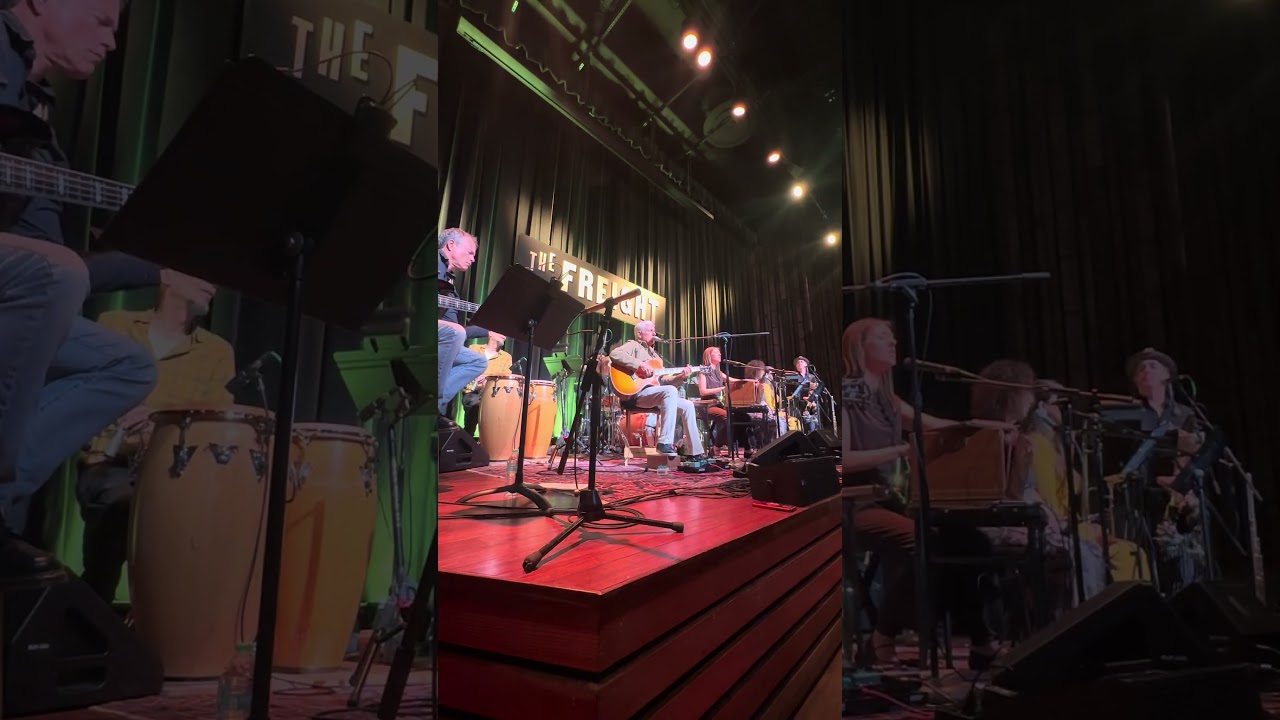
Somewhere in Nicaragua, deep into a breathwork session, a singer with a guitar realized she had no song for the moment. Susie Ro's "Breath of Life" was not written at a desk or polished over months. By her own account it was made up on the spot, as the room was closing, and recorded on a phone before the feeling could fade. That origin is the spine of the piece. It is a song built to hold what breathwork opens, shaped by the people who were in the room when it was needed. Read as a text, its lyrics move through a deliberate sequence: name the pain, let the tears return to the sea, feel and welcome what arises, breathe it out, and then remember why we came to breathe and to receive at all. The video, a recording of 4 minutes and 57 seconds posted on April 7, 2021, presents the song as it was shared at the Movement Medicine Equinox Ceremony, an online gathering hosted by Susannah and Ya'acov Darling Khan, founders of The School of Movement Medicine.
The most direct account of the song's making is the one Susie Ro gave in the YouTube description. She was asked to sing during a breathwork ceremony in Nicaragua, and she describes what happened in the room: "The session was extremely powerful, with many shaking and having big tearful releases." As the session drew to a close, it was her turn to pick up the guitar. She found that the energy was too particular for anything she had prepared.
"The energy in the space was so intense and unique I realised I had no song that would perfectly fit this moment, so I had no choice but to make one up on the spot." (Susie Ro, YouTube description, 2021)
She slipped away and recorded it on her phone "while it was still fresh." That detail matters to any musician. Improvisation under emotional pressure has no room for ornament. The melody has to be simple enough for people who are not performing to join, and the words have to be ones a person can take into the body while breathing. The description does not detail the breathwork method used that day, and this piece does not speculate about it. What it does establish is the purpose she gave the song: "This song is a creation for breathwork, and my prayer is that it will accompany many people on their healing journeys."
The song opens with an address rather than a confession. "This pain that I carry, I no longer need / Mother Earth take away, that which does not serve me" (heard at 0:30 in the recording). The singer does not ask to be rid of pain in the abstract. She names the carrying, then hands what no longer serves her to the earth, a figure who can receive what is heavy and transform it. The next image is water: "These tears that are flowing, going back to the sea." Tears are treated as something that returns to a larger body of water rather than something that drowns the singer. The verse ends on the purpose behind the release: "Making space in my being, for my heart to receive."
The second verse adds a sequence that is easy to miss on a first listen. "This sorrow that binds me, I begin to untie. Thank you for your teachings, for shaping my life." Gratitude arrives before release, and it is gratitude for the difficult material itself. Then the order becomes explicit: "Now it's time to feel it, to welcome it all. I'm ready now to breathe it, and let it all go." Feel, welcome, breathe, let go. The song insists that release comes after acceptance, not as a way of skipping over the feeling. For anyone who has tried to force a cry or a letting go, that ordering is the teaching in the lyric.
The refrain is the song's most unusual move. "My breath you are releasing me, releasing me, releasing me." Grammatically, the breath is the agent. The singer is the one being released. In ordinary speech we breathe; here the breath does something to us. That reversal shifts the work from effort to allowance. The listener is not asked to push anything out. The listener is asked to notice that the breath is already moving through and doing the releasing. The line returns again and again through the recording, most often in runs of four and six repetitions, so that a room can hold onto one phrase while emotion moves faster than language.
Repetition is a practical choice in a song made for a shared breath. The long runs of "let it go," which begin at 2:13 in the recording, give a fixed anchor for people whose attention is moving inward. A listener does not need to follow a plot. They need a phrase that comes back on schedule, like a tide.
The third verse widens the frame from the individual body to a lineage: "Angels circle around and ancestors remind me / That I came here to live and I came here to breathe." Then the couplet turns: "That I came here to give and I came to receive." The pairing of giving and receiving echoes the early line about making space "for my heart to receive." The song ends where it began, with the heart in a state of openness rather than in a state of struggle. Around 3:03 in the recording, the verse returns and the opening lines come back with them, so the piece completes a loop instead of resolving into a single final chord.
The angels and ancestors are not explained in the lyric, and the song does not define them. It simply places the singer among a company of presences who remind her of what she came here to do. For listeners who work with ancestral or devotional frames, that line is an invitation. For others, it reads as a reminder that the breath is not a private act.
The video places the song inside a live, online event. At 0:10 the singer greets the gathering: "such an honor to be here with you all in your dance." At 0:15 she introduces the piece: "this song is called breath of life and it's an invitation to really get into the magic of our breath." Her opening framing is an invitation, not a performance. That posture matters. A song made in one room in Nicaragua now travels to viewers across the internet, many of whom will never have been in that session. The video has been viewed 28,602 times as of this writing, and each of those listeners brings their own breath to the lyric.
Susie Ro thanks Susannah and Ya'acov Darling Khan in the description for inviting her to share her songs as part of the equinox ceremony. The equinox, a moment of balance between light and dark, is a fitting setting for a song about release and receiving. The description does not make that link explicitly, so the reader should take it as an observation rather than a claim from the artist.
Start with the video and let the first three minutes do their work. Then read the lyrics on their own, slowly, noticing the sequence from pain to welcome to release. If you want the full context of Susie Ro's work, the description links to her site, susiero.com, where her albums are listed. If you are drawn to the ceremonial side of the song, the description also points to the work of Susannah and Ya'acov Darling Khan at 21gratitudes.com, the couple behind The School of Movement Medicine. The most useful next step is to take the song into your own breath, and to notice which line you return to when the breath starts to move.