




What is Slow Flow Yoga?
Slow flow yoga is a contemporary style of postural yoga in which poses (asanas) are linked by breath-synchronized movement at a deliberately reduced tempo. It descends from the vinyasa approach, in which movement and inhalation or exhalation are coordinated, but it replaces the brisk pace and athletic emphasis of many vinyasa classes with longer transitions, extended breaths and, often, brief holds of several breaths. Anyone asking “what is slow flow yoga” will find that the term describes a pace and an intention rather than a codified lineage: there is no single governing organization, fixed sequence or official syllabus. The slow flow yoga meaning is therefore best understood as a family of classes sharing a common quality: continuous, attentive, breath-led movement without hurry.
Origins & lineage
Slow flow has no single founder or founding date. Its roots lie in the twentieth-century modernization of hatha yoga in India, especially the teaching of Tirumalai Krishnamacharya (1888–1989) in Mysore, who emphasized coordinating breath with movement. His students shaped most modern postural yoga: K. Pattabhi Jois developed Ashtanga Vinyasa, B.K.S. Iyengar developed a method centered on precise alignment and prolonged holds, and T.K.V. Desikachar taught a individualized, breath-centered approach. In the United States, from the 1980s and 1990s, Ashtanga-derived teaching spread and was adapted into freely sequenced “vinyasa flow” classes.
The slow variant appears to have emerged from the 1990s onward, as teachers and studios offered gentler alternatives to vigorous power and vinyasa classes. It draws on several streams: the alignment attention of Iyengar yoga, the long holds and tissue-oriented approach of yin yoga popularized by Paulie Zink and Paul Grilley, and the secular mindfulness movement associated with Jon Kabat-Zinn’s mindfulness-based stress reduction. Which of these influences is dominant varies by teacher, and historians of yoga such as Mark Singleton (author of Yoga Body, 2010) have argued that modern postural yoga as a whole is a hybrid of Indian and international physical culture, so no “slow” form should be regarded as an ancient practice.
How it’s practiced
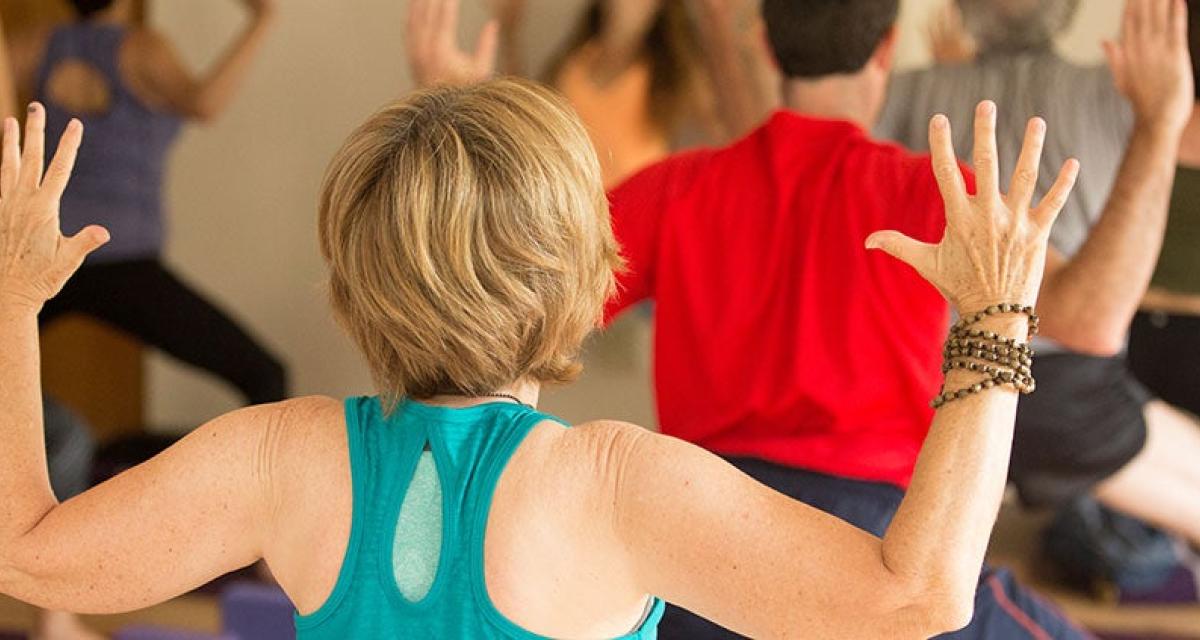
A typical class lasts 60 to 90 minutes. It often begins with a few minutes of seated or reclined breathing, followed by gentle spinal movements such as cat-cow. Sequences then build through familiar forms: sun salutations performed at half speed, lunges, standing poses such as warrior II, balances, hip openers, and seated or supine twists and folds. Transitions may take a full breath or more, and poses may be held for three to five breaths. Classes usually end with savasana, a period of lying still.
The breath, often ujjayi (a soft, audible breath through the nose), sets the tempo. Teachers commonly cue the sensation of movement, not the final shape of the pose, and music is often unobtrusive. The room is typically moderately warm rather than heated. The experience is generally described as steady and meditative, though sustained holds and slow transitions can be physically demanding, particularly for the legs, hips and shoulders.
Slow Flow Yoga today
Slow flow is now widely listed on studio schedules, gym timetables, online platforms and retreat programs, sometimes under names such as “gentle flow,” “flow and restore,” “mindful flow” or “yin-yang yoga.” Online video classes have made it accessible at home, and many teachers pair it with evening or recovery-oriented sessions. Retreats frequently use it as a daily morning practice alongside meditation, breathwork or sound sessions. Because the label is unregulated, content varies: one teacher’s slow flow may resemble restorative yoga, another’s a decelerated Ashtanga-style sequence. Prospective students should read class descriptions or ask the teacher about pace, hold length and level.
Common misconceptions
- It is not necessarily easy. Slowing down removes momentum, so muscles work longer. Many experienced practitioners find it more demanding than faster classes.
- It is not yin yoga. Yin typically involves passive holds of several minutes, mainly on the floor, whereas slow flow remains continuous and active.
- It is not restorative yoga. Restorative practice uses props to support the body in near-total rest; slow flow involves active muscular engagement.
- It is not an ancient tradition. The Yoga Sutras of Patanjali describe asana only as a steady and comfortable seat (sthira sukham asanam), and flowing posture sequences are a modern development.
- It is not a medical therapy. Research on yoga generally suggests benefits for stress and flexibility, but claims about a specific named style should be treated cautiously.
How to begin
Slow flow yoga for beginners can start with a studio class labeled “slow flow,” “gentle flow” or “level 1 vinyasa.” Tell the teacher about injuries before class, and expect to use blocks and a strap. For home practice, choose a recorded class of 20 to 40 minutes from an established teacher and keep the pace comfortable enough to breathe through the nose. Readings that provide background include B.K.S. Iyengar’s Light on Yoga (1966) for alignment principles, and Mark Singleton’s Yoga Body for historical context. Practicing two or three times per week for several weeks is a reasonable way to judge whether the style suits you.