Share your light with the world.
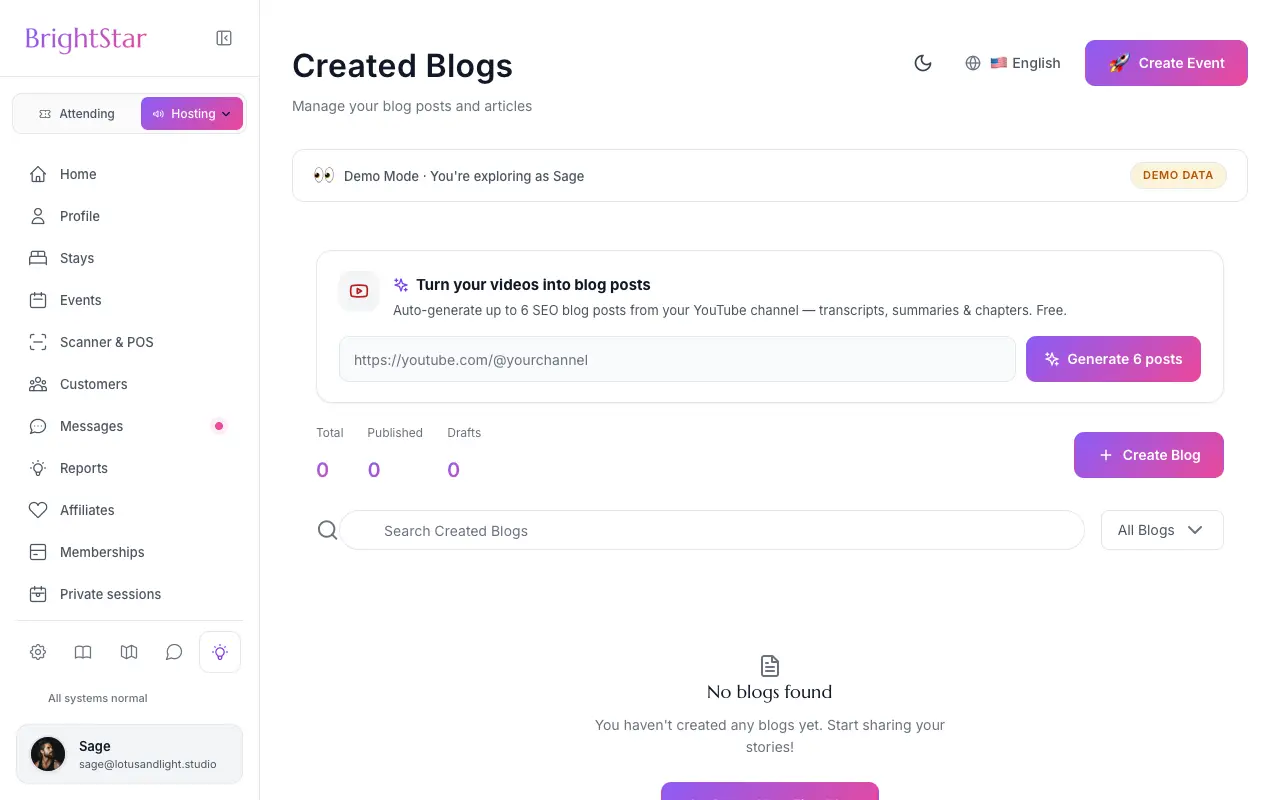
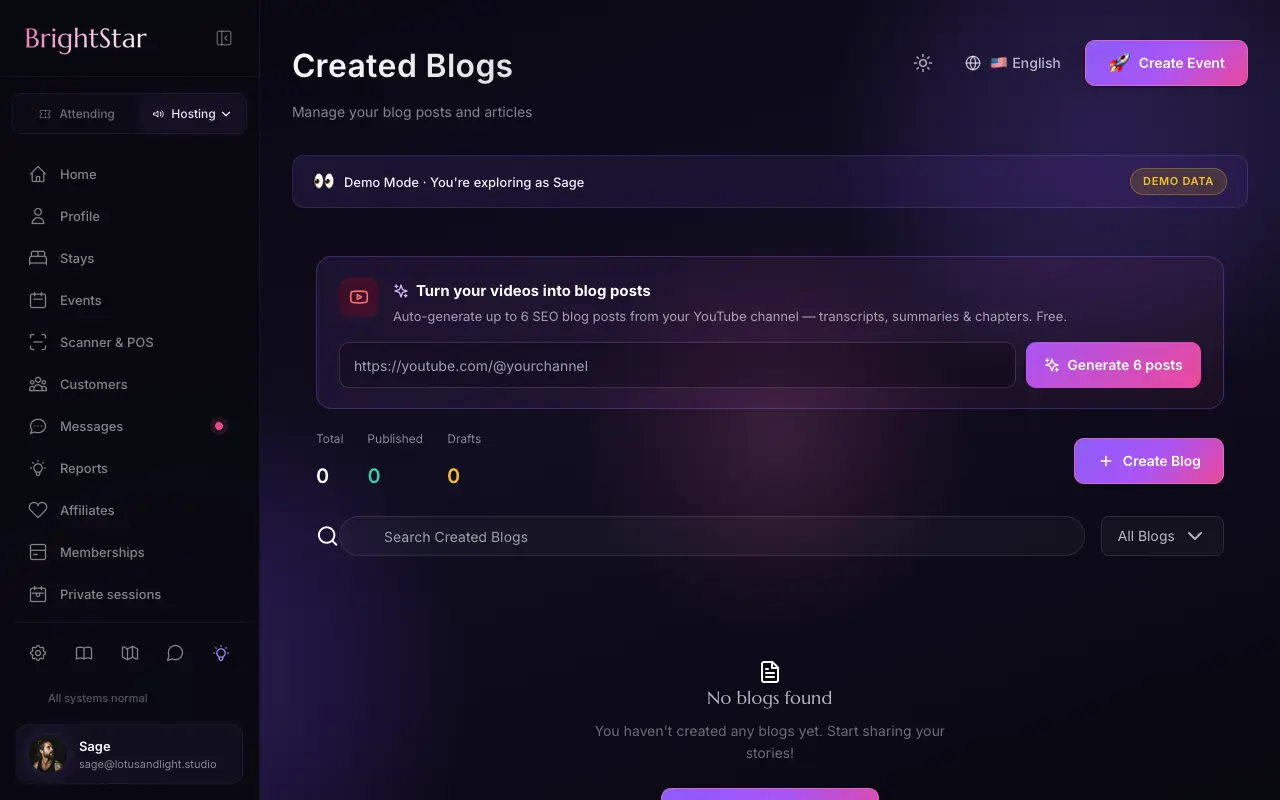
Publish articles, videos and podcast episodes on BrightStar, where people already come looking for what you offer.
新規登録Included on every plan, Seva included.
A home for content with depth
Articles, videos, podcasts
Long-form teachings, guided practices, album releases and episodes, each with its own page.
Built to be found
Every post carries full structured data with its original publish date, so search engines and AI answers can cite it.
Connected to your events
Posts credit the people in them and link to the events you mention, so a reader is one tap from a ticket.
How it works
Write and publish
Create a post from your dashboard, or embed your video or episode.
It goes live
The post is published with its search markup and shows on your profile.
Readers find you
People arriving from search or AI answers reach your work and your events.
Loved by artists and organizers
“BrightStar はキャリアのいちばん最初から私のコンサートを支え、聴衆を広げるうえで決定的な役割を果たしてくれました。アーティストにも主催者にも注がれる誠実さと献身は、そのプロフェッショナリズムと同じく模範的です。”

Snatam Kaurグラミー賞ノミネート(2005年からのクライアント)
“20年近くにわたり、Akal(BrightStar のオーナー)はその力をバクティ・ムーブメントのために捧げてきました。彼のプラットフォームは、真実さと心をもって、私たちのムーブメントに他にはないかたちで貢献しています。技術も最高です!”

Jai Uttalグラミー賞ノミネート(2014年からのクライアント)
“BrightStar と仕事をする中で受けてきた素晴らしいサポートに、私たちはとても満足しています。より高い意識の理想に真摯に取り組む会社を支えられることを、心から嬉しく思います。”

Eric ForbisBuddhaFest 創設者(2012年からのクライアント)
Questions organizers ask
Is publishing free?
Yes. Publishing on the blog costs nothing.
Can I publish videos and podcasts?
Yes. Video and podcast posts get their own pages and the matching structured data.
Can I write about other people’s events?
Yes. Write about any event on BrightStar you want to recommend; the post links to it.
続きを読む
Why a ticketing platform has a blog
People do not only search for events. They search for a mantra’s meaning, a teacher’s talk, a guided practice, a review of an album. The answers to those searches are articles, videos and podcast episodes. BrightStar’s blog is where that content lives, next to the events it relates to. For a teacher or musician, publishing here puts your work in front of people who are already looking for it, one tap away from your next date.
What you can publish
Three kinds of post are supported. Articles: teachings, essays, interviews, stories from the road. Videos: talks, practices, performances, each embedded with its own page. Podcast episodes: each with its own page as well, and channel pages that gather a series. A post has a title, an image, your text and the people it features.
Each post is its own page
Every post has a permanent address, a share image and a description for search results. It can be linked from your newsletter and your social profiles like any page on your own site. Posts are grouped into categories, so a reader who finishes one piece on kirtan finds the next.
Built to be read by search engines and AI
Posts are published with structured data that matches what they are: an article is marked as an article, a video as a video, a podcast episode as an episode. Questions and answers inside a post are marked as such. Videos are listed in a video sitemap. This is what allows a search engine to show a video result, and an AI assistant to cite the piece when someone asks the question it answers.
Honest dates
A video or episode keeps its original publication date, the day it was first released on its platform, not the day it was added here. We hold to this because misdating content is a way of pretending it is new, and both readers and search engines are right to distrust that.
Credited to the people in it
A post names the teachers and musicians it features, the way an event lists its line-up, and links to their profiles. So an interview with you leads to your profile, and your profile leads to your upcoming events. Content and calendar are joined.
Linked to events
Where a post mentions an event on BrightStar, it links to it. A reader who has just watched your talk about a retreat can go straight to the retreat page. This is the practical difference between publishing here and publishing on a general blogging site: the next step is present on the page.
Writing about others
You can write about gatherings that are not your own: a festival you loved, a teacher you recommend. The post links to the event, and the people named in it are credited. Generosity of this kind is how a field grows, and it tends to be returned.
The regional emails
BrightStar sends regional emails that gather upcoming events near each reader. Readers who follow artists, venues or organizers receive a section with new events from the people they follow. Each issue is prepared from what is actually on sale and reviewed before it is sent. This is BrightStar’s own newsletter to its readers, not a tool for sending your own; for your own list, export your customers and use the newsletter service you prefer.
What makes a post worth publishing
Depth, not volume. One careful piece that answers a real question will be found for years; ten thin ones will not. Write what you know from practice. Give the reader something they can use today. Use your own photographs where you can. If you publish a video, add a few paragraphs about what it contains, since text is what search engines read best.
Transcripts
For videos and podcast episodes, a transcript is the single most useful addition. It makes the whole content readable by search engines and AI assistants, not only the title, and it serves people who prefer reading or cannot listen.
Who it is for
Teachers with a body of talks. Musicians with releases and stories. Writers in this field. Centers that want to document what happens within their walls. Publishing is free.
What it is not
The blog is not a private membership area and not a course platform. Everything published is public and meant to be found.
Ideas for a first post
If you are unsure where to begin, start with the question you are asked most often. A kirtan leader might explain what happens at a kirtan for someone who has never been. A yoga teacher might write about the practice she teaches and whom it suits. A retreat host might describe a day on retreat, hour by hour. A musician might tell the story behind one song. Posts like these answer what real people type into a search box, and they remain useful for years.
Using a post to support an event
A good time to publish is a few weeks before a gathering. Write about the subject of the event, not about the event itself: the teaching you will give, the music you will play, the place where it happens. Link to the event once, near the end. Then share the post, not the ticket link, on your channels. People respond more warmly to something given than to something sold, and the ticket is one tap away for those who want it.
Images and video
Use your own images wherever possible, and name the people in them. For a video post, the video is embedded from where it is hosted and loads only when the reader presses play, which keeps the page quick on a phone.
Custom Event Pages
Your page is designed from your poster, ready on every phone, and set up for search and sharing the moment you publish.
機能を見る →Artist Profiles
If you have taught or played at events on BrightStar, you likely have a profile waiting: claim it, make it yours, and let people follow you.
機能を見る →Link in Bio
Your link-in-bio page shows your upcoming events as you add them, beside your bio and social links, free.
機能を見る →Event Blog
BrightStar’s blog writes spotlight articles about upcoming events, so people searching for what you offer find a second way in.
機能を見る →Ticket Categories
Group your ticket types into clear categories, so buyers see the shape of your event and find their ticket fast.
機能を見る →Stripe による決済
すべてのチケットは Stripe を通じてあなた自身の Stripe アカウントに支払われ、お客様がすでに使っている支払い方法が利用できます。
機能を見る →See allThere is more to see.