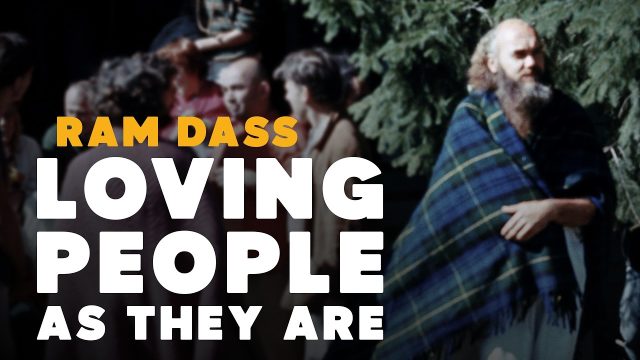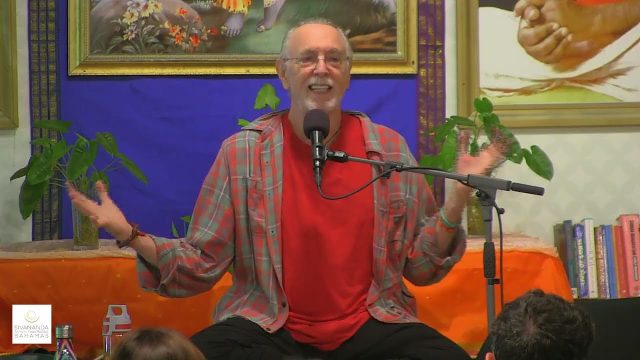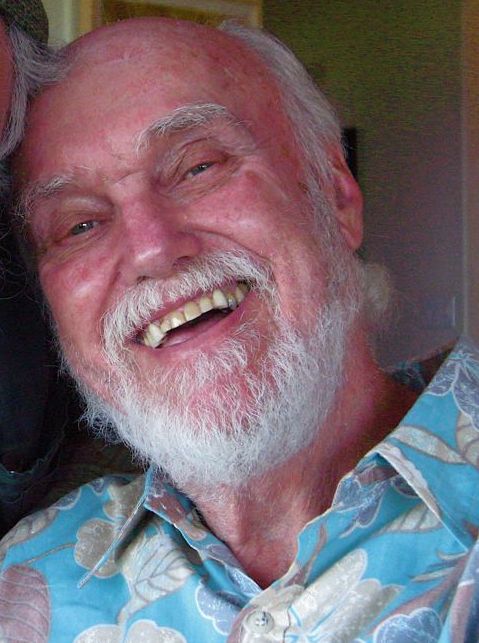
In this 1980s talk recorded during the AIDS crisis, Ram Dass and Stephen Levine examine how negative experiences—including pain, dying, and emotional suffering—become catalysts for awakening when met with compassion rather than resistance. Both teachers argue that spiritual growth emerges not from avoiding difficulty but from shifting perspective to recognize that all experience can dissolve the illusion of separateness and reconnect us to our shared humanity and heart.
Ram Dass and Stephen Levine approach suffering not as something to overcome or transcend, but as material for practice. The core insight they share is that our resistance to pain—the ways we meet difficulty with anger, denial, or self-hatred—creates more suffering than the original experience itself. When we instead bring awareness and compassion to what we're feeling, we begin to dissolve the barrier between self and other that creates the sense of isolation in the first place.
Stephen Levine, a Buddhist teacher and poet, shares a powerful story about an AIDS patient he was working with during the height of the crisis. This patient initially met his pain with tremendous self-hatred and anger—a natural response to life-threatening illness, yet one that compounded the suffering. When the patient began to practice meeting his pain with loving-kindness instead of hatred, something shifted. The pain itself did not disappear, but his relationship to it transformed. Rather than being a force that isolated him or confirmed a sense of wrongness in his body or his self, the pain became a gateway to deeper compassion—both for himself and for others experiencing similar struggles.
This practice of meeting pain with loving awareness rather than resistance is not about spiritual bypassing or denying real difficulty. Instead, it reflects a recognition that psychological suffering—the story we tell about our pain—can be worked with and transformed in ways that physical sensation cannot always be. Ram Dass emphasizes that we must open to both physical pain and the psychological responses that accompany it. When we resist feeling what is true, we fragment ourselves and increase our sense of separation.
Ram Dass introduces a crucial dimension often missing from individual healing work: the healing that happens through our shared caring and shared heart. He argues that we are being healed out of our separateness precisely through the acts of caring for one another, especially in the face of mortality and suffering. During the AIDS crisis, as many in the community were dying, the response of others to meet them with compassion and presence became a form of healing—not healing in the sense of curing disease, but healing in the sense of reconnecting people to their fundamental interconnection.
This reflects a shift in perspective that both teachers advocate: recognizing that we are more than our bodies, and that our bodies are not obstacles to our awakening but entry points into it. The modern tendency is to treat the body as a machine that can be fixed or a problem to be solved. Both Ram Dass and Levine suggest that when we meet the body's limitations—pain, illness, aging, dying—with full awareness and compassion, we discover something else entirely: a doorway into understanding that our true nature is not confined to physical form.
Stephen Levine identifies a specific psychological pattern that arises around pain and dying: the sense of anger and self-hatred that gathers as people confront mortality or serious illness. This makes complete sense psychologically. A person facing AIDS in the 1980s, for instance, faced not only the virus but also profound grief, loss, the possibility of premature death, and—in that era—social stigma and abandonment. The anger and self-hatred are understandable responses to profound injustice and fear.
Yet Levine and Ram Dass suggest that these emotional reactions, while natural, can be met differently through practice. The patient Levine describes who shifted to loving-kindness did not achieve this shift by suppressing his anger or pretending it didn't exist. Rather, he learned to hold the anger itself with compassion—to notice the anger arising, to feel its texture and energy, and to respond to it with the same loving-kindness he might offer a suffering friend. This creates space between the pain and the story about the pain, between the anger and the sense of self that claims the anger.
This distinction is critical for anyone working with chronic pain, illness, or grief. The practice is not to replace anger with positivity, but to become larger than the anger—to hold it as something moving through you rather than something that defines you. This is how negative energy transforms: not by being repressed or replaced, but by being met with full awareness and compassion.
Ram Dass shares a personal teaching about one of the heaviest learnings of his own practice: allowing himself to need help from others and acknowledging his own full humanity. For someone who had been a teacher and guide for decades, this was not easy. There is often an implicit belief in spiritual communities that the goal is to transcend human limitation, to move beyond needing others, to become more evolved. But Ram Dass suggests the opposite: that true spiritual maturity involves fully acknowledging and accepting our fundamental dependence on others and on community.
This is especially relevant to the healing work both teachers discuss. We cannot heal ourselves alone. Just as the AIDS patients Levine worked with needed the presence and care of others, all of us require connection, support, and witnessing in order to grow. Ram Dass points out that to do the work he really wanted to do—to serve, to teach, to be of use—he had to first acknowledge the fullness of his own humanity: his needs, his limitations, his vulnerability, his dependence.
This represents a significant reorientation of the spiritual path away from individual transcendence and toward what might be called "horizontal" growth—deepening into our humanity rather than trying to escape it. The spiritual work becomes learning to be with what is true about our condition rather than trying to transcend it.
Ram Dass makes an important distinction between opening to physical pain and opening to psychological or emotional pain. Physical pain has certain qualities that are more stable and less subject to our interpretation. Psychological pain—shame, fear, grief, humiliation—arises from our relationship to experience and can shift when our perspective shifts. When we bring loving awareness to psychological pain instead of resistance and denial, we begin to work with the root of suffering rather than just its surface manifestations.
This is why practices like loving-kindness meditation can be so powerful in contexts of illness and dying. The practice is not to think positively about pain or to dissociate from it, but to gradually train the mind to meet experience with openness rather than contraction. Over time, this creates a different neurological and psychological baseline. We become less reactive, more capable of holding difficulty without being overwhelmed by it.
Both teachers suggest that this kind of opening is not weakness but tremendous strength. It takes far more courage to fully feel what we're feeling than to armor ourselves against it. And when we develop that capacity, we become less isolated—we can recognize the pain and fear in others not as foreign or frightening, but as part of the shared human condition.
Throughout the talk, both Ram Dass and Stephen Levine suggest that dying and the preparation for dying offer a unique opportunity for awakening. This is not morbid or depressing in their framing, but liberating. When we come close to death—either our own or another's—the usual concerns that preoccupy us become less important. What suddenly matters is presence, love, and whether we've touched something real in ourselves and in others.
The AIDS crisis provided a context in which many people were forced to confront these questions directly and urgently. Rather than spiritualizing this tragedy, both teachers suggest that it created an opportunity for genuine practice and genuine awakening. The process of dying, from this perspective, is not a failure of medicine or life but a natural part of the human condition that can deepen us if we meet it with awareness.
Stephen Levine's work with dying patients was predicated on the belief that the dying process itself could be a time of profound spiritual growth—not because death is good, but because it offers unique clarity. In that clarity, many of the illusions that bind us become transparent. We see what matters. We see how connected we are to others. We see that identity and form are constantly changing.
Both teachers point toward a fundamental shift in perspective that makes all the other work possible. Ram Dass speaks of touching the possibility that we are more than our bodies. This is not a denial of the body or of its genuine limitations and needs. Rather, it's a recognition that consciousness itself—the capacity to witness and be aware—is not dependent on physical form in the ways we assume.
This shift doesn't happen through intellectual understanding alone. It emerges through sustained practice and through direct experience. When we meditate, when we open our hearts to others, when we allow ourselves to be vulnerable and held, we sometimes touch something that cannot be contained by our usual sense of self. We recognize a continuity of consciousness that is not bounded by skin and bone. This is what both teachers mean by "awakening out of the illusion of separateness."
From this perspective, illness, pain, and dying are not enemies of this awakening. They are, in fact, particularly powerful opportunities for it. They break through our defenses and bring us to a place of radical honesty where the usual illusions become harder to maintain.
If you are working with pain, illness, or grief, consider experimenting with loving-kindness practice. Rather than trying to make the pain disappear, practice opening to it with compassion—the kind of compassion you would offer a friend who was suffering. Notice where resistance shows up in your body and mind, and practice softening into that resistance with awareness.
If you are working with anger or self-hatred, remember that the goal is not to eliminate these feelings but to hold them with compassion. Can you allow the anger to be there without letting it define you or drive your actions? This is the practice both teachers point toward.
Finally, consider reaching out for help and connection. The isolation that compounds suffering often comes not just from pain itself but from the belief that we should be able to handle it alone. Both Ram Dass and Stephen Levine emphasize that healing and awakening are fundamentally relational processes. Who in your life might benefit from your presence and care? And who might you allow to support you?