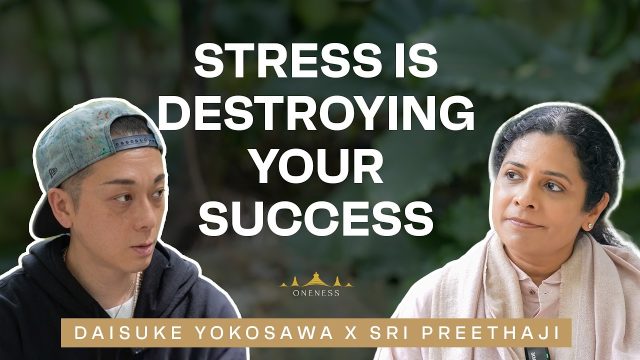
True resilience in a rapidly changing world is not built through external adaptation alone, but through deliberate cultivation of your inner world—managing internal stress, integrating failures, and maintaining mental clarity. When your inner foundation is stable, external shifts become navigable rather than destabilizing, and you retain the intelligence and confidence needed to respond effectively in business and life.
In contemporary life, the advice to "adapt to change" has become almost reflexive. Companies restructure, markets shift, technologies emerge, and the implicit instruction is to be flexible, pivot quickly, and move with the times. Yet this counsel overlooks a critical gap: the person doing the adapting. Most frameworks for managing change focus entirely on the external landscape—market trends, competitive dynamics, organizational structures—while leaving the internal landscape unexamined. What happens inside your mind, body, and nervous system when those external shocks occur often determines whether adaptation is sustainable or whether it simply compounds stress into chronic dysfunction.
The Oneness Movement teaching in this talk distinguishes between two layers of change management. The first is behavioral and tactical: you learn new skills, you adjust your strategies, you adopt new tools. This is necessary but insufficient. The second layer, and the one most neglected, is the cultivation of what the speaker describes as your inner world. This refers not to positive thinking or affirmations, but to the actual quality of consciousness, the state of your nervous system, your capacity to hold difficult emotions without being overwhelmed by them, and your ability to maintain clarity when failure or loss occurs.
When you experience repeated external changes without attending to the internal reverberations, stress accumulates in the body and mind. This stress acts as a filter that distorts perception and shrinks your cognitive capacity. Under chronic stress, your brain defaults to survival mode—threat-detection and fear-based decision-making dominate. What the Oneness tradition calls intelligence—the capacity to see situations with clarity, to access creative solutions, to discern what truly matters—becomes unavailable. You may be adapting frantically on the surface while your actual decision-making capacity deteriorates.
This dynamic is especially visible in business contexts. A leader can make a series of strategic pivots in response to market changes while simultaneously losing the internal stability needed to make wise decisions. Confidence, in this framing, is not swagger or overconfidence. It is the felt sense that you can handle what comes, that failures do not define your capability, that you have access to your own resourcefulness. This confidence erodes not when external circumstances are difficult, but when internal stress goes unaddressed and failures accumulate as psychological wounds rather than learning events.
The talk emphasizes that overcoming internal stress and failures is key to maintaining resilience. This phrasing is deliberate. Failures are inevitable in any changing environment. What differs is how they land in your consciousness. If you internalize failures as personal inadequacy, as proof that you cannot handle complexity, then each failure compounds the next. Your nervous system learns to associate change with threat and personal diminishment. Over time, you become reactive rather than responsive—you are not choosing your moves; you are being driven by fear and self-doubt.
Conversely, if failures are processed as information, as feedback from the environment rather than feedback about your worth, they can integrate into your growing competence. This requires an inner capacity to feel the disappointment, the loss, even the shame that may arise, without being overtaken by these emotions or without needing to suppress them. It requires what contemplative traditions sometimes call equanimity—the ability to hold both success and failure with equal clarity, without inflation or deflation. This is not a one-time achievement but an ongoing practice of returning to this balanced perspective.
The description of the talk points to nurturing the inner world as vital. In practical terms, this includes several dimensions. The first is somatic—the state of your physical body and nervous system. Chronic stress lives in tight shoulders, shallow breathing, a constricted chest, a hyperactive mind. Practices that discharge this held tension—whether through movement, breathwork, or genuine rest—begin to restore the baseline from which you operate. When your nervous system is not in perpetual high alert, your access to intelligence and creativity improves measurably.
The second dimension is emotional. Many people in high-pressure environments (which increasingly means most people) have learned to bypass or suppress emotion in the name of productivity. Yet emotions are data. They tell you what matters, what threatens, what is working and what is not. Nurturing your inner world means developing the capacity to feel emotions fully, to allow them to pass through without either being controlled by them or controlling them. This is the opposite of toxic positivity, which demands you feel only pleasant emotions. Instead, it is the capacity to contain the full spectrum.
The third dimension is relational and existential. How do you speak to yourself when things do not go as planned? What narratives have you internalized about your capability? What assumptions underlie your choices? The inner world includes the stories you tell yourself about change, failure, and your own role in navigating them. When these narratives are examined and, where necessary, updated to reflect what is actually true rather than what you absorbed early in life, your relationship to difficulty shifts fundamentally.
A common misunderstanding of resilience is that it means bouncing back unchanged, or not being affected by difficulty. The framework presented here is different. Resilience, in the context of nurturing your inner world, is the capacity to be moved by circumstances while remaining fundamentally grounded. It is the difference between a tree that sways in the wind because its roots are deep and a tree that snaps because it is rigid or because its foundation is shallow.
In business and in life, this means you can take feedback seriously, make genuine adjustments, hold yourself accountable, and still maintain a core sense of okayness. You can acknowledge a failure—a project that flopped, a relationship that ended, a strategy that did not work—without needing to defend yourself, shame yourself, or pretend it did not happen. This kind of resilience is actually what builds trust in others. When people see that you can handle difficulty without either collapsing or lashing out, they trust you more. And when you trust yourself in this way, your decisions improve because they are not distorted by the need to protect a fragile self-image.
The teaching does not remain abstract. The implication is that building and maintaining this inner foundation while navigating constant external change is a deliberate practice, not something that happens by accident or only in retreat settings. This might include regular practices that ground you—meditation, time in nature, genuine rest, or creative expression. It might include relationships where you can be honest about struggle without needing to perform competence. It might include working with a therapist or coach to examine the stories and patterns that no longer serve you.
Critically, this is not separate from your engagement with the external world. As you stabilize your inner world, your capacity to perceive external shifts with clarity improves. You become less reactive to noise and more responsive to genuine signals. You can make bolder moves in business because they come from clarity rather than fear. You can take interpersonal risks because your sense of self is not entirely dependent on external approval. The inner work and the outer work reinforce each other.
If you find yourself caught in the cycle of constant external adaptation while feeling increasingly depleted, consider where your inner world might need attention. Notice where stress is held in your body. Identify the stories you tell yourself about failure and change. Experiment with practices that settle your nervous system and create space between stimulus and response. Seek out teachings or mentors who understand that true leadership and resilience originate in the quality of consciousness you bring to challenges, not only in the strategies you deploy. The world will continue to change rapidly—that is not something to fix. What you can cultivate is the inner stability from which wise choices become possible.