Found wherever people search.
Your event is published the way search engines and AI assistants read, the moment it goes live.
S'inscrireIncluded on every plan, Seva included.
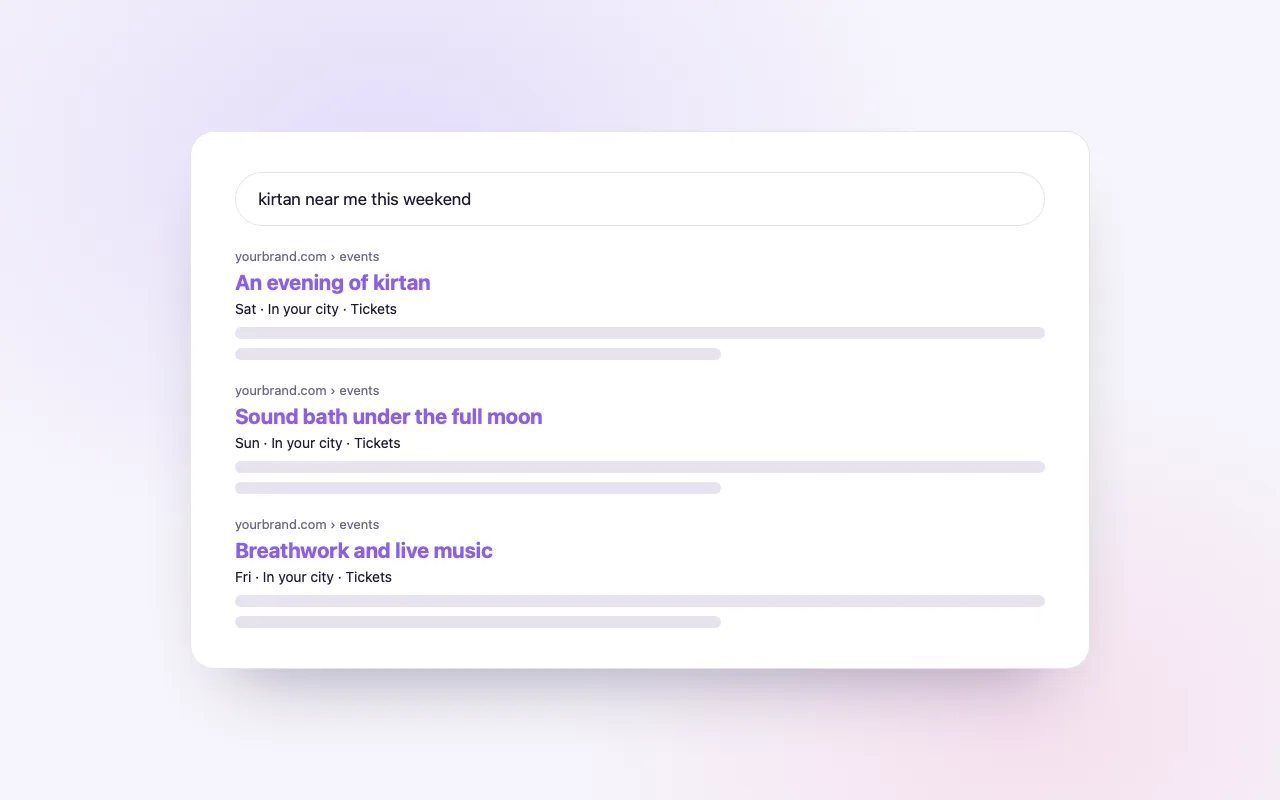
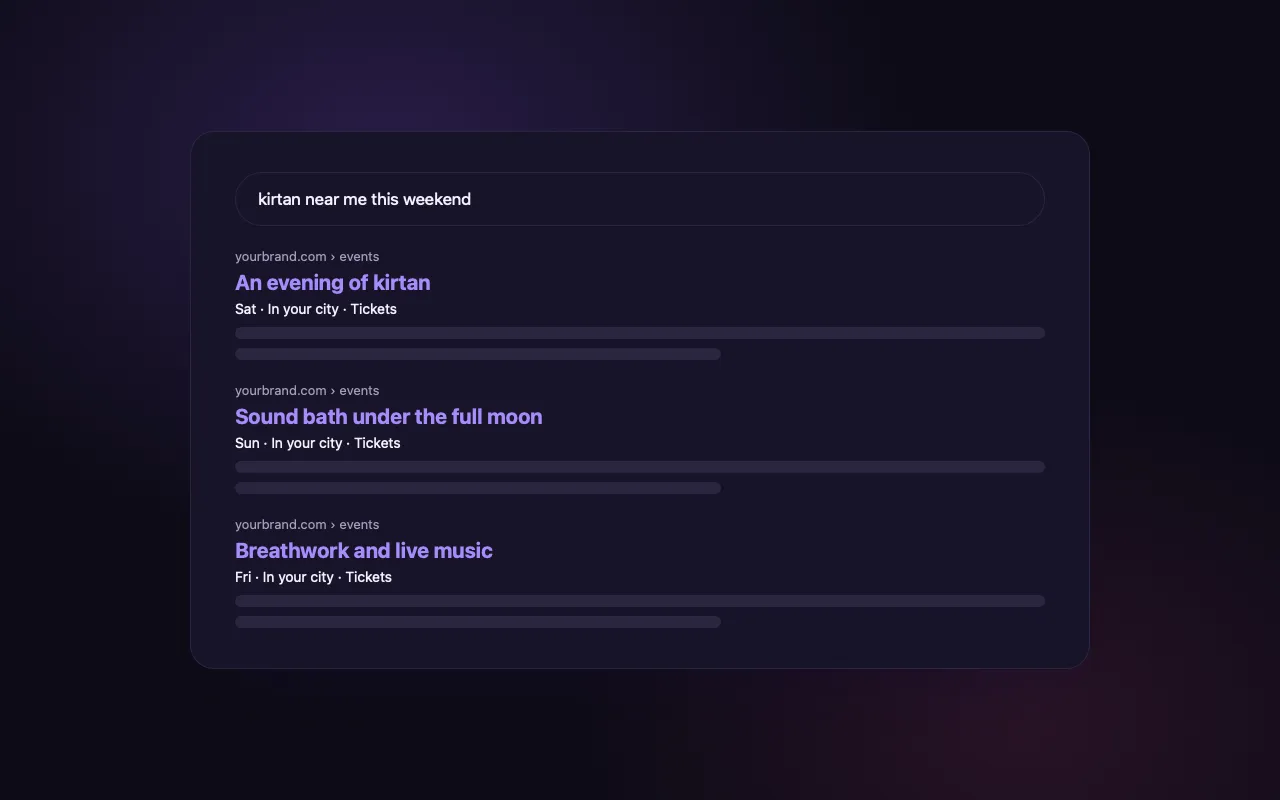
Born search-optimized
Full structured data
Event markup with offers, performers, place and FAQs, so search can show rich results.
Discovery pages
Your event appears on the category and city pages people browse and search engines crawl.
Ready for AI answers
An llms.txt guide and clean markup help AI assistants find and describe your event.
How it works
Publish your event
Nothing extra to do.
It is marked up
Meta tags, share images and structured data are generated.
It is found
Through search, discovery pages and AI assistants.
Loved by artists and organizers
“BrightStar accompagne mes concerts depuis les tout débuts de ma carrière et a joué un rôle déterminant dans la croissance de mon public. Leur loyauté et leur dévouement envers les artistes comme envers les organisateurs sont exemplaires, tout comme leur professionnalisme.”

Snatam KaurNommée aux Grammy Awards (cliente depuis 2005)
“BrightStar est un ami proche et un allié de The Shift Network, et son aide a été inestimable pour faire connaître nos programmes. Nous partageons des valeurs spirituelles tournées vers l’élévation de l’humanité. BrightStar allie une vraie expertise marketing à un service qui vient du cœur.”

Philip HellmichDirector of Peace, The Shift Network (client depuis 2012)
“Depuis près de vingt ans, Akal (le fondateur de BrightStar) met ses talents au service du mouvement Bhakti. Sa plateforme sert notre mouvement avec une authenticité et un cœur uniques. Et la technologie assure aussi !”

Jai UttalNommé aux Grammy Awards (client depuis 2014)
Questions organizers ask
What is schema markup and why does it matter?
It tells search engines and AI exactly what your page is: who, what, where, when and the tickets, so they can show and quote it correctly.
Do I need any SEO knowledge?
No. Everything runs automatically when you publish.
Do you publish to Bandsintown or Songkick?
Not directly. Search engines read your event’s structured data, and AI assistants read the guide we publish for them.
Lire la suite
Being found is part of ticketing
A beautiful event that nobody can find sells to the people who already know you. Growth comes from the ones who do not: someone searching for a sound bath this weekend, a kirtan near them, a yoga retreat in the spring. Whether your event appears for them depends on technical details most organizers never see. BrightStar handles those details for every published event, with nothing for you to set up.
Structured data, explained simply
Search engines read pages better when a page states, in a standard format, exactly what it is. This is called structured data. Every event page on BrightStar carries it: this is an event, it has this name, it starts at this time, at this place, with these performers, and tickets are offered at these prices. Concerts are marked as music events. Your FAQs are marked as questions and answers.
What that makes possible
With that information, a search engine can show your date, place and ticket availability directly in its results, and can include your event in the event listings it shows for searches such as “events near me”. Whether and how it does so is the search engine’s decision, but without structured data it cannot.
The sitemap
A sitemap is the list of pages a site asks search engines to read. Published events are included in BrightStar’s sitemap, so a new event is put in front of search engines without waiting to be discovered by a link.
Category and city pages
BrightStar has discovery pages for the kinds of gathering it serves and for the places where they happen: kirtan, meditation, yoga, retreats, sound healing, and city by city. Your event appears on the pages that match its category and place. These pages are built so that their events are readable as plain links, and they are often what a searcher lands on first.
Profiles that point to you
When you name your teachers and performers, your event appears on each of their profiles. A person who searches for an artist and finds their profile sees your date there. For touring artists this is one of the most common ways a concert is found.
Readable by AI assistants
More and more people ask an AI assistant where to go. BrightStar publishes a guide for these assistants, in the llms.txt format, describing the site and listing its upcoming events, artists, venues and organizers. Together with clean structured data, this helps an assistant find your event and describe it correctly: the right date, the right place, the right link.
Languages
Pages are available in seven languages, and each page tells search engines about its other language versions, so a visitor searching in German is sent to the German version of the frame around your event.
Share previews
Search is not the only way a link travels. Every event page has a share image and description, so that it appears as a proper card in messages and social posts.
What you can do to help
The system works from what you enter. Use a title that says what the gathering is, not only its poetic name: “Evening of Kirtan with” and the artist’s name will be found; a single evocative word will not. Write a real description. Choose the right category. Give the full venue with its city. Name every performer. Add FAQs. Publish early, since pages need time to be read and listed.
What we do not do
BrightStar does not post your event to other listing sites such as Bandsintown or Songkick, and it does not promise a position in search results. Anyone who guarantees a ranking is guessing. What we provide is a page built the way search engines and AI assistants ask pages to be built.
Speed and phones
Search engines favor pages that load quickly and work on phones, because that is where people search. event pages are built for both.
Where it is included
All of this is part of every published event on every plan, including Seva. There is no SEO add-on to buy and nothing to switch on.
A short glossary
Structured data: information in a page, in a standard format, that tells a search engine what the page is about. Schema markup: another name for the same thing. Sitemap: the list of pages a site asks search engines to read. Meta title and description: the lines shown for your page in search results. Share preview: the card shown when your link is pasted into a message. llms.txt: a file that describes a site for AI assistants. You do not need to manage any of these on BrightStar; it is simply useful to know the words.
Why your own website still matters
If you have a website, keep it, and link from it to your event page or embed your tickets there. Links from sites that are about your work help search engines understand that your event is real and relevant. Ask your venue and your performers to link to the event as well. This is ordinary good practice, and it complements what BrightStar does for the page itself.
After the event
Search visibility builds over time. An organizer who hosts regularly, with well-described events and a complete organizer profile, becomes easier to find with each gathering, because there is more for search engines to read and more reason for others to link. Your profile remains after each date has passed and lists what comes next.
Measuring it
If you use an analytics tool, you can add it in the Integrations tab and see how visitors reach your event pages. For most hosts a simpler test is enough: search for your kind of gathering in your city a few weeks after publishing, and see what appears.
Meta Retargeting
Set a daily budget and BrightStar runs ads built from your event to the people most likely to come.
Voir la fonction →Verified Buyer Network
Your event is promoted to nearby people who buy tickets to events like yours, not a purchased list.
Voir la fonction →Outbound Email Marketing
BrightStar writes and sends email campaigns about your event to your past buyers and nearby people who go to events like yours.
Voir la fonction →SMS & WhatsApp
Buyers who opt in get your event reminders by text or WhatsApp, on the same schedule as the emails.
Voir la fonction →Event Upsell Network
When someone buys a ticket to a similar event, yours can appear right after, on the pages and emails they are already reading.
Voir la fonction →Direct Mail Campaigns
A printed postcard or letter composed from your event, with a QR code that opens your event page.
Voir la fonction →See allThere is more to see.