BrightStar

Parcourir tous les Events

Découvre des rassemblements conscients

events

Yoga
Meditation
Breathwork
Qigong
Tai Chi
Sacred Music
World Music
Medicine Music
Sound Healing
Ecstatic Dance
Destinations populaires
BaliSedonaLos AngelesCosta RicaNew YorkSan FranciscoAustinMiamiJoshua TreeTulum
Voir toutes les catégoriesVoir toutes les destinations

Explorer toutes les fonctionnalités

Des outils puissants pour développer tes événements

Fonctionnalités de la plateforme

Tarification dynamique intelligente
Catégories de billets
Places assignées
Récupération des paniers abandonnés
Récupération des visiteurs
Dons & Prix variables
Système d'affiliation
Scanner de billets
Codes promo
Questions personnalisées
Partage de billets
Ventes additionnelles & Options
Analyses & Rapports
Séquences d'emails
Liste d'attente / Notifier / Rappeler
Personnes & Lieux
Artists & TeachersEvent OrganizersVenues & StudiosKnowledge BaseGlossaryInspiration
Voir toutes les fonctionnalitésÀ propos
TarifsBlog
Language
Saved events
Parcourir tous les événements

events

YogaMeditationBreathworkQigongTai ChiSacred MusicWorld MusicMedicine Music

Destinations populaires

BaliSedonaLos AngelesCosta RicaNew YorkSan Francisco

Personnes & Lieux

Artists & TeachersEvent OrganizersVenues & StudiosKnowledge BaseGlossaryInspiration

Fonctionnalités de la plateforme

Tarification dynamique intelligenteCatégories de billetsPlaces assignéesRécupération des paniers abandonnésRécupération des visiteursDons & Prix variablesSystème d'affiliationScanner de billetsCodes promoQuestions personnaliséesPartage de billetsVentes additionnelles & OptionsAnalyses & RapportsSéquences d'emailsListe d'attente / Notifier / Rappeler
Voir toutes les fonctionnalitésÀ propos
TarifsBlog
ConnexionChercheursCréateurs
  • Parcourir tous les Événements
  • Pour les chercheurs
  • Yoga
  • Méditation
  • Breathwork
  • Qi gong
  • Tai-chi
  • Musique sacrée
  • Musiques du monde
  • Musique médecine
  • Soins sonores
  • Danse extatique
  • Retraites
  • Ateliers
  • Toutes les catégories →
  • Bali
  • Sedona
  • Los Angeles
  • Costa Rica
  • Tulum
  • Byron Bay
  • San Francisco
  • Austin
  • New York
  • San Diego
  • Denver
  • Seattle
  • Portland
  • Miami
  • Toutes les villes →
  • Join the Movement
  • Why we list
  • Sell Globally
  • Pour les créateurs
  • Pour les équipes
  • Pour les écrivains
  • Pour les enseignants
  • Pour les artistes de kirtan
  • Pour les studios
  • Pour les festivals
  • Pour les centres de retraite
  • Pour les associations
  • Ambassadeur de marque
  • Billetterie gratuite
  • Elevate
  • Amplify
  • Réseau de 500K+ acheteurs
  • Récupération des paniers abandonnés
  • Tarification dynamique intelligente
  • Catégories de billets
  • Événements récurrents
  • Places assignées
  • Système d'affiliation
  • Liste d'attente / Notifier
  • Scanner de billets
  • Widget intégrable
  • Diffusion d'événements
  • Messagerie
  • Intégrations
  • Rapports
  • Toutes les fonctionnalités →
  • À propos
  • L'écosystème
  • Blog
  • Glossaire
  • Inspiration
  • Centre d'aide
  • Contact
  • Documentation API
  • Ressources de marque
  • Carrières
  • Presse
  • Conditions d'utilisation
  • Politique de confidentialité

Événements

  • Parcourir tous les Événements
  • Pour les chercheurs
  • Yoga
  • Méditation
  • Breathwork
  • Qi gong
  • Tai-chi
  • Musique sacrée
  • Musiques du monde
  • Musique médecine
  • Soins sonores
  • Danse extatique
  • Retraites
  • Ateliers
  • Toutes les catégories →

Destinations

  • Bali
  • Sedona
  • Los Angeles
  • Costa Rica
  • Tulum
  • Byron Bay
  • San Francisco
  • Austin
  • New York
  • San Diego
  • Denver
  • Seattle
  • Portland
  • Miami
  • Toutes les villes →

Pour les créateurs

  • Join the Movement
  • Why we list
  • Sell Globally
  • Pour les créateurs
  • Pour les équipes
  • Pour les écrivains
  • Pour les enseignants
  • Pour les artistes de kirtan
  • Pour les studios
  • Pour les festivals
  • Pour les centres de retraite
  • Pour les associations
  • Ambassadeur de marque
  • Billetterie gratuite
  • Elevate
  • Amplify

Fonctionnalités

  • Réseau de 500K+ acheteurs
  • Récupération des paniers abandonnés
  • Tarification dynamique intelligente
  • Catégories de billets
  • Événements récurrents
  • Places assignées
  • Système d'affiliation
  • Liste d'attente / Notifier
  • Scanner de billets
  • Widget intégrable
  • Diffusion d'événements
  • Messagerie
  • Intégrations
  • Rapports
  • Toutes les fonctionnalités →

Entreprise

  • À propos
  • L'écosystème
  • Blog
  • Glossaire
  • Inspiration
  • Centre d'aide
  • Contact
  • Documentation API
  • Ressources de marque
  • Carrières
  • Presse
  • Conditions d'utilisation
  • Politique de confidentialité
BrightStar
Téléchargez l'app
Télécharger dans l'App StoreDisponible surGoogle Play
© 2026 BrightStar. Tous droits réservés.
Inspiration

Mahamrityunjaya Mantra: Structure, Meaning and Chant

Manish Vyas
Manish Vyas
Dec 30, 2023
8 min de lecture
À regarder · 6

The Mahamrityunjaya Mantra is one of the best-known Shiva chants in the devotional repertoire, and Manish Vyas's recording of it, released on his album Adiyogi, is a six-and-a-half-minute study in how a sacred text and a set of seed syllables can be braided into a single meditative cycle. The video carries no spoken commentary. It is music from first note to last, which makes it an unusually pure object for listening: the form does the teaching. Once you know what to listen for, the recording reveals a clear architecture. A Beeja sequence opens each cycle, the Tryambakam verse rises through the middle, a short instrumental breath follows, and the whole thing turns back on itself, with small changes in vowel and phrasing each time around.

Lecture · 6 sections

What does the Mahamrityunjaya Mantra sound like in this recording?

The video opens with about forty seconds of music before the first syllables arrive. The transcript marks these stretches only as music, and that is how they feel: an unhurried entry that lets the ear settle before any words are asked of it. The first vocal phrase, at 0:41, is not the verse at all. It is a run of short, percussive seed syllables, "Om Hoom Jum Sah," followed by "Om Bhur Bhuva Svaha." Only after that does the familiar Tryambakam text come in, at 0:49.

That ordering matters. Listeners who arrive expecting the long-form verse first can miss the point of the opening. The recording establishes its sonic ground with the short syllables, then lowers the listener into the longer line. The contrast between the two is the engine of the piece.

The video's own description frames the recording plainly. It calls the mantra "one of the most well known powerful mantra," chanted by people "seeking Moksha and freedom from fear of death," and notes that it is often sung for a person who is "gradually leaving the physical plane." It also describes the mantra as "a powerful Shiva Mantra for protection, for healing and nurturance," and says the Beeja mantras included in the text "create very powerful vibration for meditation." Those four claims are the frame through which the rest of the recording should be heard.

Why do the Beeja syllables sit beside the Tryambakam verse?

Beeja means "seed." In the mantra tradition, a beeja is a short, concentrated syllable, often a single sound with a vowel and a nasal or closing consonant, that is held to carry a compressed force rather than a dictionary meaning. The description calls these the seed syllables of this text and credits them with creating a strong vibration suited to meditation. That is the single most useful thing to know when listening: the Beeja sounds are not decoration. They are the density the longer verse opens out from.

Hear how the seeds behave in the recording. At 0:41 and again at 1:08, the seed run is delivered briskly and closed with a hard consonant, giving each cycle a clean beginning. The vowels are sustained just long enough to ring. In the second cycle, around 1:14, the syllables loosen and begin to slide ("Om Ho Jum Sah"), so the seed run itself starts to breathe. Those small shifts are easy to miss on a first pass and easy to feel on a fifth.

"This is a powerful Shiva Mantra for protection, for healing and nurturance. The Beeja Mantras included in this text create very powerful vibration for meditation."

Manish Vyas, video description, YouTube (published 2023)

For a listener who wants to meditate with the recording, the practical implication is straightforward. Let the seed syllables set the pace of the breath. Let the verse be the thing you travel through. Return to the seeds when the verse seems to lose its center.

What do the words of the Tryambakam verse say?

The longer text at the center of the recording is the Tryambakam verse, a line whose words appear in Vedic-era sources and are sung throughout Shiva devotion. As it is commonly rendered in English, the verse reads roughly: we worship the three-eyed one, fragrant, the nourisher of well-being; may we be released from death the way a cucumber is loosened from its stem, and not from immortality itself. The image of the ripe cucumber, released from the vine without being harmed, is the verse's most vivid moment, and it is the reason the chant is so often sung in times of illness and transition.

The transcript for this recording is machine-generated and renders the words with variations, such as "mrityu mukhi" and "mukshiya," which reflect how the syllables are sung rather than a textual change. The sung form follows the familiar shape: tryambakam yajamahe, sugandhim pushti-vardhanam, urvarukam iva bandhanan, mrityor mukshiya mamritat. Note the phrase "mamritat," which closes the verse with the word for immortality. Every time the line arrives at that closing word, the chant is making its central request: release from death, held inside the larger hope of not being cut off from life itself.

In the middle of the recording, around 2:56, the verse runs through a cluster of phrases that sounds noticeably more open. The vocal line stretches and the syllables take more space. This is the place where the chant feels most like prayer, not recitation.

How does the chant move from cycle to cycle?

The recording is built as a loop, but not a mechanical one. Each full cycle contains the same elements: a seed sequence, the verse, and a closing seed phrase. Yet the repetitions drift. At 3:53 the seed sequence returns with the vowel in "Bhuva" altered and the closing phrase lengthened. At 5:50 the verse comes around with the word "mrityor" pronounced with more weight, and the closing returns to "amrita," the word for deathlessness, where earlier cycles ended on "mamritat." The difference is small. It is the difference between a chant that rehearses and one that arrives somewhere different each time it passes the same ground.

This is worth paying attention to, because it shows what the form is for. A short mantra repeated mechanically tends to become background. A mantra repeated with slight variation keeps the attention working. The recording seems designed to do the second thing, so the listener is never fully allowed to coast.

The instrumental breaths between cycles deserve notice too. Around 2:56 and again near 4:24, the voice falls silent for a few seconds, and the music carries the space alone. These are the moments where the sound settles, and they are where a listener can stop following the words and simply sit with the drone of the chant still in the air.

How is the mantra used around death and healing?

The description places this chant in two settings: the seeker's pursuit of freedom from fear of death, and the bedside of a person who is gradually leaving the physical body. The recording itself does not show either setting, and nothing in the video documents how it is used in practice. What the recording does do is hold a sound that suits both. The seed syllables are steady and grounding. The verse is gentle in its repetition and carries its image of release in the middle of the form. Nothing in the performance rushes.

For a listener who comes to this chant because someone they love is dying, the practical suggestion is the same one the recording implies: keep the pace unhurried, let the seed sequences set the rhythm, and allow the closing words to land each time. The mantra does not need to be understood word by word to be felt. Its sound has been shaped to be easy to return to.

Where to go from here

If you want to go deeper, listen to the full recording twice: once to follow the verse, and once to follow only the seed syllables. Then listen a third time for the small changes at each return, the altered vowels, the lengthened closings, the shift from "mamritat" to "amrita." Those differences are the closest thing this video offers to a commentary.

The album Adiyogi is the larger context for this recording, and Manish Vyas's own site, linked in the video description, is where to find it. For readers who want the words in full and a translation to check against the chant, a good printed edition of the Tryambakam verse and a standard reference on Beeja mantras will fill in what the video leaves to the ear.
Comments

Loading the conversation…

Transcript

[0:00] [संगीत]

[0:14] [संगीत]

[0:27] [संगीत]

[0:41] ओम होम जूम सह ओम भूर भुव स्वहा ॐ

[0:49] त्रयंबकम

[0:50] यजामहे सुगंधिम पुष्टि वर्धनम उर्वारुकमिव

[0:57] बंदना मृत्यु मुखी

[1:01] मामता ओम स्वहा भुव हु ओम सह जूम हो

[1:09] [संगीत]

[1:14] ओ ओ होम ूम सह ओम भूर भुव स्वहा ओम

[1:23] त्रयंबकम

[1:25] यजामहे सुगंधिम

[1:28] पुष्टिवर्धनम पूर्वा रु कव

[1:31] बंधना मृत्यु मुक्षीय

[1:35] मामता ओम स्वाहा भुव बहु ओम सह जूम हो

[1:46] [संगीत]

[1:48] ओम ओम होम जूम सह ओम भूर भुव स्वहा ॐ

[1:57] त्रयंबकम

[1:59] यजामहे सुगंधिम पुष्टि वर्धनम उर्वारुकमिव

[2:05] बंधना मृत्यु मुक्षीय

[2:09] मामता ओम स्वहा भुव बुह ओम सह जूम हो

[2:23] ओ ओम होम ूम सह ॐ भूर भुव

[2:31] ॐ त्रयंबकम

[2:33] यजामहे सुगंधिम

[2:36] पुष्टिवर्धनम उर्वारुकमिव

[2:40] बंदना मृत्यु मुक्षीय

[2:43] मामता ओम स्वाहा भुव बहु ओम सह ूम हो

[2:56] [संगीत]

[2:59] ओ

[3:02] [संगीत]

[3:38] [संगीत]

[3:53] ओम होम जूम सह ओम भूर भुव स्वः ॐ त्रयंबकम

[4:02] यजामहे सुगंधिम

[4:06] पुष्टिवर्धनम उर्वारुकमिव

[4:09] बंधना मृत्यु मुक्षीय

[4:13] मामता ओम स्वाहा भुव बहु ओम सह जूम होम

[4:24] [संगीत]

[4:26] ओ ओम होम जम स ॐ भूर भुव स्वहा ॐ त्रयंबकम

[4:37] यजामहे सुगंधिम

[4:40] पुष्टिवर्धनम उर्वारुकमिव

[4:43] बंदना मृत्यु मुक्षीय

[4:47] मामता ओम स्वहा भुव बुह ओम सह ूम हो

[4:56] [संगीत]

[4:59] ओ

[5:02] ॐ होम जूम सह ओम भूर भुव स्व ॐ त्रयंबकम

[5:11] यजामहे सुगंधिम

[5:14] पुष्टिवर्धनम उर्वारुकमिव

[5:18] बंधना मृत्यु मुक्षीय

[5:21] मामता ओम स्वाहा बुव बहु ओम सह जूम होम ओ

[5:36] ओम होम जूम सहा ॐ भूर भुव स्वहा ॐ

[5:43] त्रयंबकम

[5:45] यजामहे सुगंधिम पुष्टि वर्धनम उर्वारुकमिव

[5:52] बंदना मृत्योर मुक्षीय

[5:55] मामता ओम स्वाहा भुव बुह ओम सह जूम होम

[6:07] [संगीत]

[6:09] ओम ओम होम जूम सह ओम भूर भूव स्वहा ॐ

[6:18] त्रयंबकम

[6:19] यजामहे सुगंधिम

[6:23] पुष्टिवर्धनम उर्वारुकमिव

[6:26] बंदना मृत्यु मुक्षीय

[6:30] अमृता ओम स्वः भुव बुह ओम सह जूम होम

[6:48] ओ

Manish Vyas
ArtistManish Vyas

Gujarat-born musician, composer, singer and multi-instrumentalist who devotes his work to sacred Indian music, mantra, kirtan and the intrinsic power of sound known as naad yoga.

Voir le profilSite web
Explorer les thèmes
Mahamrityunjaya-mantraBeeja-mantraTryambakam-verseShiva-mantraAdiyogi-album

Des questions ?

Questions fréquemment posées

The video description says the mantra is widely chanted by people seeking moksha and freedom from fear of death, and is often sung for a person who is gradually leaving the physical plane. It is also described as a Shiva mantra for protection, healing and nurturance.
Tryambakam refers to Shiva as the three-eyed one, and the opening line of the verse, 'tryambakam yajamahe,' means roughly 'we worship the three-eyed one.' In Manish Vyas's recording it is the central verse, sung after the opening Beeja sequence.
Beeja means seed, and beeja mantras are short, concentrated syllables. The video description says the Beeja mantras included in this text create a powerful vibration suited to meditation, which is why they open each cycle of the recording.
A common English rendering of the verse's closing lines is that we ask to be released from death, like a ripe cucumber loosened from its stem, and not from immortality itself. The word 'mamritat' carries the sense of immortality, and the chant returns to it at the close of its cycles.
The video runs six minutes and fifty seconds. It is taken from his album Adiyogi and contains no spoken commentary, only the chant and instrumental music.
Yes, the recording is built for meditation. Let the seed syllables set the pace of your breath, travel through the longer verse, and return to the seeds when your attention drifts.

Continuer la lecture

More from Manish

Voir tout
Karpur Gauram in London: Inside a Live Shiva Chant
Inspire

Karpur Gauram in London: Inside a Live Shiva Chant

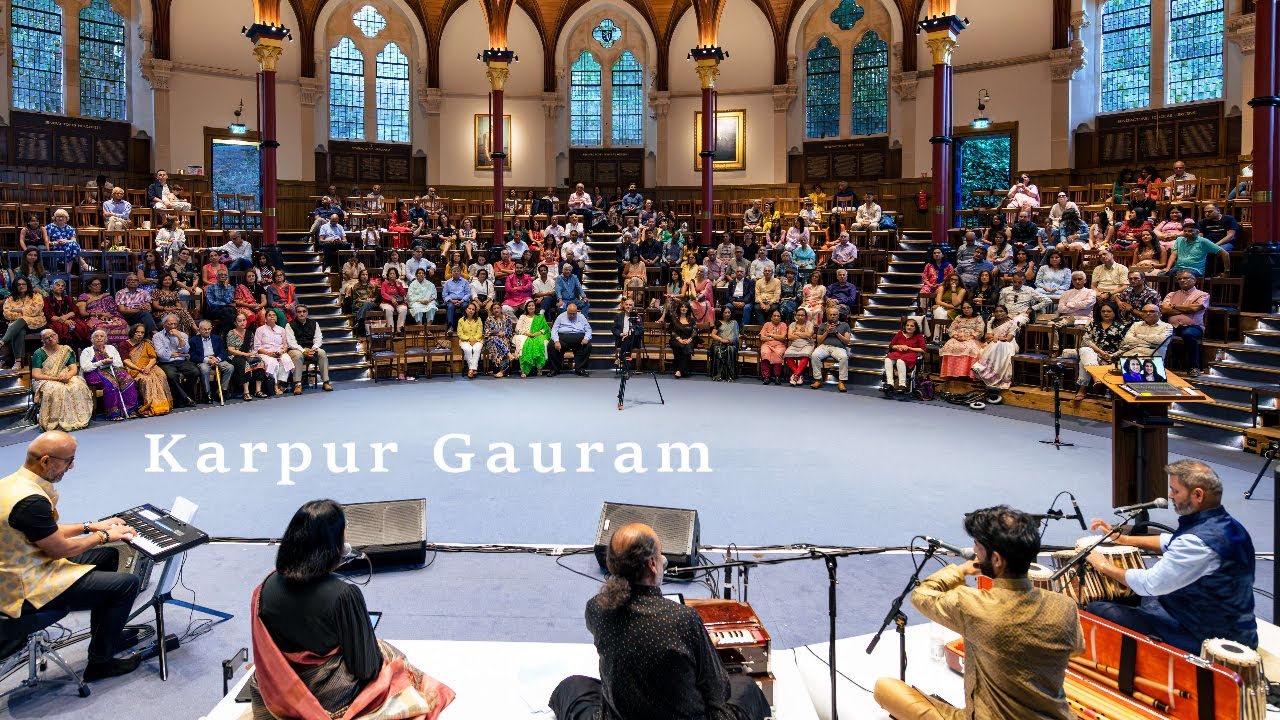
A six-minute live recording of "Karpur Gauram" by Manish Vyas and his band, performed in a London school library. Here is how the verse, its…

1 min read
Shiva Mantras for Morning: Panchakshara in Vedic Chanting
Inspire

Shiva Mantras for Morning: Panchakshara in Vedic Chanting

Manish Vyas's "Vedic Chanting" packs Shiva's names, a Tryambakam verse, and the five-syllable Panchakshara into four minutes. Here is how th…

1 min read
Yoga Nidra for Wholeness: Sankalpa and Body Scan Guide
Inspire

Yoga Nidra for Wholeness: Sankalpa and Body Scan Guide

A 35-minute guided Yoga Nidra rest that moves from breath to sankalpa to a full body scan and back to waking. Here is how its structure work…

1 min read
Om Namah Shivaya Live Kirtan: Call, Response and the Shiva Chant
Inspire

Om Namah Shivaya Live Kirtan: Call, Response and the Shiva Chant

A live kirtan of Om Namah Shivaya, recorded at Medicine Festival 2026 in Reading, moves from slow mantra into ecstatic chant. Here is what t…

1 min read

Continue d’explorer

Poursuis ton chemin

Plus de sagesse et de rassemblements dans tout l’annuaire BrightStar.

Plus d’articles

Parcours toute la bibliothèque d’enseignements, d’entretiens et de guides.

Retour à tous les articles →

Enseignants et artistes

Découvre les lignées, les musiciens et les guides du monde conscient.

Explorer les artistes →

Trouver un événement

Kirtan, retraites, bains sonores, breathwork, festivals — bientôt près de chez toi.

Parcourir les événements →