

Priyesh Dhoolab
Kirtan Artist
À propos
Priyesh Dhoolab is a musician, kirtan leader and devotional artist whose work centres on sacred music, mantra and kirtan. He describes his music as "Ancient Mantras. Modern Hearts." Its aim is to awaken the heart and connect people across the world.
Priyesh Dhoolab is a musician, kirtan leader and devotional artist whose work centres on sacred music, mantra and kirtan. He describes his music as "Ancient Mantras. Modern Hearts." Its aim is to awaken the heart and connect people across the world.
He came to music from a highly competitive sporting environment, where performance decided opportunity and the pressure was constant. Insight Timer describes him as born and raised in England, and says he moved from playing professional sport to a spiritual path. On his own website he says he was not searching for another achievement but for peace.
That changed in 2013 at a spiritual retreat in Wembley, London. He describes a wave of devotion rising from the crowd, and the chanting seeming to take over, so that the fear and pressure dissolved. Back home he recorded Kali Durge, intending only to share it with a few friends and family. The recording reached people he had never met, and messages arrived from listeners around the world. He felt called to keep letting the work flow through him.
His mission is to help others find the same peace that changed his own life. He does this through kirtan, mantra and devotional music, and by creating spaces where people can step away from the noise of everyday life. His channel carries the line "I am a medium through which God sings and creates music," and he dedicates it to his Guru and to God.
His recordings include Hanuman Chalisa, Lingashtakam, Ram Mantra, Hare Krishna Maha Mantra, Rudrashtakam and Aum Meditation. His music has reached listeners in more than 100 countries. He teaches on Insight Timer, which says he has travelled to Mauritius, India, England, Switzerland and North America, where he now lives.


FAQ
Questions
Priyesh Dhoolab is a kirtan leader, devotional musician and meditation teacher whose work centres on sacred music, mantra and kirtan. He describes his music with the line 'Ancient Mantras. Modern Hearts.' and says its aim is to awaken the heart and connect listeners across the world. He came to music from a highly competitive sporting environment where performance decided opportunity, and he has said he was looking for peace rather than another achievement. The turning point was a 2013 spiritual retreat in Wembley, London, where he describes a wave of devotion rising from the crowd and fear dissolving into the chanting. Listeners tend to care because the account is consistent across his website, his Insight Timer teaching and his YouTube channel. The catalogue is concrete, with recordings such as Hanuman Chalisa, Gayatri Mantra and Lingashtakam, and the former-athlete background helps explain the plain, disciplined approach of the releases.
His work sits within the Indian devotional tradition of bhakti, though the profile data does not name a lineage teacher beyond a Guru he dedicates his channel to. The repertoire points to several currents. Hanuman, Ram, Krishna and Radha titles draw on Vaishnava devotion, Lingashtakam and Rudrashtakam (listed in his bio) belong to Shaiva praise, and Kali Durge and Jai Bhawani are invocations of the Goddess. Waheguru Meditation draws on Sikh practice, and Om Mani Padme Hum is a Tibetan Buddhist mantra. That crossing of traditions is less common among kirtan artists, who usually work within one lineage. Treat this as a reading of the titles rather than a stated school, since his own emphasis is on devotion to a Guru and to God. Readers wanting more on the Guru and the sources behind the repertoire should look for a future long-form piece on his lineage.
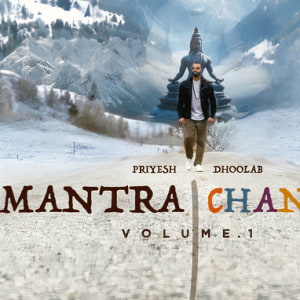
A newcomer should start with the album before the singles, since Mantra Chanting, Vol.1 (released March 2024 with six tracks) is the only full album in the catalogue and gives the most continuous listen. From there, compare the two versions of Hanuman Chalisa, the 2021 original and the 2026 Fast Version, to hear how tempo changes the devotional feel of the same text. Gayatri Mantra (2026) and Lingashtakam (2025) are short, focused entry points into Sanskrit chanting. Ram Mantra (Peace Version) suits anyone who wants the most settled pieces first. The fastest way to understand the mission is to listen to Kali Durge, the recording made after the 2013 Wembley retreat that reached listeners he had never met. Newcomers who want to chant along should begin with one familiar text and return to it across several releases.
The most visible difference is the catalogue's shape. Most kirtan artists build around one tradition or a single long album, while Priyesh Dhoolab's discography has 20 entries, 19 of them singles, with nine releases in June 2026 alone. The repertoire also crosses Hindu, Sikh and Tibetan Buddhist mantras, which is unusual for a single artist. The origin story is distinctive as well, since he came from a competitive sporting world where performance was the measure of worth. His mission language is direct: he frames the work as helping others find the peace that changed his own life, not as performance or entertainment. The bio claims listeners in more than 100 countries, and the emphasis on one-track releases makes each text easy to return to. Readers comparing artists should weigh the single-release pattern against those who prefer a sequenced album.
This work is not for listeners who want high-tempo electronic music, sound-led production or English lyrics that build a narrative. The tracks rest on repeated Sanskrit and Hindi names and mantras, so repetition is the point, and it can feel static to anyone expecting development across a song. Listeners who approach kirtan as entertainment rather than practice may find long, open-ended chanting slow. Because the bio frames the music as devotional, people uncomfortable with theistic language around Hanuman, Shiva, Krishna, Waheguru or God will be working against the grain of nearly every release. Students of Indian classical music looking for raga construction or instrumental development will find the approach far simpler. Those who want a written philosophy from the teacher will also be disappointed, since the teaching is mostly the chanting itself.
The most direct channel is the official website at priyeshdhoolab.com, which is the artist's own statement of mission and the place most likely to carry travel news. For new releases, follow the Spotify artist page, where the 2026 singles have appeared in bursts, and the Apple Music artist page on the Canadian storefront. The YouTube channel at @priyeshdhoolab carries the recordings and is the simplest place to see new uploads. His teaching is published on Insight Timer, so check there for sessions. No upcoming events were crawled for this profile, so confirm dates directly before planning travel. Release cadence has been irregular, with a quiet spring and a dense June 2026, so follow the artist page rather than relying on a schedule.
The music is built on chanted mantra and kirtan, meaning sung repetition of divine names and sacred texts, and the release titles make the form plain: Hanuman Chalisa, Gayatri Mantra, Lingashtakam, Aum Meditation. The voice carries Sanskrit and Hindi texts, and the releases are short, single-focus pieces, each listed as one track. Pacing varies by piece. The Fast Version of Hanuman Chalisa shows that the same text is recorded at more than one tempo, while Ram Mantra (Peace Version) and the Waheguru and Aum meditation titles point to slower, settling pieces. The profile data does not specify instrumentation, so I won't name specific instruments. The aim is clear from the work itself: the music is for chanting along and sitting with, not for dramatic arrangement or climax.
The catalogue has one full album, Mantra Chanting, Vol.1, released March 22, 2024, with six tracks, so it is the natural first listen for anyone who wants a sequence rather than isolated singles. Everything else is single releases, and several recordings anchor the catalogue. The two Hanuman Chalisa recordings, from 2021 and 2026, show the same text in different tempos. Lingashtakam and Kali Durge, both released in June 2025, cover Shaiva and Devi devotion respectively. Kali Durge carries the most personal weight, as it is the recording made after the 2013 Wembley retreat that reached listeners he had never met. Newcomers should not expect a canonical album list, since in this catalogue the single is the working form.
The profile data does not name collaborators, producers, session musicians or instruments, so no specific partner or instrument can be confirmed here. Every release is listed under the artist's own name, and no record label is documented for any of them. The performance context is clear: he leads kirtan, a form that typically involves call-and-response singing with a group, so the recorded voice is closer to a leader's line than to a band arrangement. Listeners who want instrument credits should check the release information on Spotify or Apple Music, which this profile does not capture. Be cautious of any profile that names specific collaborators without a source. Treat the absence of credits as a gap in the record rather than evidence of a particular sound.
Several recordings fit meditation, and the titles are the clearest guide. Aum Meditation and Waheguru Meditation are labelled for sitting practice, and Ram Mantra (Peace Version) is named for stillness. For group or ceremonial settings, Hanuman Chalisa is the most widely recognised devotional text in the catalogue, available in the standard and Fast versions. Gayatri Mantra is a traditional recitation in Hindu practice, often associated with dawn and dusk, which makes it a fit for morning or evening ceremony. Bajrang Baan and Hanuman Jaap suit devotional recitation, and Om Mani Padme Hum suits practitioners with a Buddhist meditation background. The data does not describe yoga sequencing or pairings, so choose by the mantra you already practise.


C’est vous ? Revendiquer cette page ›
There's more where this came from.
BrightStar is the global directory of artists, teachers, and healers in the wellness and spiritual movement. Find your next experience — or add yourself.
Discover More Artists
Browse 14,000+ curated profiles across kirtan, yoga, meditation, and beyond.
Explore directory →Find an Event Near You
Kirtan, retreats, sound baths, breathwork, ceremonies — happening this week.
Browse events →Add Your Profile
Are you an artist, teacher, or healer? Get listed — free, AI-assisted, live in minutes.
Get started →