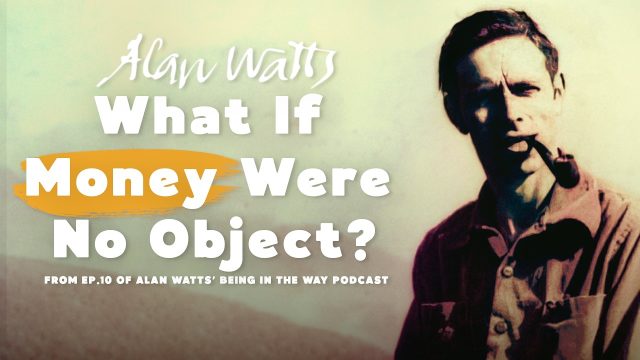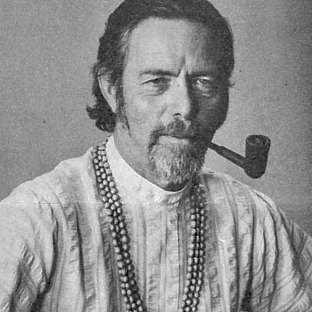
In this talk, Alan Watts unpacks the paradox at the heart of existence: that the universe involves two seemingly opposed perspectives—one focused on structure and definition, the other on what he calls the formless "goo" underlying all form. He argues that fixating exclusively on practical, structural knowledge is like memorizing every word of a song without ever hearing the music. Watts distinguishes between scientific and spiritual perspectives, showing that both are necessary but incomplete, and concludes that the universe itself cannot be adequately captured or explained through words alone. True understanding requires recognizing structure and formlessness as inseparable aspects of a single cosmic process.
Watts identifies a fundamental split in how humans approach understanding the world. One school privileges structure—the discrete, definable, measurable aspects of existence. This is the domain of science, logic, and practical knowledge. The other school, which Watts describes with deliberate imprecision as those who focus on what he calls "goo," is concerned with the formless, the indefinable, the background from which all structure emerges. These aren't merely different disciplines; they represent two irreducible ways of apprehending reality. The structure-focused perspective seeks clarity through definition and categorization. The formlessness-focused perspective recognizes that behind every defined thing lies something that cannot be pinned down by language or conceptual thought.
Most of modern culture, Watts suggests, has become heavily skewed toward the structure-first approach. We have been trained to value what can be measured, quantified, and communicated in words. Schools teach us to focus on definitions and categories. Science has given us unprecedented power through this method. Yet in privileging structure, we've largely abandoned the other perspective—the one that recognizes the primacy of the undefined, the flowing, the alive.
Watts uses a striking metaphor to illustrate the trap of structural fixation: knowing every word to a song is not the same as hearing the music. This distinction cuts to the heart of his argument. A person could memorize the lyrics, understand the grammar, analyze the poetic devices, and still utterly miss what makes the song alive. The music—the rhythm, the tone, the feeling, the flow—cannot be fully captured in a written description or analysis. You must hear it. You must experience it directly.
In the same way, Watts argues, we can know all the structural facts about the universe—all the definitions of atoms, energy, matter, and the laws that govern them—and still miss what the universe is. We can catalog the words but remain deaf to the song. This is especially dangerous when we mistake the map for the territory, when we believe that having a complete set of definitions and categories constitutes genuine understanding. Practicality, he suggests, often locks us into this very trap. We become so focused on what works, what gets results, that we forget to ask whether we're actually experiencing reality or merely manipulating its structural elements.
Watts draws a clear distinction between the scientific perspective and the spiritual perspective, though he doesn't present them as opposed so much as complementary and incomplete. Science is essentially a method for describing and predicting the behavior of structure. It asks: "What are the patterns? What are the relationships between defined things? How can we use these patterns to create reliable outcomes?" This approach has been extraordinarily successful and has given us medicine, engineering, technology, and a vastly increased ability to navigate the material world.
The spiritual perspective, by contrast, is concerned with direct experience of what lies beneath and within all structure. Rather than asking "How can I describe and predict this?", the spiritual approach asks "What is my immediate, unmediated relationship to existence itself?" It is interested in the ground of being, the undefinable source from which all forms arise. Science tends toward the particular and measurable; spirituality tends toward the whole and the ineffable.
The problem, Watts indicates, arises when either perspective claims totality. A purely scientific worldview, treating the universe as a collection of measurable structures with no reference to the formless ground, becomes spiritually sterile and existentially hollow. A purely mystical or spiritual perspective that ignores structure and dismisses the value of logical thought and empirical investigation becomes untethered from reality. Both are ways of knowing, but neither is complete by itself.
This is perhaps Watts' central insight: structure and formlessness are not two different things competing for dominance. They are two inseparable aspects of the same cosmic process. Every defined thing—every atom, every creature, every star—exists in relationship to the undefined whole. Form emerges from formlessness, and formlessness interpenetrates all form. You cannot have one without the other.
Consider a wave. You might analyze the wave in purely structural terms: measure its height, frequency, and velocity. But a wave is inseparable from the ocean. It is not a thing separate from the water; it is the water in motion. Similarly, the universe is not a collection of separate structures floating in an empty void. Everything—matter, energy, space, time—is an expression of a fundamental, formless creative process. The universe is simultaneously structured and formless, just as the ocean is simultaneously wave-like and undifferentiated.
This means that genuine understanding cannot come from studying structure alone or pursuing formlessness alone. Both matter. Both are necessary. The mistake is treating them as opposed or valuing one at the complete expense of the other. A life that is purely practical and structural—focused only on getting results, maintaining control, acquiring and defending possessions—misses the music. A spiritual life that is purely abstract and detached from the embodied, relational, structured world is incomplete.
Watts' central assertion is radical: the universe cannot be adequately explained through words alone. This isn't a limitation we should hope to overcome through better language or more sophisticated theories. It's a fundamental characteristic of reality itself. Words are tools designed to structure, categorize, and communicate about discrete things. But the universe itself—the totality of existence, the fundamental nature of being—is not a discrete thing. It is the ground from which all discrete things emerge.
Words necessarily divide reality into subject and object, self and world, thing and not-thing. But at the deepest level, these divisions break down. The universe is not an object that can be fully known by a subject standing outside it, describing it in words. We are part of the universe; the universe is not separate from us. Language inherently creates a distance between the knower and the known, but that distance doesn't ultimately exist. It's a useful fiction for practical purposes, but it's not the ultimate truth.
This is why Watts says the only answer that would really please him to the question "What is it?" wouldn't be in words at all. Words can point, suggest, evoke, and clarify. They can remove certain misunderstandings. But they cannot capture the living, breathing, undefinable reality of existence itself. You must know it directly, through immediate experience, through what we might call presence or awareness or being-ness. That knowing is fundamentally different from knowing about something through information.
Watts warns against a cultural obsession with practicality and results. When we fixate exclusively on what works—on getting things done, on measurable outcomes, on the bottom line—we gradually train ourselves to ignore entire dimensions of reality. We become like people who have learned to read music but have never actually heard music played. We understand the notation but miss the sound.
This has real consequences. A person living a purely practical, structural life—always thinking about the next goal, the next achievement, the next acquisition—never actually lives. They're always preparing for life rather than inhabiting it. They miss the beauty of ordinary moments because they're focused on getting to the next moment. They miss the aliveness of the present because they're locked in strategic thinking about the future.
Moreover, a civilization that privileges only the structural and practical perspective tends to treat the natural world as merely material to be exploited. It loses a sense of reverence, of participation, of being part of a living whole. This contributes to ecological destruction and spiritual impoverishment. We need to recover the capacity to experience the universe not just as a collection of things to be manipulated but as a living, creative, formless process in which we participate.
This talk invites a radical reorientation of how we approach knowledge and experience. Rather than dismissing either the scientific/structural perspective or the spiritual/formless perspective, we might cultivate what Watts calls a both-and vision. Learn the structures, use the practical knowledge, understand the systems. But also develop the capacity to step back from constant strategic thinking and simply be—to experience directly, without the mediation of words and concepts, what it's like to be alive in this universe.
In daily life, this might mean sometimes setting aside the question "How can I make this work?" and asking instead "What is this, just as it is?" It might mean periods of sitting quietly without trying to accomplish anything, allowing the formless ground of being to come into awareness. It might mean noticing, when reading or discussing ideas, whether you're truly understanding or merely collecting words. Above all, it's an invitation to recognize that the deepest questions about existence cannot be answered through information alone. They require a shift in how we relate to existence itself—a move from subject trying to know object to a kind of knowing that is participation in the living universe.