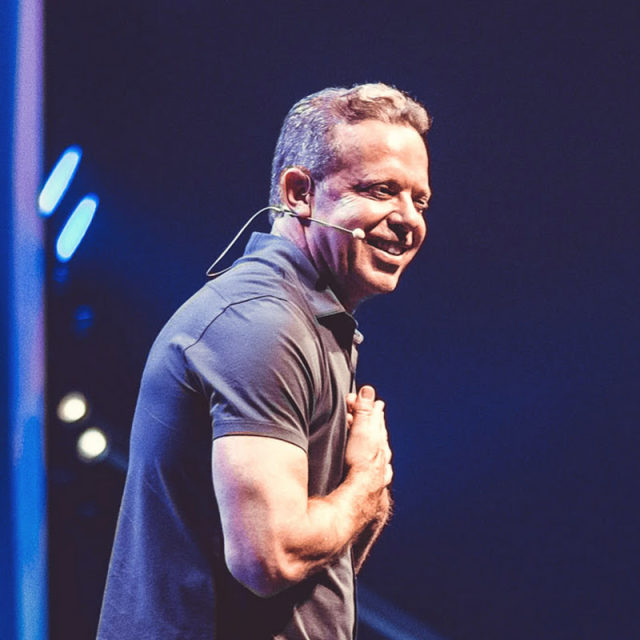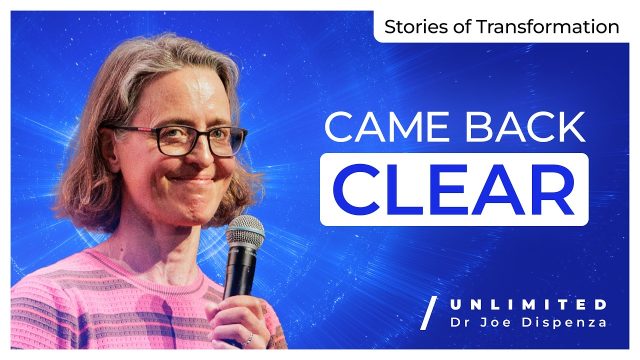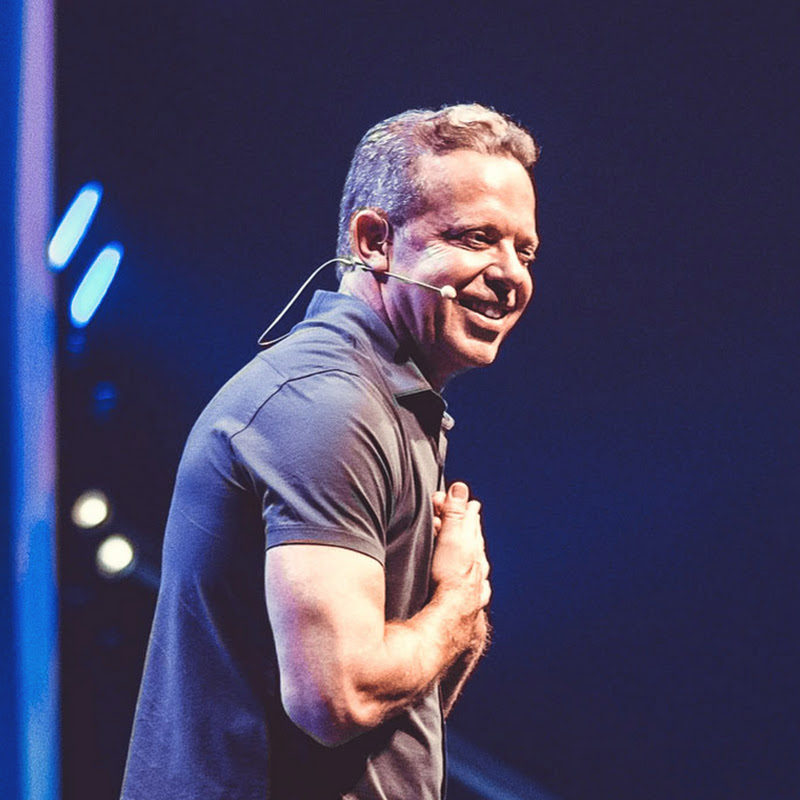
Jim began his testimonial at the Denver Advanced Follow Up Retreat in July 2026 with a belief he had carried for years: that a person who was healing had to be out of the wheelchair. He was in the wheelchair when he spoke, and he said so plainly. What he offered in its place was a different definition of the word healed. "I am healed," he said. "I am healing in action." The short video, posted to Dr. Joe Dispenza's channel, traces Jim's path from a multiple sclerosis diagnosis in 1998 through a divorce, years of self-medication, and a first event in Cancún in 2019, to seven years of meditation that have changed what he measures and how he holds his past. Dispenza's work, as his channel describes it, sits at the intersection of neuroscience, epigenetics, and quantum physics, with a focus on spontaneous remissions. Jim's account is not a scientific argument. It is a lived one, and its core claim is specific: progress does not have to be physical to be real, and the emotional charge on an old memory can change.
The answer starts with a timeline. Jim was diagnosed with multiple sclerosis in 1998, and in his words he went through "a lot of different pharmaceuticals, every medical thing that I could try." Stress was, by his account, "a really big problem," but for a long time he functioned. He worked, he lived his life, and he raised two daughters. Then in 2016 he went through a divorce, and "that really amplified things." His mobility narrowed in stages: from walking behind a walker, to a scooter, to a wheelchair he now uses full time.
That sequence shaped what he thought progress looked like. The most visible marker of recovery, to him, was a return to walking. When he opened his testimonial with "I thought that in order to do a testimonial like I'm doing right now, I needed to be out of this wheelchair" (0:00), he was describing a rule he had internalized, not a rule the work had given him. The rest of the talk is largely about how that rule came apart.
Jim found Dr. Joe's work in 2019, and he says he "immediately clicked with everything." His first meditations had a specific purpose. "It was really to get me out of my body," he explained, "to regulate my nervous system, which was so dysregulated." He did not recognize the dysregulation at the time. He had grown used to the stress and trauma he carried from childhood, and for years he had tried to manage it with alcohol and other substances. Underneath that was a belief he describes directly: that he "wasn't worthy," and that he lacked "a foundation for who I was."
"Finding Dr. Joe's work really gave me a platform to believe in me."
— Jim, testimonial at the Denver Advanced Follow Up Retreat, July 2026 (1:29)
What Jim describes here is a shift in where he stood, not an immediate physical change. Meditation gave him somewhere to start from, a kind of footing, before he had any idea what he was building on top of it.
Jim's first Dr. Joe event was in Cancún in 2019, and the trip was loaded in ways he is candid about. It was the first time he had traveled alone, the first time he had traveled in a wheelchair, and he was newly divorced. He went, he says, "but I wasn't alone because I had so many stories rambling through my head." At night he could not sleep. He had nightmares. He assumed this was normal. "It wasn't normal," he says now. "Obviously it was familiar."
It was also in Cancún that he set the terms he would later have to abandon. "I thought the healing for me was that it's time for me to walk," he says, and then, bluntly: "I wasn't ready. I wasn't ready at all." (2:06) The line is worth sitting with. Jim was not wrong to want to walk. What he was not yet able to see was that his readiness was a separate question from his mobility, and that the work might ask for a different kind of change first.
Over the seven years since, Jim says he has been able to "stop measuring myself so much," and that his anxiety has decreased as a result. The shift he describes is less about feeling better and more about his relationship to the question of progress itself. Measuring, in this account, was a form of control, and it was part of what kept him in the familiar pattern.
He is also direct about the role of blame. "In 2019 I was a victim," he says, "and I've learned that victims don't heal." In 2026, he says, he is "not pointing the finger at anybody else. I know that it's all me." He names resentment and anger as things that "were not serving me," and he admits, "I was trying to control things. I was trying to measure it. I thought I knew the work, but I wasn't connected to my heart yet." Opening his heart, he says, has been "very crucial" for his family relationships, because he needs to open his heart "in order to heal" (3:04).
That sentence reads as a kind of correction. Jim is not describing a technique he mastered. He is describing a gap between knowing the work intellectually and being connected to it emotionally, and the closing of that gap as the real movement of the seven years.
Jim was born in Lakewood, Colorado, and the retreat was held in Denver, close to the place where many of his memories are rooted. He says he had not been back in twelve years, "because of all the memories that were charged." During this recent visit he spent four days with family and friends, and he describes it as "love filled." He arrived with a motto, "love, laughter, and hugs," and an explanation for why it mattered: "I'm done carrying the old stuff." He described the weight in concrete terms, "a backpack filled with rocks," which he says had been pulling him down "for years and years."
The idea that carries the most weight in Jim's testimony is one he attributes to Dr. Joe:
"When you take the emotional charge out of a memory, it becomes wisdom."
— Dr. Joe Dispenza, as quoted by Jim in his testimonial (3:46)
Jim admits he did not understand it when he first heard it, because he was "so emotionally charged about everything." Now he says the wisdom is what carries him. The implication is that the memory itself does not have to disappear. What changes is the grip it holds on the body and the nervous system. The same events that once triggered panic, avoidance, or resentment can be held as information, and that difference is what he means when he talks about his transformation.
Jim does not claim that the MS has gone. "The MS is still there," he says plainly. "I can move my hand like this." What he describes instead is a change in his relationship to his body during movement. In a walking meditation the group did that day, called the Electric Body, he says: "I moved all over the place. I wasn't thinking about my body."
He ties this to the early goal of the practice. "By doing the meditations with Dr. Joe, I found my ground, I found my balance, and I was able to get the mind out of the body and let my body start healing." The sequence is telling. The ground and balance came first; the healing was something his body could begin once his mind stopped managing it. Jim frames this as the most significant change he has experienced, and he compares where he was in 2016 with where he is now.
Jim closes with an honest caveat and a commitment. "It's not just a linear path," he says. "It takes work to get where you want to go, and I'm going to keep on going. I have more to do, and I'm doing the healing right now, and I am healing in action." His message to others is simple: "love, love, love and keep going, keep going, keep going."
What makes his testimony useful beyond the retreat room is that he does not pretend the trajectory was clean. He lost time to a belief that his worth depended on walking. He spent years trying to regulate himself with substances. He reached a point where he could sit in the room where his memories were charged and find love there. None of it erases the diagnosis. It changes the terms on which he measures his life.
If you are living with a chronic condition and have found yourself waiting for a physical marker before you allow yourself to call your life well, Jim's story is a prompt to examine that measure. A few questions drawn from his account are worth carrying:
- What am I using as the single proof that I am healing, and what would I notice if I stopped measuring for a while?
- Which memories still carry a charge strong enough to keep me from places or people I care about?
- Where am I still telling myself a story of victimhood, and what would change if I stopped waiting for others to act first?
- What could I do with my body today that I would not have expected to be possible a few years ago?
To hear Jim's full account in his own voice, watch the original video, and browse the other videos recommended alongside it on Dr. Joe Dispenza's channel. The most honest next step may simply be the one he describes: keep going, and keep noticing where you are healing in action.