Yoga is not about how deep you go into a pose—it's about how present you are in your body. The fourth day of Sri Sri School of Yoga's 14-day free online yoga challenge centers on one of the most overlooked and misunderstood aspects of practice: asana alignment. While beginners often chase the visual accomplishment of a posture, seasoned practitioners know that true progress lives in the micro-adjustments, the subtle corrections that transform a shape into a living, breathing expression of your body's unique architecture.
The ancient yogic texts describe asana as a state of ease and stability—not as an achievement or Instagram-worthy shape. When alignment is compromised, you're not deepening practice; you're accumulating patterns of tension and imbalance that compound over time. The body will compensate for misalignment, drawing other muscle groups into unnatural work. What feels like progress becomes a slow erosion of joint integrity.
Proper alignment does several things simultaneously. It distributes effort evenly throughout the body rather than concentrating strain in vulnerable joints. It activates the stabilizing muscles rather than allowing larger, more dominant muscles to hijack the work. Most importantly, it creates the conditions for safe, sustainable deepening—the kind that unfolds over years and decades, not weeks.
The challenge with asana correction is that your body is not a neutral observer. What feels "right" is often what feels familiar, not necessarily what is structurally sound. This is where the practice of honest self-observation becomes crucial. Film yourself in poses, or better yet, work with a teacher who can spot the patterns you cannot see from inside your own skin.
Some universal principles apply across body types and experience levels. Your joints should stack vertically when possible—wrists under shoulders, shoulders under hips, hips under ankles. Your spine should maintain its natural curves rather than flatten or hyperextend. Your breath should remain full and unforced; if you're holding your breath, you've gone too far. These are not aesthetic criteria—they are biomechanical truths.
In forward bends, most practitioners collapse from the hips and round the lower spine, compressing discs and straining ligaments. The correction: hinge from the hip crease, maintaining a neutral spine until hamstring tightness naturally brings you to your edge. Keep your sit bones rooted and active throughout.
In backbends, the tendency is to dump the arch into the lower back, creating excessive compression in the lumbar spine. The antidote is to distribute the bend evenly through all twelve thoracic and five lumbar vertebrae. Engage your core, broaden your collarbones, and imagine lengthening your spine even as you curve it backward.
In standing poses, the lower body often bears misalignment that the upper body tries to compensate for. Turn your front thigh inward in Warrior I. Keep your back heel grounded. Press all four corners of your feet into the earth. These foundational adjustments ripple upward, creating stability that allows your upper body to relax into proper positioning rather than bracing against instability.
Blocks, straps, bolsters, and blankets are not crutches for inflexible bodies—they are tools for understanding alignment. A block under your hand in a triangle pose allows your spine to stay long and straight rather than side-bending to reach the floor. A strap around your feet in a seated forward bend lets you maintain a neutral spine while gradually releasing hamstring tightness. Props give your body permission to be honest about where it actually is, rather than forcing it into an approximation of a shape.
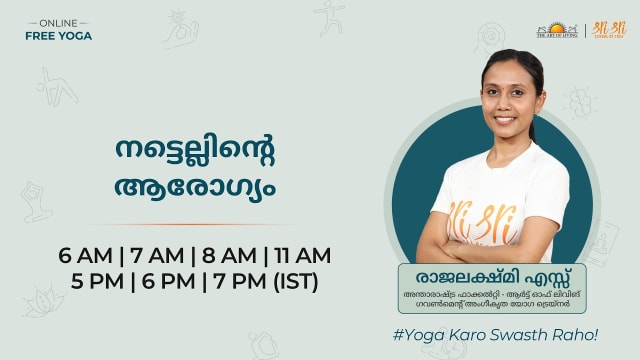
The 45-minute classes offered throughout the Sri Sri challenge at multiple times daily (6 AM, 7 AM, 8 AM, 11 AM, 5 PM, 6 PM, and 7 PM) are structured to meet participants at different levels. Begin by choosing a consistent time and attending regularly. Consistency matters more than intensity. Your body will gradually adapt, stabilize, and reveal itself more fully with each session.
As you practice, resist the urge to deepen poses based on ego or comparison. Your alignment is a conversation between your nervous system and your structural reality—it's unique to you. What looks like "advanced" in someone else's body might be recklessness in yours. What looks "beginner" in you might represent genuine integration and understanding.
When alignment is sound, the body stops demanding attention. There's no sharp pain to manage, no compensation pattern to monitor, no whisper of doubt about whether you're doing it "right." The body becomes transparent. The breath deepens naturally. The mind settles. This is when asana becomes what the texts promise: a stable seat from which consciousness can unfold freely. The posture itself becomes a meditation.
Sri Sri School of Yoga's approach, guided by the traditions of classical yoga science, emphasizes this integration. Physical practice is never divorced from breath work and meditation—they are three pillars supporting one another. As you correct your alignment during the asana portion of the challenge, you're simultaneously training the nervous system to settle, preparing the ground for pranayama and meditation work that deepens awareness and builds resilience to life's inevitable stresses.
If Day 4 of the 14-day challenge resonates with you, consider building a longer-term relationship with alignment-based practice. The free challenge runs through November 29, 2026, offering classes at multiple times daily to accommodate different schedules. After the challenge concludes, the Sri Sri School of Yoga app (available on iOS and Android) and website offer ongoing programs rooted in classical yogic science. The goal isn't to perfect your poses—it's to let your body become an instrument of your own deepening awareness and health.