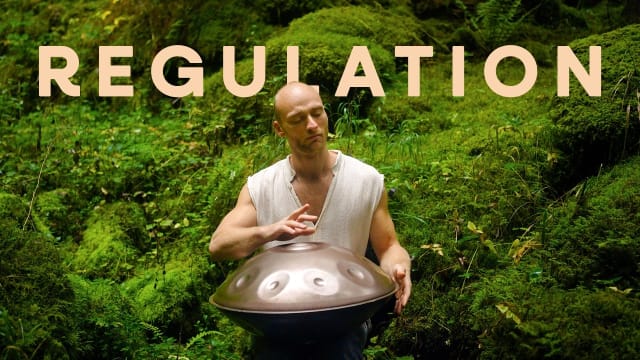
When the day crowds your mind, sometimes the answer isn't a breakthrough—it's a single note, held long enough to dissolve everything else. Malte Marten walks into the woods with his handpan and does exactly that. At first, his thoughts still cling to whatever he left behind. But then a melody emerges, and he finds himself so absorbed in a handful of notes that hours collapse into the space between breath and sound. "I love that feeling," he says. Calming Moment (1111 Hz) is an invitation to experience it too: two hours of handpan music recorded in a natural setting, stripped down to the essential practice of listening.
The piece opens with a simple instruction: find a position where your body feels supported, let your breath move at its own pace, and pick out one note. Listen to it as long as you can hear it. That's not guidance from a meditation teacher—it's the musician's own method. Marten describes what happens next with precision: when your mind returns to the preoccupations of the day, you don't resist or judge. You simply come back to whichever note you can hear. That anchor—the presence of sound itself—becomes the tool. The handpan's acoustic properties help here; a single strike continues to evolve and fade, giving the ear something to follow in its diminishment, much like watching a candle flame.
This is not a technique borrowed wholesale from Eastern philosophy or modern wellness culture, though it shares DNA with both. It's closer to what musicians themselves do: Marten listens to the sound that's there and lets it be enough for a breath or two. When a thought intrudes, he returns. The practice has no ambition to "fix" you or deliver enlightenment. It simply offers what it offers: the chance to be present with sound long enough for the nervous system to settle.
The title references 1111 Hz, a frequency that sits in the upper midrange of human hearing. While popular wellness discourse assigns mystical properties to specific frequencies, the handpan's appeal here is more straightforward: the instrument naturally produces rich harmonic content across a range of frequencies. The 1111 Hz tuning reinforces the clarity and presence of the notes, making them easier to isolate and track—essential for the single-note listening practice Marten proposes. The frequency becomes practical rather than symbolic; it supports the listening itself.
The handpan is played on a F# Nordlys YataoPan, a specific instrument with its own voice and character. This detail matters. The handpan is a relatively young instrument—the most recognizable modern version developed in the early 2000s—and it carries an unusual relationship to sound. Unlike a piano or guitar, where you can play multiple voices independently, the handpan favors singular melodic exploration. Strike one note, and the instrument invites you to listen to that strike's full decay. Play two notes in quick succession, and they begin to interact, their overtones creating interference patterns the ear can track. This acoustic reality shapes the meditation practice itself.
The forest setting is essential too. An indoor recording would be dry and immediate; the natural environment adds space, the subtle presence of wind and distance. The handpan's sound moves through air, not a controlled studio environment. Listeners hear the instrument as Marten experienced it—not as a perfect artifact, but as a living event in a particular place.
Two hours is a significant duration. Short meditation music has its place, but length changes the neurological experience. A twenty-minute session can feel like an accomplishment; you've "done something." Two hours asks something different: it invites you to stop counting minutes and let time become texture. The handpan's continuous presence—not the same loop but the same few notes explored across variations and silences—creates what Marten describes: you might stay for a few breaths or leave it playing as you go about your day. The practice adapts to you, not the reverse.
For some listeners, the extended duration will become meditative. For others, it will serve as ambient background—calming without demanding attention. This flexibility is intentional. Marten doesn't ask you to sit in silence or follow a guided voice. He offers sound as company and lets you decide the relationship.
If the listening practice resonates, Marten offers deeper engagement through his method training. The Handpan Fundamentals course at maltemartenmethod.com extends this approach into active playing—learning to hear and produce these single-note meditations yourself. His mailing list unlocks exclusive learning videos and a secret album, deepening the relationship with both the instrument and the practice. For those drawn to the live experience, his performance schedule at maltemarten.com shows dates where you can sit with him and the handpan in person.
The core insight, though, requires nothing but listening: when your mind wanders, come back to the note that's there. That's not a technique to master. It's a permission to rest.