Transcript
[0:00] Good morning everyone.
[0:04] Happy Sunday.
[0:08] So wonderful to see all your faces
[0:12] continuing to spontaneous spontaneously
[0:16] arise on the screen.
[0:18] Give it a minute.
[0:22] So on this Sunday morning, I am going to
[0:26] start with probably some disappointment
[0:28] for many of you if not all of you.
[0:30] Lamasuri Doas was to lead us this
[0:33] morning and unfortunately he had
[0:36] something come up and is not able to.
[0:40] So, uh, you're here with me.
[0:43] I was reminded of
[0:46] a trunka quote
[0:49] that maybe is one of the pathiest
[0:52] instructions.
[0:53] Um, so I'm paraphrasing here because I
[0:55] didn't get a chance to look it up, but
[0:57] his quote is, "Expectation
[1:01] is premeditated suffering."
[1:04] So I thought that might be apppropo of
[1:08] today as we all hoped to see our dear
[1:11] llama here and natural to feel
[1:13] disappointment. So I I won't take that
[1:15] personally although I do encourage you
[1:17] to stay with us and uh sit together. The
[1:20] people are still streaming in so I'm
[1:22] going to give it one more moment but as
[1:25] we're waiting
[1:27] you can begin. No reason to wait.
[1:51] So for those of you just joining us,
[1:54] Lama Das wasn't able to make it this
[1:57] morning.
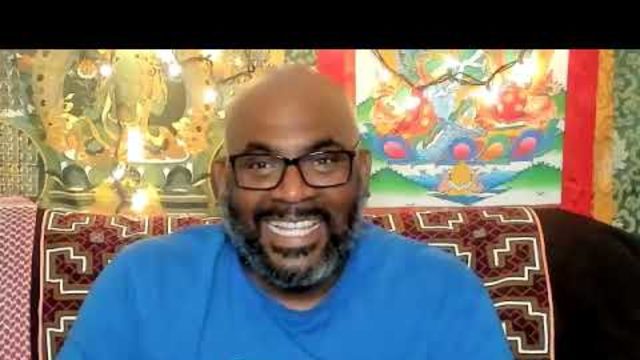
[1:58] So you have me, Kelly Amade. I've seen
[2:02] most of your faces before. I will have
[2:06] the honor of leading our leading our
[2:09] sitting today. So thank you for your
[2:11] presence. And let's begin.
[2:47] Allow the sound of the singing bowl to
[2:51] enter you into this space.
[2:56] And we're bowing
[2:58] to our Buddha nature. We're bowing to
[3:02] the Buddha nature that's in all of us.
[3:09] And let's begin with the four
[3:12] immeasurable aspirations.
[3:15] We always begin with setting our
[3:17] intentions, our aspirations for the
[3:19] benefit of our practice. Not just for
[3:21] ourselves, but for all.
[3:26] May all beings possess happiness and the
[3:29] inner causes of happiness.
[3:32] May all beings be free from suffering
[3:34] and the inner causes of suffering.
[3:37] May all beings remain undivided from the
[3:40] sacred joy which is free from suffering.
[3:44] May all beings come to rest in great
[3:46] peace and equinimity
[3:49] beyond attachment and aversion to
[3:51] friends, enemies or strangers.
[3:56] The four dharmas of Gampopa and Lchempa.
[4:02] Let each word really wash over you.
[4:06] Bless and empower us that our minds and
[4:08] hearts turn toward the dharma, the truth
[4:11] as it is.
[4:13] Bless and empower us that our dharma
[4:15] practice becomes the path.
[4:19] Bless and empower us that the path truly
[4:21] dispels confusion.
[4:25] Bless and empower us that confusion
[4:27] itself dawn as primordial awareness.
[4:53] So I invite you to
[4:56] softly and gently arrive.
[5:10] Starting with our physical bodies.
[5:15] Adjust yourself in your seat.
[5:20] Finding a posture that works for you.
[5:27] One in which you can remain open,
[5:30] relaxed,
[5:32] and alert and aware.
[5:40] allowing your attention
[5:43] to rest on your breath for a moment.
[5:47] Just breathing naturally.
[6:56] So as we sit here feel very fortunate my
[6:58] my family is gathering in Chicago for
[7:01] the celebration of life for my
[7:03] stepfather Jim who passed away in
[7:05] September and uh for a number of circum
[7:09] a num number of reasons. Um I'm in New
[7:11] York and I'm not able to join, but I
[7:14] feel um grateful that I can be here with
[7:17] all of us in this moment as they're
[7:20] celebrating his life and we're
[7:23] celebrating ours. Using this as an
[7:25] opportunity
[7:28] over and over again to come home,
[7:32] to come home to who and what we really
[7:34] are.
[7:40] And we come into this world
[7:43] as these beautiful, perfect newborns,
[7:49] soft, open, available,
[7:53] vulnerable,
[7:57] our Buddha nature fully on display.
[8:02] And looking into the face of an infant,
[8:05] of a newborn baby, there's
[8:08] there's nothing there but pure
[8:11] love, pure essence.
[8:20] It's impossible. It's it's the great
[8:22] unifier. It's impossible for us not to
[8:24] have empathy and care and love for a
[8:27] newborn.
[8:28] And we were all once that newborn.
[8:32] And we come into this world
[8:35] really
[8:37] essentially in each moment.
[8:40] Newborns aren't worrying.
[8:42] They're not regretting their behavior.
[8:47] They're not wishing they had done
[8:49] something differently.
[8:51] They're spontaneously eating meeting
[8:54] each moment
[8:56] fully present. When they're hungry,
[8:58] they're hungry.
[9:00] You know, when they're tired, they're
[9:01] tired. When they need to be held and
[9:03] loved, they need to be held and loved.
[9:08] And if we're lucky,
[9:11] we have those needs met.
[9:14] Some of us aren't so lucky,
[9:17] don't have those needs met.
[9:24] But we're open, available
[9:27] like the sky, like open space, just
[9:30] really a blank
[9:32] pure space.
[9:36] And then our human predicament
[9:39] starts to show itself.
[9:43] Right? Over time with each moment, each
[9:46] experience, we begin to become
[9:48] conditioned
[9:50] slowly
[9:52] and then all at once.
[9:55] Each experience that we have
[9:59] comes to shape who we are.
[10:03] We become a collection of deeply
[10:06] conditioned habits based on our
[10:08] experiences.
[10:10] And as humans, we're wired towards
[10:13] survival. You, if you've been here with
[10:15] me before, you hear me open with this
[10:18] almost every time.
[10:22] And and my intention for that is to sort
[10:24] of remember where we've come from and
[10:26] also as a as a way to create context to
[10:29] remember who we really are. We are not
[10:31] our conditioned experiences.
[10:36] We are wired to crave, to thrive, to
[10:38] analyze, to think, to feel, but all with
[10:42] the aim of surviving.
[10:45] All with the aim of avoiding pain
[10:48] and seeking
[10:51] at best pleasure, but hopefully comfort
[10:55] and safety.
[10:58] And so over time and our act of
[11:00] surviving
[11:02] our conditioning leads us to expect
[11:05] struggle and reward. Struggle and
[11:07] reward.
[11:09] And
[11:11] I'm super curious and have have been for
[11:13] many many years and this is sort of the
[11:15] foundation of the work that I do in
[11:17] relative life. Um but is this work of
[11:20] these cognitive neuroscientists who are
[11:22] working with uh you know Buddhist
[11:25] practitioners
[11:27] and they describe the science
[11:30] of our conditioning which I think is
[11:32] helpful
[11:34] especially for those of us who um are
[11:37] hyper
[11:38] critical of ourselves and think that
[11:41] somehow who we are is our fault. those
[11:45] parts of ourselves that we don't that we
[11:48] wish were different.
[11:51] Um, and the interesting thing for me is
[11:54] that our brain which is really a machine
[11:58] does not experience what one way I'll
[12:01] say this one way to look at our brain is
[12:04] that it doesn't experience the world as
[12:06] it is. There are a lot of scientists out
[12:09] there who who tell us that our brain is
[12:13] a prediction machine
[12:17] and it's constantly gathering prior
[12:20] experiences to interpret information
[12:23] about what's happening now.
[12:28] But it is not our essential nature.
[12:33] It's a machine
[12:35] that helps us navigate this relative
[12:37] world. We we can't be without it.
[12:42] But what happens over time is that while
[12:44] while our history creates our future
[12:47] from a brain science standpoint,
[12:49] it creates expectations
[12:52] and it influences what we notice. It
[12:55] influences how we interpret events.
[13:01] It interprets
[13:03] one event
[13:05] that if all 78 of us were experiencing
[13:08] it would interpret it differently,
[13:11] subtly differently based on our own
[13:13] conditioning.
[13:15] So for example, I grew up in an
[13:18] environment that was very unstable and
[13:22] um hyperritical. I'll put it that way.
[13:27] And so within me, it created this
[13:29] conditioned pattern of defensiveness
[13:32] where my condition pattern became
[13:34] self-reinforcing over time. So how does
[13:37] that happen? Well, somebody tells me,
[13:40] you know, as a child that they, you
[13:44] know, aren't available. So I feel
[13:46] rejected.
[13:48] Somebody
[13:51] criticizes me for something. I get
[13:54] defensive and I anticipate being
[13:56] rejected.
[13:59] And what happens over time is that I
[14:00] begin to expect rejection. I begin to
[14:03] expect abandonment. I begin to expect
[14:06] criticism.
[14:08] Where even the most
[14:10] neutral of experiences, not to mention
[14:13] somebody who actually means well, at a
[14:16] certain time in my life, I could
[14:17] experience that as criticism, as
[14:19] judgment.
[14:22] And so I started to anticipate and scan
[14:24] for safety, right? It's all about
[14:26] scanning for safety. Who's going to
[14:28] stay? Where do I belong? Who, you know,
[14:31] how do I make sure that the way I'm
[14:33] showing up in the world makes people
[14:35] stick around.
[14:38] And so
[14:40] what it ended up creating in me was a
[14:42] lot of interpersonal difficulty.
[14:45] Um, and so I'm I'm sharing this as an
[14:48] example of it's it was not how I came
[14:51] into the world.
[14:53] It was not it's not my true nature. It
[14:55] was a learned behavior.
[14:58] And so you know one of the gifts of this
[15:01] path and many paths but one of the gifts
[15:03] of our Buddhist path or Zoin path is to
[15:07] start to understand how did we become
[15:09] who we became
[15:13] and who are we really?
[15:17] And so in this world where we go about
[15:19] seeking pleasure and safety and avoiding
[15:21] pain,
[15:25] what we experience, what we call our
[15:27] personality,
[15:29] many scientists would say is mostly
[15:31] learned.
[15:35] And then we attach to that. We attach to
[15:37] the parts we like and we reject the
[15:39] parts we don't like.
[15:42] And the gift of this practice is to seek
[15:45] to cultivate awareness,
[15:48] to slow down,
[15:51] to witness ourselves, to witness our
[15:54] minds,
[15:56] and to do that from a curious,
[16:00] open place
[16:02] so that we can begin to recognize
[16:05] our patterns
[16:07] and not to analyze them from from our
[16:10] for for for our sake here. Maybe you
[16:12] might be doing something different with
[16:13] your therapist, but here we're just
[16:15] noticing. Oh, look at that.
[16:19] I got defensive when the person in the
[16:22] grocery store looked at me a certain way
[16:25] and made a whole assumption and they
[16:28] probably weren't even looking at me. You
[16:30] know, it's like this whole internal
[16:31] world creates itself. This narrative
[16:33] creates itself.
[16:35] So, the conditioning begets more
[16:37] conditioning.
[16:39] And so what we have the opportunity to
[16:42] do here is really start to recognize our
[16:44] p our patterns and deidentify
[16:49] deidentify from those thoughts, those
[16:51] emotions, those habitual reactions that
[16:53] we've become attached to, expecting to
[16:57] show up
[16:59] and then begin to decondition.
[17:04] And in that deconditioning,
[17:06] an openness,
[17:09] a softening,
[17:12] uh the ability to see,
[17:15] to recognize who and what we really are,
[17:18] to recognize that pure blue open sky
[17:22] that is stainless, that is our essential
[17:24] nature.
[17:26] And all of these experiences, all of
[17:28] these thoughts, all of these patterns,
[17:31] all of these emotions
[17:35] are just arising within that space,
[17:41] but they're not who we are.
[17:45] And so the practice
[17:48] is to come home to that again and again
[17:50] and again. Again, like if you're like
[17:52] me, you've had a glimpse of that. Maybe
[17:54] it was a momentary glimpse
[17:57] and then you know you sit down to dinner
[17:59] with your family and all of a sudden
[18:01] those patterns come right back and you
[18:04] want you wonder where did my essential
[18:06] nature go? Where did that Buddha nature
[18:08] go? Well, it's still right there.
[18:11] But it takes some work to decondition
[18:14] and to stay open.
[18:19] So, we're going to play with this today.
[18:23] um work with it. This path of our
[18:26] awakening, this this ability to
[18:29] recognize,
[18:31] you know, this great gift we have of
[18:34] being humans that we actually get to
[18:37] intentionally practice, recognize our
[18:40] thoughts, our emotions, our patterns,
[18:43] and awaken one moment at a time. So, in
[18:46] order to do that, we first have to sit.
[18:51] We have to slow down and we have to
[18:54] rest.
[19:02] Many of you may have started studying
[19:04] with Lamasura because of his first book
[19:07] awakening the Buddha within.
[19:12] I mean if that had been his first and
[19:14] only book
[19:16] everything is right there.
[19:19] We are awakening the Buddha within.
[19:23] We are not going outside of ourselves to
[19:26] find a Buddha and put it on.
[19:33] So, I'm going to do my best today to do
[19:35] a gentle guided meditation. We'll have a
[19:39] few short practices with a little bit of
[19:41] guidance.
[19:43] And I invite you if you do nothing else
[19:45] just to rest
[19:47] to see if you can soften a little more.
[19:51] So let's begin again.
[20:05] You're not pushing anything away
[20:11] including any disappointment.
[20:19] So arrive again.
[20:23] Feel your body on your seat.
[20:28] Feel
[20:34] your feet.
[20:40] Feel your sitsbones settling in.
[20:52] Notice your spine rising up to hold you.
[20:58] If you're so lucky to be able to do
[21:00] that,
[21:07] notice your chair or your bed or the
[21:10] floor
[21:13] rising up to hold you.
[21:24] and let it relax into your seat.
[21:30] Allow it to hold you.
[21:44] Notice your breath.
[21:54] Just breathing naturally.
[22:22] Notice anywhere
[22:24] in your body that you're clenching,
[22:28] holding,
[22:32] contracting.
[22:41] Sometimes just putting our attention on
[22:43] that spot softens it even a little
[23:12] Your eyes can be open or closed,
[23:19] but open your posture.
[23:22] Open your heart
[23:26] just a little.
[23:31] Slowing down your breath just a little.
[24:23] Bring your awareness, all of your
[24:26] awareness into your body.
[24:44] Nothing else to do,
[24:47] nothing to fix,
[24:52] nothing to invite in or push away.
[24:56] Just full awareness in your body.
[26:11] And notice any bit of softness or
[26:15] openness
[26:21] anywhere you can find it.
[26:27] and rest your awareness into that open
[26:30] soft space.
[26:33] No matter how small it is,
[26:36] just rest there.
[29:11] allowing your thoughts to come and go.
[29:18] No action necessary.
[29:23] resting in that soft open space.
[29:31] A witness
[31:46] relaxing just a little more.
[38:01] And now let's refresh,
[38:04] stretch,
[38:07] reposition yourself.
[38:11] Our
[38:15] goal is not
[38:18] duration.
[38:26] Any quickies?
[38:28] Says Llama.
[38:31] As you'll notice, as you sit for longer
[38:33] stretches,
[38:35] you can lots of things can happen, but
[38:37] one thing can happen is we can think
[38:40] we're sitting in awareness and resting,
[38:42] but really we're zoning out.
[38:46] And so, lots of short sittings, short
[38:49] interruptions, and coming back really
[38:51] helps habituate the practice to come
[38:54] back again and come back again
[38:57] until eventually we're just there.
[39:00] But I don't know about you, I'm not
[39:01] there all the time. So, I'm still
[39:03] practicing.
[39:06] So, let's refresh. Sit up straight.
[39:11] Just in your jaw,
[39:15] shoulders, anywhere you feel
[39:18] contraction.
[39:26] Letting go of whatever has just
[39:28] happened.
[39:31] No need to remember.
[39:35] Here we are again.
[39:41] Going to take a big deep breath in
[39:43] through your nose and hold.
[39:47] And then on the exhale, we're going to
[39:49] exhale with an ah and empty out.
[39:55] If you want, you can watch me do it
[39:57] first.
[39:58] So,
[40:00] taking a deep breath in
[40:06] holding
[40:10] till you can't hold anymore.
[40:23] A
[40:32] then a natural breath in between.
[40:39] Then again a deep breath in
[40:48] holding
[41:09] really emptying out till no more air can
[41:12] come out. Not worrying about how you
[41:15] sound
[41:18] and a deep breath in between.
[41:24] Releasing all of that stale prana,
[41:26] clearing our channels.
[41:31] And now this time, let's really do it.
[41:34] Exhaling first, emptying yourself out.
[41:40] And a big inhale in
[41:45] filling all the way up.
[41:49] Holding
[41:52] and exhaling.
[42:22] Settling back into the moment.
[42:30] Nothing to remember,
[42:33] nothing to imagine.
[42:36] Just this
[42:40] safe right where you are.
[42:45] Not alone. We're all here with you.
[42:52] Softening and opening and resting just a
[42:55] little more.
[43:35] Open like the sky.
[43:39] Not bothered by the weather.
[45:55] open and empty
[45:57] like a sunlit room.
[46:06] Bringing your awareness again
[46:09] to that soft spot,
[46:17] that glimpse of open space within you.
[46:25] Susing it with your attention, your
[46:27] awareness, your being,
[46:33] and resting there.
[48:33] softening,
[48:34] relaxing.
[48:46] Just a little more.
[50:32] Now softly,
[50:34] gently turning that awareness,
[50:37] that soft spot in on itself.
[50:44] Awareness. Aware of itself.
[53:32] taking refuge in the Buddha,
[53:37] the one who has come before,
[53:41] shown us this path of awakening,
[53:46] introduced us to our true nature.
[53:58] Our true nature of being like the sun.
[54:02] The sun that does not cease to shine
[54:06] even when the clouds arise. Just
[54:09] momentarily obscured.
[54:13] Our true nature momentarily obscured by
[54:17] our thoughts and projections, our
[54:19] experiences.
[54:23] Like the sky that is never harmed by the
[54:26] storms passing through it,
[54:31] our fundamental nature is not created
[54:36] by practice nor destroyed by
[54:39] conditioning.
[54:42] Coming back again and again
[54:46] to remember who we are,
[54:48] who we all are.
[55:17] So, we'll go out
[55:20] singing and praying.
[55:25] You're welcome to join along or to just
[55:30] let the words wash over you.
[55:34] Do the path clearing and wishfulfilling
[55:36] prayer to Padma Simbava.
[55:55] New
[56:02] poe
[56:19] so
[56:21] g up to soul
[56:26] chong
[56:29] way.
[56:49] Precious guide, one with all the Buddhas
[56:52] of the three times.
[56:55] Blissful presence and source of all
[56:57] spiritual accomplishments.
[57:00] Fierce destroyer of illusion who dispels
[57:03] every obstruction. We pray to you for
[57:06] blessing, inspiration, and realization.
[57:10] Please remove all outer, inner, and
[57:12] secret obstacles and spontaneously
[57:15] fulfill our aspirations.
[57:24] We'll do the bodhicittita dedication
[57:28] just in English.
[57:31] May the pure brilliant son of bodhicitta
[57:34] dawn in each and every heart and mind
[57:38] dispelling the darkness of suffering and
[57:40] confusion
[57:42] unstoppably until all are illumined and
[57:46] awakened.
[58:05] Sending all my love to all of you. My
[58:07] gratitude for your presence, for your
[58:11] Buddha nature
[58:14] and to all the teachers who have come
[58:16] before us, to Lamasurya Das and all of
[58:18] his teachers and to any guru god
[58:24] that you're devoted to
[58:29] and sending so much love to you all and
[58:32] we hope to see you here back next week.