BrightStar
BlogMeine Tickets
BlogMeine Tickets
Saved events
Hilfe & KontaktRegistrierenAnmelden
Events
  • Alle Events durchsuchen
  • Yoga
  • Meditation
  • Breathwork
  • Qigong
  • Heilige Musik
  • Weltmusik
  • Medicine Music
  • Klangheilung
  • Ecstatic Dance
  • Zeremonie
  • Pflanzenmedizin
  • Energieheilung
  • Satsang & Weisheit
  • Tantra
  • Retreats
  • Alle Kategorien →
Reiseziele
  • Bali
  • Sedona
  • Los Angeles
  • Costa Rica
  • Tulum
  • Byron Bay
  • San Francisco
  • Austin
  • New York
  • San Diego
  • Denver
  • Seattle
  • Portland
  • Miami
  • London
  • Maui
  • Boulder
  • Alle Städte →
Plattform
  • Für Veranstalter
  • Werde Teil der Bewegung
  • Sell Globally
  • Für Kreative
  • Für Teams
  • Für Autoren
  • Für Lehrer
  • Für Kirtan-Künstler
  • Für Studios
  • Für Festivals
  • Für Retreat-Zentren
  • Für gemeinnützige Organisationen
  • Markenbotschafter
  • Kostenloses Ticketing
  • Pro
  • Amplify
  • Das Ökosystem
Funktionen

Ticketverkauf und Checkout

  • Ticket categories
  • Assigned seating
  • Custom questions
  • Coupon codes
  • Smart pricing
  • Ticket sharing
  • Waitlist
  • Flexible refunds
  • Digital waivers
  • Tip jar
  • Donations and sliding scale
  • Embed widget
  • Mindful checkout
  • Recurring events
  • Private sessions
  • Online courses
  • Summits
  • Rooms and stays
  • Ticket scanner

Marketing und Wachstum

  • Abandoned cart recovery
  • Visitor recovery
  • Upsells and add-ons
  • Affiliate engine
  • Upsell affiliate network
  • Brand ambassador
  • Meta retargeting
  • Verified buyer network
  • Outbound email marketing
  • Email sequences
  • SMS and WhatsApp
  • Event upsell network
  • Direct mail campaigns
  • SEO engine
  • Syndication
  • Event sharing
  • Custom event pages
  • Artist profiles
  • Link in bio
  • Event blog
  • Blog newsletter

Zahlungen

  • Payments, powered by Stripe
  • Buy now, pay later
  • Apple Wallet
  • Multi currency

Daten und Betrieb

  • Team access
  • Message center
  • Reports
  • Analytics reporting
  • Performance reporting
  • Customer data
  • Integrations
  • Switch from another platform

KI

  • Assistant
  • AI FAQ assistant
  • Alle Funktionen →
Unternehmen
  • Über uns
  • Häufige Fragen
  • Kontakt
  • Blog
  • Glossar
  • Guides
  • Inspiration
  • Hilfe-Center
  • API-Dokumentation
  • Marken-Assets
  • Presse
  • Nutzungsbedingungen
  • Datenschutzrichtlinie

Events

  • Alle Events durchsuchen
  • Yoga
  • Meditation
  • Breathwork
  • Qigong
  • Heilige Musik
  • Weltmusik
  • Medicine Music

Reiseziele

  • Bali
  • Sedona
  • Los Angeles
  • Costa Rica
  • Tulum
  • Byron Bay
  • San Francisco
  • Austin

Plattform

  • Für Veranstalter
  • Werde Teil der Bewegung
  • Sell Globally
  • Für Kreative
  • Für Teams
  • Für Autoren
  • Für Lehrer
  • Für Kirtan-Künstler

Funktionen

  • Community-Netzwerk
  • Warenkorbabbruch-Wiederherstellung
  • Ticket-Kategorien
  • Wiederkehrende Veranstaltungen
  • Sitzplatzreservierung
  • Affiliate-System
  • Warteliste / Benachrichtigen
  • Alle Funktionen →

Unternehmen

  • Über uns
  • Häufige Fragen
  • Kontakt
  • Blog
  • Glossar
  • Guides
  • Nutzungsbedingungen
  • Datenschutzrichtlinie
Mehr lesen

Events

  • Klangheilung
  • Ecstatic Dance
  • Zeremonie
  • Pflanzenmedizin
  • Energieheilung
  • Satsang & Weisheit
  • Tantra
  • Retreats
  • Alle Kategorien →

Reiseziele

  • New York
  • San Diego
  • Denver
  • Seattle
  • Portland
  • Miami
  • London
  • Maui
  • Boulder
  • Alle Städte →

Plattform

  • Für Studios
  • Für Festivals
  • Für Retreat-Zentren
  • Für gemeinnützige Organisationen
  • Markenbotschafter
  • Kostenloses Ticketing
  • Pro
  • Amplify
  • Das Ökosystem

Unternehmen

  • Inspiration
  • Hilfe-Center
  • API-Dokumentation
  • Marken-Assets
  • Presse

Ticketverkauf und Checkout

  • Ticket categories
  • Assigned seating
  • Custom questions
  • Coupon codes
  • Smart pricing
  • Ticket sharing
  • Waitlist
  • Flexible refunds
  • Digital waivers
  • Tip jar
  • Donations and sliding scale
  • Embed widget
  • Mindful checkout
  • Recurring events
  • Private sessions
  • Online courses
  • Summits
  • Rooms and stays
  • Ticket scanner

Marketing und Wachstum

  • Abandoned cart recovery
  • Visitor recovery
  • Upsells and add-ons
  • Affiliate engine
  • Upsell affiliate network
  • Brand ambassador
  • Meta retargeting
  • Verified buyer network
  • Outbound email marketing
  • Email sequences
  • SMS and WhatsApp
  • Event upsell network
  • Direct mail campaigns
  • SEO engine
  • Syndication
  • Event sharing
  • Custom event pages
  • Artist profiles
  • Link in bio
  • Event blog
  • Blog newsletter

Zahlungen

  • Payments, powered by Stripe
  • Buy now, pay later
  • Apple Wallet
  • Multi currency

Daten und Betrieb

  • Team access
  • Message center
  • Reports
  • Analytics reporting
  • Performance reporting
  • Customer data
  • Integrations
  • Switch from another platform

KI

  • Assistant
  • AI FAQ assistant
Hol dir die App
Laden imApp StoreJetzt beiGoogle Play
© 2026 BrightStar. Alle Rechte vorbehalten. BrightStar Selection · Bildnachweise · Änderungsprotokoll ·
Inspiration

Guru Brahma Guitar Chord Guide for Beginners

Jai Uttal
Jai Uttal
Oct 3, 2016
4 Min. Lesezeit

Von Jai Uttal

Ansehen · 4
This guitar lesson breaks down the chord structure for Guru Brahma into manageable shapes. The song uses a repeating progression of B minor and D for the intro, shifts to E minor, D major, and G major 7th for the verse, and ends with a slide from G major 7th to B flat major 7th. A capo on the second fret raises the pitch to suit the singer's voice. No exotic voicings required—these are foundational chords accessible to intermediate and advancing players.

Lesen · 7 Abschnitte

What Are the Basic Chords in Guru Brahma?

The song's architecture rests on two distinct sections. The intro cycles through B minor and D major, played repeatedly (approximately four times, though the exact count is flexible). This opening establishes the harmonic foundation and gives players time to settle into the groove before the verse begins.

The verse introduces more harmonic movement. After the intro repeats, the progression shifts: E minor leads to D major, followed by G major 7th, and resolves back to D minor. This sequence repeats twice before the final phrase, which requires a single chord change—sliding the G major 7th shape up three frets to reach B flat major 7th.

How Do You Play the Intro Section?

The intro alternates cleanly between B minor and D major. If you already know these basic chord shapes, you're ready to start. The movement between them is straightforward—no barres or complex finger stretches. The rhythm isn't specified in the lesson, so listen to the recorded version on "Return To Shiva Station" to absorb the timing and feel. Repetition—playing the intro four times—gives your muscle memory and ears a chance to lock into the song's emotional tone.

What Changes in the Verse?

Once past the intro, the verse deepens the harmonic landscape with four chords: E minor, D major, G major 7th, and D minor. The presence of the 7th extension (G major 7th) adds a touch of color beyond simple triads; if you're unfamiliar with this voicing, it's worth looking up in a chord reference or online diagram. The teacher notes it's "not hard"—meaning the shape is learnable without advanced technique. The verse repeats twice, creating space for singing or instrumental soloing before moving to the outro change.

What Is the B Flat Major 7th Change?

The final harmonic moment arrives when you slide the G major 7th shape up three frets. This produces a B flat major 7th chord and marks the outro or ending phrase. Because you're moving the same finger shape (a transpose rather than a new position), the physical movement is simple—lift your hand as a unit and shift it up the neck. This kind of sliding voicing technique is common in folk and devotional guitar and conserves mental energy by reusing familiar shapes.

Should You Use a Capo?

The teacher recorded the version on "Return To Shiva Station" using a capo on the second fret. This raises the pitch and places the song in a range that suits their voice. If you're singing or playing solo, experiment with a capo between the first and third fret to find what feels natural for your vocal range or ensemble. Without a capo, the progression is the same—only the absolute pitch changes, not the relative relationships between chords.

How Does This Fit Into Kirtan and Devotional Music?

Guru Brahma is a Sanskrit mantra or invocation, likely addressing Brahma, the creator in Hindu cosmology. Kirtan—call-and-response devotional singing—relies on guitarists who can hold a harmonic foundation while singers (or a congregation) layer melody and voices on top. These simplified chords provide that foundation without requiring complex jazz voicings or fingerstyle technique. The song's repetitive structure aligns with kirtan's meditative and cyclical nature, where phrases loop to deepen presence and communal resonance.

Where to Go From Here

Start by drilling the intro progression (B minor to D major) until you can switch smoothly without thinking. Then add the verse chords one at a time: E minor, D major, G major 7th, back to D minor. Once the changes feel automatic, listen to the recorded version and match your rhythm and pacing to the original. Experiment with a capo to locate the pitch that suits your voice. If the G major 7th is unfamiliar, spend a few minutes with a chord chart to build the muscle memory. As you internalize the progression, you'll free mental space to focus on the melody, the breath, and the intentionality behind singing a sacred mantra.

]]>
Kommentare

Gespräch wird geladen…

Transcript

[0:01] hey everybody how's it going I wanted to

[0:04] show you the the simplified chords for

[0:07] Guru Brahma uh here they are starts with

[0:11] the B

[0:13] minor and the

[0:15] [Music]

[0:19] D this is the

[0:22] intro so it goes a bunch of times

[0:25] probably four or

[0:29] whatever B

[0:31] minor then to D then for the

[0:36] verse

[0:39] [Music]

[0:45] a so that's E

[0:49] minor D major then G major

[0:55] 7th you might have to look in a book or

[0:57] something to get that but it's not hard

[0:59] and then back to the D Minor so that

[1:01] repeats twice I mean happens

[1:05] [Music]

[1:25] twice then the last one

[1:28] changes my sh

[1:30] Guru so that's the same position it's

[1:33] the G major 7th so slide it up three

[1:36] Frets to the B flat major 7th that's

[1:39] easy Once you got the G major 7 just go

[1:41] [Music]

[1:45] there back to the

[1:49] [Music]

[1:53] beginning

[1:58] urur oh

[2:02] etc etc etc so on the CD return TOA

[2:06] station I use a capo on the second fret

[2:09] so it's uh a little bit higher a little

[2:11] bit nicer for my voice but here it is

[2:13] and I I hope that helps

Der Künstler in dieser Geschichte

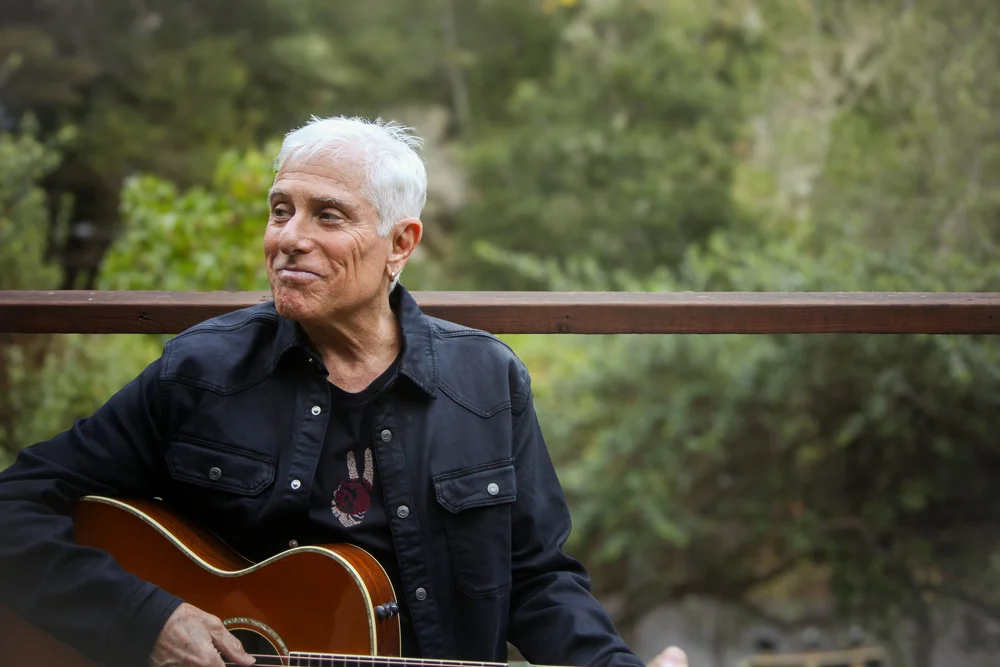
Jai Uttal

Jai Uttal

Kirtan Artist

Grammy-nominated kirtan artist who pioneered the fusion of Indian devotional chanting with Western rock, jazz, and reggae. A disciple of Neem Karoli Baba, he has led kirtan worldwide for nearly five decades.

Profil ansehen
Themen erkunden
Kirtan guitarChord progressionGuitar lessonBhakti musicCapo technique
Häufig gestellte Fragen

Häufig gestellte Fragen

The intro uses B minor and D major, repeated four times. The verse progresses through E minor, D major, G major 7th, and D minor, repeating twice. The outro slides the G major 7th shape up three frets to B flat major 7th.

A capo is optional. The original recording uses a capo on the second fret for a higher pitch suited to the vocalist's range, but you can play without one—the chord shapes remain the same, only the absolute pitch changes.

The exact voicing isn't detailed in the lesson, but G major 7th is a standard chord found in most guitar references or online chord databases. Once learned, you can slide it up three frets to create the B flat major 7th ending.

Guru Brahma is a Sanskrit invocation likely addressing Brahma, the creator deity in Hindu philosophy. In kirtan, it's sung as a devotional chant with call-and-response vocals layered over a repeating harmonic foundation.

The intro repeats approximately four times, though the teacher notes flexibility—the exact count depends on the recording and the ensemble's feel during performance.

Start with the intro (B minor to D major) until you can switch smoothly, then add verse chords one at a time. Listen to the recorded version and match the rhythm, and experiment with capo placement to find your voice's natural range.

Das könnte dir auch gefallen

Alle anzeigen
Where Souls Meet: Shiva, Self-Concept, and Sacred Chanting
Inspire

Where Souls Meet: Shiva, Self-Concept, and Sacred Chanting

Ram Dass explores how devotional chanting transforms ego-based identity into soul awareness, merging with the Divine through bhakti practice…

8 min read
Hanuman Chalisa for World Peace: Ancient Chant for Modern Times
Inspire

Hanuman Chalisa for World Peace: Ancient Chant for Modern Times

Jai Uttal leads a devotional rendering of the Hanuman Chalisa, a 40-verse Sanskrit hymn invoking strength, clarity, and peace through kirtan…

9 min read
Kirtan as Mourning: Grief and Presence in Devotional Practice
Inspire

Kirtan as Mourning: Grief and Presence in Devotional Practice

A live kirtan honoring Shyam Das explores how chanting the Maha Mantra holds both longing and presence—the dual nature of bhakti when rememb…

8 min read
Zâhid Bizi Ta'n Eyleme: 400 Years of Turkish Devotion Reborn
Inspire

Zâhid Bizi Ta'n Eyleme: 400 Years of Turkish Devotion Reborn

Sami Yusuf performs a 16th-century Turkish spiritual masterpiece with a 50-piece ensemble, honoring four centuries of tradition while forgin…

6 min read
AlleDas könnte dir auch gefallen→

Setze deinen Weg fort

Mehr Weisheit und Zusammenkünfte aus dem BrightStar-Verzeichnis.

Mehr Artikel

Durchstöbere die ganze Bibliothek an Lehren, Interviews und Leitfäden.

Zu allen Artikeln →

Lehrer & Künstler

Entdecke die Linien, Musiker und Wegbegleiter der bewussten Welt.

Künstler erkunden →

Event finden

Kirtan, Retreats, Klangbäder, Atemarbeit, Festivals — bald in deiner Nähe.

Events ansehen →