BrightStar

Alle Events durchsuchen

Bewusste Zusammenkünfte entdecken

events

Yoga
Meditation
Breathwork
Qigong
Tai Chi
Sacred Music
World Music
Medicine Music
Sound Healing
Ecstatic Dance
Beliebte Reiseziele
BaliSedonaLos AngelesCosta RicaNew YorkSan FranciscoAustinMiamiJoshua TreeTulum
Alle Kategorien anzeigenAlle Reiseziele anzeigen

Alle Funktionen entdecken

Leistungsstarke Tools für Ihre Veranstaltungen

Plattform-Funktionen

Intelligente dynamische Preisgestaltung
Ticket-Kategorien
Sitzplatzreservierung
Warenkorbabbruch-Wiederherstellung
Besucher-Wiedergewinnung
Spenden & Staffelpreise
Affiliate-System
Ticket-Scanner
Rabattcodes
Individuelle Fragen
Ticket-Teilen
Upsells & Extras
Analysen & Berichte
E-Mail-Sequenzen
Warteliste / Benachrichtigen / Erinnern
Menschen & Orte
Artists & TeachersEvent OrganizersVenues & StudiosKnowledge BaseGlossaryInspiration
Alle Funktionen anzeigenÜber uns
PreiseBlog
Language
Saved events
Alle Veranstaltungen durchsuchen

events

YogaMeditationBreathworkQigongTai ChiSacred MusicWorld MusicMedicine Music

Beliebte Reiseziele

BaliSedonaLos AngelesCosta RicaNew YorkSan Francisco

Menschen & Orte

Artists & TeachersEvent OrganizersVenues & StudiosKnowledge BaseGlossaryInspiration

Plattform-Funktionen

Intelligente dynamische PreisgestaltungTicket-KategorienSitzplatzreservierungWarenkorbabbruch-WiederherstellungBesucher-WiedergewinnungSpenden & StaffelpreiseAffiliate-SystemTicket-ScannerRabattcodesIndividuelle FragenTicket-TeilenUpsells & ExtrasAnalysen & BerichteE-Mail-SequenzenWarteliste / Benachrichtigen / Erinnern
Alle Funktionen anzeigenÜber uns
PreiseBlog
AnmeldenSuchendeKreative
  • Alle Events durchsuchen
  • Für Suchende
  • Yoga
  • Meditation
  • Breathwork
  • Qigong
  • Tai Chi
  • Heilige Musik
  • Weltmusik
  • Medicine Music
  • Klangheilung
  • Ecstatic Dance
  • Retreats
  • Workshops
  • Alle Kategorien →
  • Bali
  • Sedona
  • Los Angeles
  • Costa Rica
  • Tulum
  • Byron Bay
  • San Francisco
  • Austin
  • New York
  • San Diego
  • Denver
  • Seattle
  • Portland
  • Miami
  • Alle Städte →
  • Join the Movement
  • Why we list
  • Sell Globally
  • Für Kreative
  • Für Teams
  • Für Autoren
  • Für Lehrer
  • Für Kirtan-Künstler
  • Für Studios
  • Für Festivals
  • Für Retreat-Zentren
  • Für gemeinnützige Organisationen
  • Markenbotschafter
  • Kostenloses Ticketing
  • Elevate
  • Amplify
  • 500.000+ Käufernetzwerk
  • Warenkorbabbruch-Wiederherstellung
  • Intelligente dynamische Preisgestaltung
  • Ticket-Kategorien
  • Wiederkehrende Veranstaltungen
  • Sitzplatzreservierung
  • Affiliate-System
  • Warteliste / Benachrichtigen
  • Ticket-Scanner
  • Einbettungs-Widget
  • Event-Syndication
  • Nachrichten
  • Integrationen
  • Berichte
  • Alle Funktionen →
  • Über uns
  • Das Ökosystem
  • Blog
  • Glossar
  • Inspiration
  • Hilfe-Center
  • Kontakt
  • API-Dokumentation
  • Marken-Assets
  • Karriere
  • Presse
  • Nutzungsbedingungen
  • Datenschutzrichtlinie

Events

  • Alle Events durchsuchen
  • Für Suchende
  • Yoga
  • Meditation
  • Breathwork
  • Qigong
  • Tai Chi
  • Heilige Musik
  • Weltmusik
  • Medicine Music
  • Klangheilung
  • Ecstatic Dance
  • Retreats
  • Workshops
  • Alle Kategorien →

Reiseziele

  • Bali
  • Sedona
  • Los Angeles
  • Costa Rica
  • Tulum
  • Byron Bay
  • San Francisco
  • Austin
  • New York
  • San Diego
  • Denver
  • Seattle
  • Portland
  • Miami
  • Alle Städte →

Für Kreative

  • Join the Movement
  • Why we list
  • Sell Globally
  • Für Kreative
  • Für Teams
  • Für Autoren
  • Für Lehrer
  • Für Kirtan-Künstler
  • Für Studios
  • Für Festivals
  • Für Retreat-Zentren
  • Für gemeinnützige Organisationen
  • Markenbotschafter
  • Kostenloses Ticketing
  • Elevate
  • Amplify

Funktionen

  • 500.000+ Käufernetzwerk
  • Warenkorbabbruch-Wiederherstellung
  • Intelligente dynamische Preisgestaltung
  • Ticket-Kategorien
  • Wiederkehrende Veranstaltungen
  • Sitzplatzreservierung
  • Affiliate-System
  • Warteliste / Benachrichtigen
  • Ticket-Scanner
  • Einbettungs-Widget
  • Event-Syndication
  • Nachrichten
  • Integrationen
  • Berichte
  • Alle Funktionen →

Unternehmen

  • Über uns
  • Das Ökosystem
  • Blog
  • Glossar
  • Inspiration
  • Hilfe-Center
  • Kontakt
  • API-Dokumentation
  • Marken-Assets
  • Karriere
  • Presse
  • Nutzungsbedingungen
  • Datenschutzrichtlinie
BrightStar
Hol dir die App
Laden imApp StoreJetzt beiGoogle Play
© 2026 BrightStar. Alle Rechte vorbehalten.
Inspiration

Vedic Chanting: The Five Syllables Inside Shiva's Mantra

Manish Vyas
Manish Vyas
Jan 15, 2023
7 Min. Lesezeit
Ansehen · 6

"Vedic Chanting" is a four-minute, thirty-six-second track from Manish Vyas's album ATMA BHAKTI, released on YouTube in January 2023 and now past eleven million views. It is a run of Sanskrit verses addressed to Shiva, chanted in sequence, and its architecture is the story. Most of the text praises Shiva through his names, and a central sequence of five stanzas takes the five syllables of the mantra Namah Shivaya and gives each one its own verse. Understanding that structure turns a pleasant background track into something you can follow line by line, and it explains why the teacher describes the piece as a return to the older sound of mantra practice.

Lesen · 7 Abschnitte

What happens in the first minute of the track?

For roughly the first minute, there are no words at all. The transcript marks this stretch only as music, sangeet, and then a single syllable, Om, surfaces around the 3:30 mark near the end of the piece. The first sung line, "Vande Shambhu Umapatim," does not arrive until 1:02. That silence before the text is worth noticing. The track asks the listener to arrive before they are told what to attend to, which is closer to how a devotional recitation actually opens than to how a pop song does.

The opening stanza is a set of bows. "Vande" means "I bow to" or "I salute," and each clause names a different face of the divine: Shambhu, the auspicious one; Umapati, the lord of Uma; Suraguru, the teacher of the gods; the cause of the world; the one who wears the serpent as an ornament; the one who bears the moon. The verse does not explain Shiva. It lists him, and repetition does the work.

Why does the track move into the death-conquering verses?

The next stanza, beginning "Mrityunjayaya Rudraya Nilakanthaya Shambhave," is built on names that carry protective meaning in Shaiva devotion: Mrityunjaya, the conqueror of death; Rudra; Nilakantha, the blue-throated one; Amriteshaya, the lord of immortality. The verse closes with an address that ties these names to a greeting: "Namaste astu bhagavan," a bow to the blessed Lord.

Shortly after, the track brings in what the text itself calls the Tryambaka verse, beginning "Om tryambakam yajamahe." Its line "urvarukam iva bandhanan mrityor mukshiya mamritat" asks to be freed from bondage to death the way a ripe cucumber, in the image the verse uses, is loosed from its stem. The request is not for an abstract liberation but for release from the grip of mortality. Many listeners who have never studied Sanskrit will recognize the cadence of this stanza, and it is one of the places where the track's emotional center becomes audible.

How do five verses spell Namah Shivaya?

This is the spine of the piece. The mantra Namah Shivaya has five syllables: na, ma, shi, va, ya. The track gives each one a stanza, and each stanza ends with the same refrain pattern: "tasmai [syllable]-karaya namah shivaya," a bow to Shiva who is that syllable. You can hear the refrain return again and again, and once you know to listen for it, the structure becomes the way through the whole middle of the track.

  • Na (around 2:13 in the track's sung text): the verse that opens with "Nagendrahaaraya," the one who wears the king of serpents as a garland, and closes with "tasmai nakaraya namah shivaya."
  • Ma (around 2:25): "Mandakini salila chandana charchitaya," the one anointed with the waters of the Ganga and sandalwood paste, closing on "tasmai makaraya."
  • Shi (around 2:38): "Shivaya Gauri vadanabja," the one who delights in the lotus face of Gauri, closing on "tasmai shikaraya."
  • Va (around 2:55): the verse invoking Vashishtha, Gautama and the sages, closing on "tasmai vakaraya."
  • Ya (around 3:01): "Yajnaswarupaya," the one whose form is sacrifice, closing on "tasmai yakaraya."

The sequence moves in the same order as the mantra itself. The listener is not asked to memorize the stanzas. They repeat the refrain, and the five syllables are heard in succession, each one a separate bow. This is what the track means when it describes itself as connecting the listener "to the original form of mantra practice." The mantra is not a single phrase repeated; it is unfolded, one letter at a time, into a devotional structure that the ear can track.

What is the closing verse claiming?

The track ends with the lines that the text presents as a benefit: "Panchakshara idam punyam yah pathechchhiva sannidhau, shivalokam avapnoti shivena saha modate." The phrase panchakshara, "five-syllable," names the hymn itself. Roughly rendered, the verse says that whoever recites this sacred five-syllable hymn in the presence of Shiva reaches the world of Shiva and rejoices with him. Notice the grammar: the text speaks of reciting in Shiva's presence, which is a devotional posture rather than a technical instruction. The track's closing claim is about intimacy with the divine, not about special effects.

After that verse the track holds on sustained sound and returns to Om several times before fading, around the 4:30 mark. Those final Oms are part of the arc, not decoration. The piece returns to its root syllable.

What does "the raw energy of Shiva" mean for a listener?

Manish Vyas's own description of the track makes a strong claim, and it is worth quoting directly:

"The verses carry the raw energy of Shiva, so just listening attentively can become a powerful uplifting practice, also purifying our vibrations those in our surroundings." (Manish Vyas, YouTube description of "Vedic Chanting")

Two ideas sit inside that sentence. The first is that the verses are themselves carriers of energy, so their sound is not only aesthetic. The second, and the more practical one, is that attentive listening is itself a practice. The teacher does not ask the listener to chant along, to sit in a particular posture, or to hold any belief. The invitation is to listen closely: to follow the refrain, to notice where a stanza turns, to let the repeated syllables do their slow work. Whether one accepts the claim about purifying surrounding vibrations is a matter of personal conviction, and the description presents it as the teacher's view rather than settled fact. What is verifiable is that the track is built so that attentive listening is rewarded.

How should a listener approach the track?

Three approaches fit the material well. Listen once straight through to hear the arc, from silence to the Om at the start, through the bows and death-conquering names, into the five-syllable sequence, and out through the closing verse. On a second listen, follow the refrain "tasmai ___ karaya namah shivaya" and count the five syllables as they arrive. On a third, read the Devanagari text alongside the audio. The automatic transcript of this video renders many words imperfectly, so the printed Sanskrit is the more reliable reference for the exact lines.

There is also a note of honesty worth keeping. The material available for this article contains the track, its text, and the teacher's description. It does not include an account of how the album was made or of the teacher's broader path, so this piece does not trace those origins. What it can do is show how the track is constructed and why that construction makes the mantra easier to hear.

Where to go from here

Listen to "Vedic Chanting" once without reading anything, then a second time with the five-syllable refrain in mind. The track rewards both. If the Shiva names are new to you, start with the opening stanza and look up each epithet; each one opens onto a story of Shiva that the verses assume you know. If you want to go further with the sound itself, the teacher's album ATMA BHAKTI is the context in which this track sits, and the description links to the artist's site for the full recording.
Comments

Loading the conversation…

Transcript

[0:04] [संगीत]

[0:10] [संगीत]

[0:17] [संगीत]

[0:23] [संगीत]

[1:02] ओम वंदे देव उमापतिम सुरगुरुं वंदे

[1:08] जगतकारणं वंदे पन्नग भूषणं मृगधरंम वंदे

[1:13] पशुनामपतिम वंदे सूर्य शशांक वही नयनम

[1:18] वंदे मुकुंद प्रियं वंदे

[1:21] भक्तजनाश्रय चरदम वंदे शिवम शंकरम ओम

[1:27] मृत्युंजयाय रुद्राय नीलकंठाय शंभवे

[1:31] अमृतेशाय सर्वाय महादेवाय ते नमः नमस्ते

[1:36] भगवन विश्वेश्वराय महादेवाय त्र्यंबकाय

[1:41] त्रिपुरांतकाय

[1:43] त्रिकाग्नीकालाय कालाग्नि रुद्राय

[1:46] नीलकंठाय

[1:47] मृत्युंजयाय सर्वेश्वराय सदाशिवाय श्रीमान

[1:51] महादेवाय नमः ओम नमः

[1:55] शंभवायच

[1:57] मयोभवायच नमः

[1:59] शंकरायच मयस्करायच नमः शिवायच शिवधरायच

[2:05] ओम त्र्यंबकम यजामहे सुगंधिम

[2:09] पुष्टिवर्धनं

[2:11] उर्वरुकमेव बंधना

[2:13] मृत्युर्मुक्षीय मामृता नागेंद्र हाराय

[2:17] त्रिलोचनाय तस्मागराय महेश्वराय नित्याय

[2:22] शुद्धाय दिगंबराय

[2:25] तस्मेराय नमः शिवाय मंदाकिनी सलील चंदन

[2:29] चर्चित

[2:31] नंदेश्वर प्रमदनाथ महेश्वराय मंदार पुष्य

[2:35] बहुपुष्य सुपूजिताय

[2:38] तस्मेराय नमः शिवाय शिवाय गौरी

[2:42] वदनावृंद सूर्याय

[2:45] रक्षानाशकाय श्री नीलकंठाय वृषध्वजाय

[2:49] तस्मै शिकाराय नमः शिवाय वशिष्ठ कुंभोत्

[2:55] गौतमायंद्र देवार्चित शेखराय चंद्रा

[2:59] विश्वान लोचना

[3:01] तस्मेराय नमः शिवाय यज्ञ स्वरूपाय जटाधराय

[3:06] विना हस्ताय सनातनाय दिव्याय देवाय

[3:11] दिगंबराय

[3:13] तस्मेयकाराय नमः शिवाय

[3:17] पंचाक्षर पठे शिव सन्निधो

[3:20] शिवलोक शिवे सहमोदते

[3:24] [संगीत]

[3:30] ओम

[3:32] [संगीत]

[3:42] [संगीत]

[4:05] [संगीत]

[4:22] ओम

[4:30] ओम

Manish Vyas
ArtistManish Vyas

Gujarat-born musician, composer, singer and multi-instrumentalist who devotes his work to sacred Indian music, mantra, kirtan and the intrinsic power of sound known as naad yoga.

Profil ansehenWebsite
Themen erkunden
Vedic-chantingNamah-shivayaShiva-mantraPanchakshara-stotraSanskrit-chanting

Hast du Fragen?

Häufig gestellte Fragen

The track is a sequence of Sanskrit verses addressed to Shiva, opening with bows to Shambhu and Umapati and moving through death-conquering names and the Tryambaka verse. Its central section gives each syllable of Namah Shivaya its own stanza. The text ends with a closing verse about reciting the five-syllable hymn in Shiva's presence.
The mantra Namah Shivaya has five syllables, na, ma, shi, va and ya, and the track assigns each one a verse. Each verse ends with the refrain 'tasmai [syllable]-karaya namah shivaya,' so listeners hear the mantra unfolded one letter at a time. The order follows the mantra exactly.
In his YouTube description, Vyas says the verses carry the raw energy of Shiva and that attentive listening can become an uplifting practice. He also says it purifies the vibrations of those nearby. These are his stated views about the track rather than established facts.
The track is built for attentive listening, and the teacher describes it as a practice in itself. Listeners can follow the repeated refrain and count the five syllables as they arrive. No posture, chanting, or belief is required to engage with it.
The closing verse, beginning 'Panchakshara idam punyam,' says that whoever recites this sacred five-syllable hymn in Shiva's presence reaches Shiva's world and rejoices with him. It frames the practice as devotional intimacy with the divine. The phrase panchakshara names the hymn itself.
The automatic transcript of this video renders many Sanskrit words imperfectly, with some syllables run together or misspelled. Reading the printed Devanagari text alongside the audio gives a more accurate picture of the lines. The track's structure is still audible even when the captions are unreliable.

Weiterlesen

More from Manish

Alle anzeigen
Karpur Gauram in London: Inside a Live Shiva Chant
Inspire

Karpur Gauram in London: Inside a Live Shiva Chant

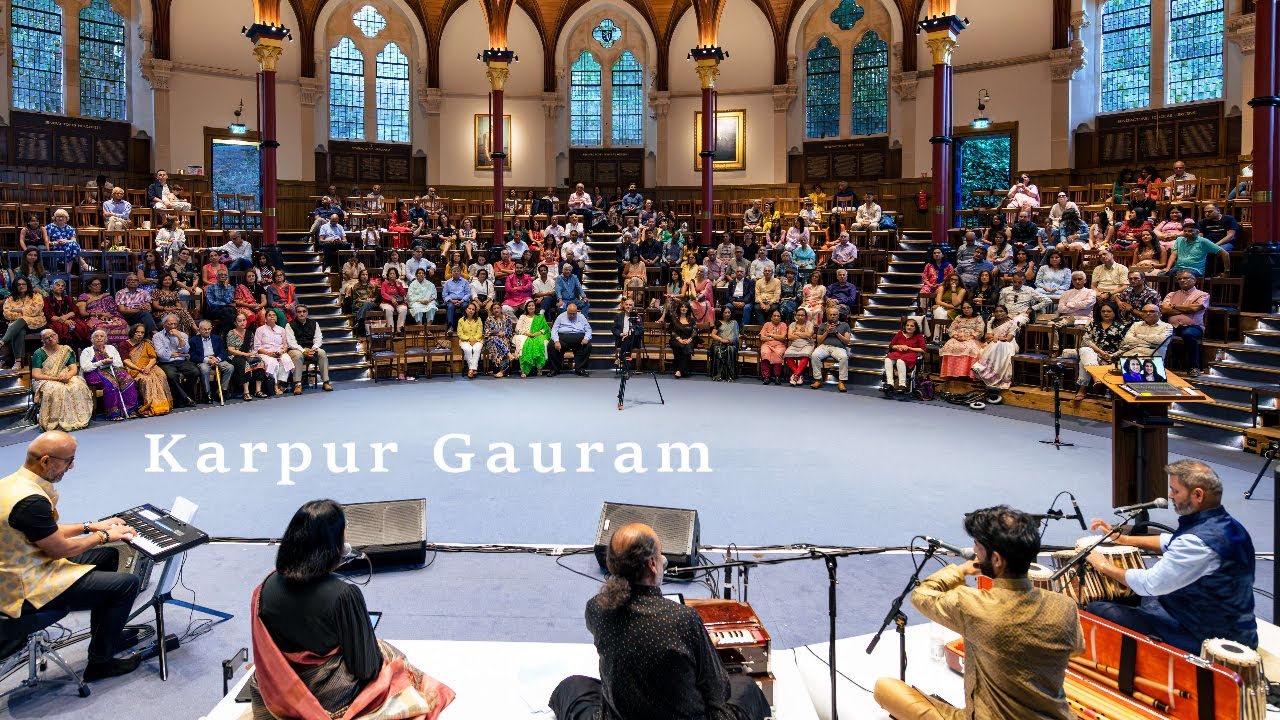
A six-minute live recording of "Karpur Gauram" by Manish Vyas and his band, performed in a London school library. Here is how the verse, its…

1 min read
Mahamrityunjaya Mantra: Structure, Meaning and Chant
Inspire

Mahamrityunjaya Mantra: Structure, Meaning and Chant

Manish Vyas's Mahamrityunjaya chant weaves the Tryambakam verse with Beeja seed syllables. Here is how the recording is built and what its w…

1 min read
Om Namah Shivaya Live Kirtan: Call, Response and the Shiva Chant
Inspire

Om Namah Shivaya Live Kirtan: Call, Response and the Shiva Chant

A live kirtan of Om Namah Shivaya, recorded at Medicine Festival 2026 in Reading, moves from slow mantra into ecstatic chant. Here is what t…

1 min read
Chanting as Home Base: Faith, Thought, and the Restless Mind
Inspire

Chanting as Home Base: Faith, Thought, and the Restless Mind

Krishna Das explains why chanting steadies a restless mind, how faith grows from lived experience, and what "vote" we really have over the t…

1 min read

Weiter erkunden

Setze deinen Weg fort

Mehr Weisheit und Zusammenkünfte aus dem BrightStar-Verzeichnis.

Mehr Artikel

Durchstöbere die ganze Bibliothek an Lehren, Interviews und Leitfäden.

Zu allen Artikeln →

Lehrer & Künstler

Entdecke die Linien, Musiker und Wegbegleiter der bewussten Welt.

Künstler erkunden →

Event finden

Kirtan, Retreats, Klangbäder, Atemarbeit, Festivals — bald in deiner Nähe.

Events ansehen →