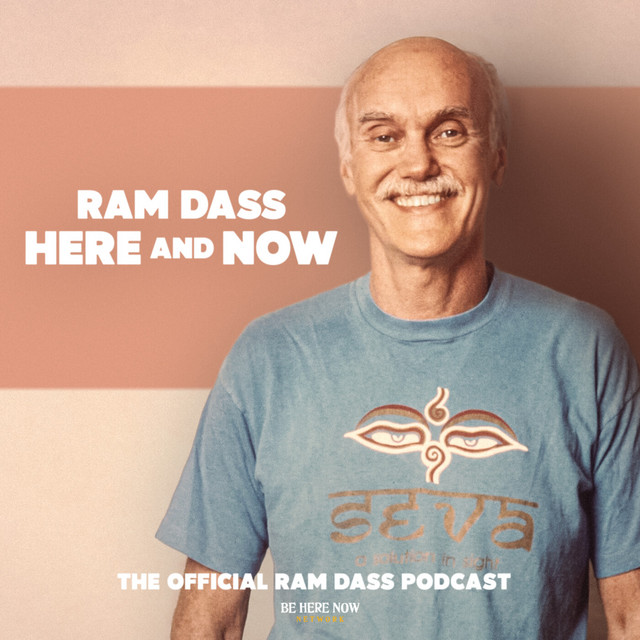
In this 1978 recording from the Lama Foundation, Ram Dass reads stories from the forthcoming Miracle of Love manuscript, sharing accounts of his guru Maharaj-ji's extraordinary miracles—from healing a dead bird to manifesting food through inner spiritual thirst. Rather than treating miracles as violations of natural law, these narratives invite listeners to suspend analytical skepticism and witness how a realized being touches the deepest places of love within people through acts that transcend ordinary human capacity. The stories reveal Maharaj-ji's unique relationship with each devotee and illustrate how divine grace operates within human connection.
Ram Dass begins this talk by sharing one of his own early experiences with Maharaj-ji—a story that so overwhelmed his analytical mind that it became a turning point in his spiritual unfolding. A dead bird came back to life through Maharaj-ji's presence or touch, an event that Ram Dass initially struggled to reconcile with his Western scientific training. Rather than dismissing the experience as hallucination or coincidence, Ram Dass invites his audience to "set aside your analytical mind" and simply receive these stories as expressions of love operating at a level beyond rational explanation.
The miracles Ram Dass describes are not presented as displays of supernatural power designed to impress or coerce belief. Instead, they emerge from Maharaj-ji's direct contact with the deepest longing within each person—what might be called the soul's hunger or the heart's deepest prayer. Maharaj-ji adapted his response to each individual, meeting them precisely where they needed to be met. This suggests that miracles in the spiritual context are less about defying physics and more about the intersection of realized consciousness with individual karma and readiness.
A central theme running through the stories Ram Dass shares is that Maharaj-ji dealt with each person in a fashion specifically tailored to that individual's spiritual condition and emotional needs. Rather than performing the same miracles for everyone, he appeared to have direct access to what each person most needed to experience—whether healing, liberation, love, or awakening.
The collection of stories from Maharaj-ji's oldest devotees reveals a pattern: he seemed to know the secret wounds, unspoken prayers, and hidden depths within people. Some devotees experienced miracles around food and nourishment, others received healing, still others encountered his presence at moments of desperate need. The variety of these accounts suggests that the miraculous wasn't a fixed phenomenon but rather a responsive expression of consciousness meeting the exact contours of a person's being.
This approach to spiritual relationship challenges the Western model of the guru as either a dispenser of teachings or a performer of wonders. Instead, Maharaj-ji emerges as someone whose presence itself created the conditions for transformation—not through coercion or magical manipulation, but through touching "the deepest love within people," as Ram Dass describes it.
Ram Dass focuses a significant portion of this talk on Maharaj-ji's relationship with food and eating, sharing stories and teachings that reveal a subtle understanding of human hunger. One of Maharaj-ji's key sayings, quoted directly in this recording, states: "We have an inner thirst for food. We don't know of it. Even if you don't feel you could eat, your soul has a thirst for food."
This teaching operates on multiple levels simultaneously. On the literal level, it acknowledges that the body and soul have needs that may not correspond to surface-level appetite or preference. Someone might believe they cannot or should not eat, yet their deeper being hungers for nourishment. On a metaphorical level, it points to the soul's hunger for spiritual food, for experiences of love, grace, and connection that sustain consciousness beyond the merely physical.
The miracles around food that Ram Dass recounts—whether sudden multiplication of provisions, unexpected nourishment appearing at critical moments, or the restoration of appetite and capacity to receive—all point to this teaching. They suggest that Maharaj-ji's interventions were designed to restore people's capacity to receive, to hunger, and to be nourished both materially and spiritually. The miracle becomes a way of saying: "Your hunger is legitimate, your body is worthy of care, your soul's thirst is real."
During this talk, Ram Dass briefly turns to Ramana Maharshi, another great Indian saint, before returning to Maharaj-ji stories. This contextual shift suggests that the miraculous dimension of enlightened beings is not unique to Maharaj-ji but rather a characteristic feature of the spiritual landscape in India, where such occurrences are treated with a different cultural normalcy than they might be in the West.
Ram Dass notes that living in India exposes one to a culture where "all of these events are sort of like everyday occurrences." In villages throughout the mountains, he observes, "every family has dozens of these stories." This cultural context is crucial to understanding how to receive these narratives. In India, the miraculous is woven into the fabric of ordinary life in a way that Western rationalism has largely excluded from collective experience.
Rather than reading this as India being more spiritually advanced or more "magical," it might be understood as a culture that has maintained categories of experience—the miraculous, the mysterious, the ineffable—as legitimate alongside the material and verifiable. Ramana Maharshi, like Maharaj-ji, operated in this context, where his extraordinary presence and the miracles surrounding him were not anomalies to be explained away but expressions of a reality many accepted as possible.
A recurring element in Ram Dass's framing throughout this talk is his explicit invitation to listeners to "set aside your analytical mind." This is not anti-intellectual but rather a recognition that certain dimensions of experience cannot be verified or understood through the analytical faculties alone. The analytical mind excels at breaking things into components, measuring, comparing, and testing—but it falters when confronted with phenomena that are singular, unrepeatable, or dependent on conditions (like the presence of a realized being) that cannot be controlled in a laboratory setting.
Ram Dass's own journey illustrates this struggle. He arrived at Maharaj-ji as Richard Alpert, a Harvard psychologist trained in the Western empirical tradition. The dead bird coming back to life—something his mind could not fit into established categories—became a threshold experience. Rather than resolving the cognitive dissonance by explaining it away, he allowed the mystery to crack open his more rigid understanding of reality.
By inviting his 1978 audience (and now, contemporary listeners) to set aside the analytical mind, Ram Dass is not asking for credulity but for a different mode of knowing—one that permits wonder, allows for the possibility of grace, and remains open to experiences that exceed the categories the rational mind has constructed. This is not irrational; it is trans-rational, moving beyond rather than against reason.
Throughout these stories, love emerges as both the medium and the content of the miracles. Ram Dass repeatedly emphasizes that Maharaj-ji touched "the deepest love within people." The miracles are not demonstrations of power separate from love; they are love expressing itself in material and spiritual forms.
When Maharaj-ji manifested food, when he healed, when he appeared at the moment someone needed him most, when he spoke words that cut through illusion—these were all expressions of the same love that connects all beings. The miracle is the bridge between the finite human heart and the infinite compassion of a being who has fully opened to that compassion.
This understanding shifts the meaning of "miracle" away from the supernatural and toward the possible—what happens when consciousness is no longer contracted by fear, ignorance, or separation. A realized being operates from love so complete that what appears impossible from the perspective of limitation becomes natural from the perspective of unity. The miracle, in this light, is simply what love does when nothing blocks its expression.
For those drawn to these stories, the next step might be to examine your own relationship with the possibility of grace and miracles in your life. Have you experienced moments where something impossible seemed to happen, where love manifested in unexpected ways, or where synchronicities suggested a dimension of reality beyond the mechanical? Rather than dismissing these, Ram Dass's teaching invites you to receive them as evidence of a different order of causality operating alongside the material world.
You might explore the full text of Miracle of Love, the manuscript Ram Dass was reading from when this recording was made. Published about a year after this 1978 talk, it contains a comprehensive collection of stories from Maharaj-ji's devotees, each offering a different lens on how divine grace operates through human relationship.
Consider also your own hunger—both literal and spiritual. What does your soul thirst for that you have not fully admitted to yourself? Where are you blocking yourself from receiving nourishment, whether material or spiritual? Maharaj-ji's teaching about inner hunger invites honest inquiry into what we deny ourselves and why, and what would shift if we allowed ourselves to truly receive.
Finally, reflect on what it means to set aside the analytical mind without abandoning intelligence. How might your relationship to spirituality, to others, and to life itself shift if you permitted mystery alongside understanding, and wonder alongside knowledge?