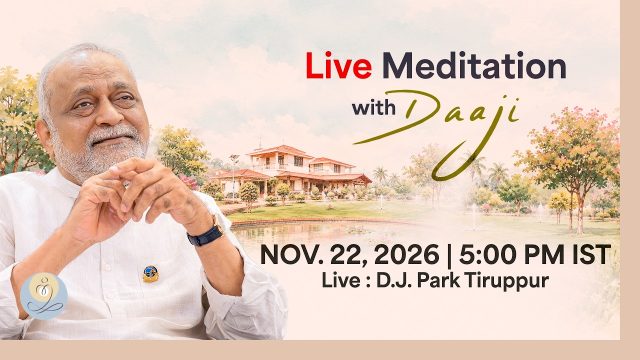
On November 21, 2026, thousands gathered—some in person at D.J. Park in Tiruppur, others through livestream—to sit in silence with Daaji, the head of the Heartfulness movement. For over eighty minutes, the meditation unfolded in real time: the settling of breath, the quieting of mind, the felt sense of presence that meditation practitioners have sought for centuries. What made this session distinct was not technique alone, but the lineage it carried—and the precision with which it was offered to a global audience hungry for genuine practice.
Heartfulness is a contemporary meditation approach rooted in a living tradition of Heart-based practices. Rather than focusing on the intellect or elaborate visualization, Heartfulness centers awareness in the heart itself—the seat of feeling, intention, and what practitioners call the "real Self." The practice is secular enough for skeptics, profound enough for seasoned contemplatives, and structured in a way that suits modern life.
The movement emerged from the Sahaj Marg tradition, a lineage of meditation that stretches back generations. Daaji, formally known as Kamlesh D. Patel, inherited and evolved this legacy, bringing it into contemporary contexts without diluting its depth. His books—The Heartfulness Way, Designing Destiny, Power of Paradox, and Spiritual Anatomy—map the terrain of this inner work, grounding abstract spiritual concepts in practical anatomy and psychology.
A live group meditation led by an experienced teacher creates a field unlike solitary practice. The collective intention, the synchronized breath and presence of hundreds or thousands, amplifies what practitioners call the "subtle transmission"—an energetic resonance that deepens individual experience. Daaji's meditations are structured to guide participants through stages: first settling the body and breath, then directing awareness inward to the heart center, then resting in silence while the guide holds the space.
The November 21 session at D.J. Park was no exception. Tiruppur, a city in Tamil Nadu with a thriving Heartfulness community, became the focal point for a practice that rippled across time zones and continents. The telecast format meant that someone in New York or London could sit with the same guidance at the same moment, creating what Heartfulness practitioners describe as a unified field of awareness.
In an age of overthinking, the Heartfulness emphasis on the heart—rather than breath counting or mantra repetition—addresses a specific human need. Modern life floods us with information, stimulation, and cognitive demand. The heart, by contrast, operates by feeling, intuition, and direct knowing. When meditation centers there, it invites a different intelligence to emerge: one less concerned with solving problems and more attuned to sensing what matters, what aligns, what calls us forward.
This is not mysticism divorced from neuroscience. Contemporary research on heart-brain coherence, vagal tone, and the enteric nervous system validates what contemplatives have long known: the heart is not merely a pump but a sophisticated sensory organ with its own intelligence. Daaji's work bridges ancient wisdom and modern science, making the heart accessible as a meditation object without requiring belief in any particular cosmology.
A live meditation session differs fundamentally from an app-based practice or solo sitting. The teacher—in this case, Daaji—functions as both guide and anchor. Through subtle cues, timing, and the quality of presence they embody, an experienced teacher can modulate the depth and character of collective experience. They offer structure for those new to practice while creating spaciousness for veterans to go deeper.
Daaji's approach emphasizes accessibility. Heartfulness offers free meditation sessions through their platform, recognizing that genuine practice should not be gatekept by cost. The November 21 live event was itself free to join via livestream—a democratization of what was once reserved for in-person seekers or initiated disciples.
A single meditation, however profound, plants a seed rather than establishing harvest. For those moved by a live session like this, the question becomes: how do I carry this forward? Heartfulness addresses this through several pathways. The Heartfulness App offers guided meditations, training modules, and a framework for daily practice. The organization also arranges free individual sessions with trained volunteers—a human touch in an otherwise digital age.
Daaji's books provide the philosophy and psychology beneath the practice. Spiritual Anatomy maps the energy centers and their relation to psychological development. Designing Destiny explores how meditation reshapes not just inner experience but choices, relationships, and life direction. Power of Paradox grapples with the seeming contradictions that arise on the spiritual path—how surrender and will coexist, how emptiness and fullness are the same, how the most direct path often winds.
While meditation is ultimately a solitary act—the work of your own consciousness—it unfolds within community. Heartfulness maintains Kanha Shanti Vanam, a meditation center near Hyderabad, India, where residential and visiting practitioners deepen their work in intensive retreats. Regional groups and centers worldwide provide ongoing support, group practice, and connection with others on the same path.
The November 21 event from Tiruppur exemplifies this network: a local gathering amplified through technology, rooted in a specific place yet accessible globally. This model honors both the intimacy of live practice and the reach of digital community.
In the Heartfulness understanding, meditation is not primarily about achieving altered states or accumulating mystical experiences. Rather, it is a practice of aligning consciousness with its own deeper nature—what some traditions call the Self or the Divine within. Through sustained practice, the gaps between aspiration and action narrow. Reactive patterns give way to conscious choice. The heart itself becomes clearer, its natural wisdom more accessible.
This transformation cannot be rushed or forced. It unfolds through what Heartfulness calls "natural unfoldment"—a phrase that respects both the work you do and the grace that seems to work through you. Regular practice, guided meditation, and community support create conditions for this unfolding, but the depths opened remain mysterious and unique to each person.
If this live meditation has sparked curiosity, Heartfulness offers multiple entry points. The easiest is to book a free introductory session through their website—a one-on-one conversation with a trained volunteer who can answer questions and offer a first guided experience. The Heartfulness App, available on iOS and Android, provides structured meditations and a learning path. For those drawn to the deeper philosophy, Daaji's books—particularly The Heartfulness Way and Spiritual Anatomy—offer rigorous exploration of both practice and principle. The Heartfulness Magazine provides ongoing essays, teachings, and community stories. And if you're in a position to visit, Kanha Shanti Vanam welcomes both residential and day visitors for retreats and group practice. Meditation, like any craft, deepens through consistent attention. One live session opens a door; daily practice over weeks and months walks through it, discovering what lies within.