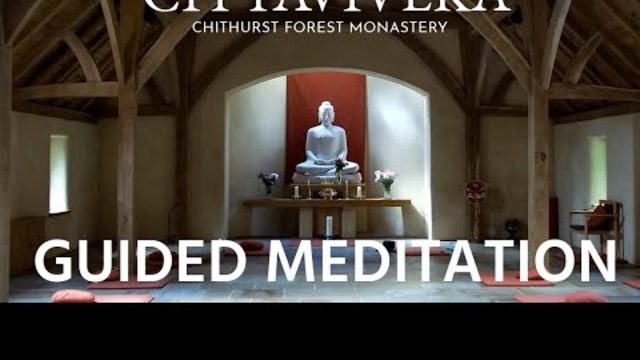
A guided meditation recorded on a Sunday evening at a working Buddhist monastery is, on paper, a simple thing: an hour of spoken instruction, pauses, and silence, offered to anyone who presses play. This recording was given on 22 November 2026 at Cittaviveka, Chithurst Buddhist Monastery in the UK, and runs one hour, eight minutes and forty-nine seconds. The video description gives the date, the place, and a set of links to the monastery's teachings library, but it does not outline what was said that evening, and no transcript is available for this piece. What follows explains how to approach a session of this kind, what the companion resources are for, and where to go next, without attributing to the speaker any claim the material does not contain.
In a guided sit, the spoken voice does the job that a bell or a timer does in a silent sit. It marks the stages of the period, suggests where attention might settle, and brings the listener back when the mind has wandered off. Because the instruction is spoken and then withdrawn, the silences are part of the teaching. A listener who fills every gap with thought, or who rushes to the next instruction, has missed the part of the session where the practice actually happens.
The length of this recording matters. Roughly an hour is a long time to hold attention on a single object, and the format asks the listener to keep returning rather than to achieve any particular state. Treat the recording as a container for your own sitting rather than as a performance to be judged.
A few practical approaches make a long guided session easier to receive:
- Sit up properly. Use a chair or cushion so the body can stay upright without strain. A comfortable posture keeps the session from becoming a test of endurance.
- Keep the instruction simple. Guided talks often contain more than one idea. Pick one instruction you can follow and stay with it, rather than trying to hold the whole talk in memory.
- Treat drifting as ordinary. When you notice you have wandered, the noticing and the return are the practice. Nobody sits without drifting; the recording is simply asking you to come back.
- Break it up if needed. An hour can be split across two or three sittings without losing the thread. Pausing the recording is part of listening well.
The description points to two volumes of chanting material. The first is the monastery's chanting book, and the second is subtitled "suttas" in its web address, which suggests it gathers discourses from the Pali canon arranged for recitation. Reading or chanting these texts gives a listener the vocabulary and context that a guided session often assumes. If a teacher refers to a passage or a phrase, having the source text nearby makes the reference easier to follow, and it lets you check the words for yourself rather than relying on memory of a single hearing.
The monastery also keeps separate categories for its Dhamma talks and its guided meditations. Listening to a talk in the same series before or after a guided session can help you hear the sit as part of a larger body of teaching rather than as a standalone event.
A recording made in a monastic community, on a regular evening, sits within a rhythm of practice rather than a one-off event. The description notes that the session was given on a Sunday evening, which is the kind of detail that marks a recurring practice. Recordings like this are useful precisely because they are unpolished and repeatable: you can return to the same kind of session over weeks and notice how your sitting changes.
- Chanting book, volume 1: https://teachings.cittaviveka.org/chanting-vol-1/
- Chanting volume 2, suttas: https://teachings.cittaviveka.org/chanting-volume-2-suttas/
- Dhamma talks: https://teachings.cittaviveka.org/category/audio-talks/
- Guided meditations: https://teachings.cittaviveka.org/category/guided-meditation/
- Audio and e-books: https://cittaviveka.org/teachings
- Supporting the monastery: https://cittaviveka.org/support