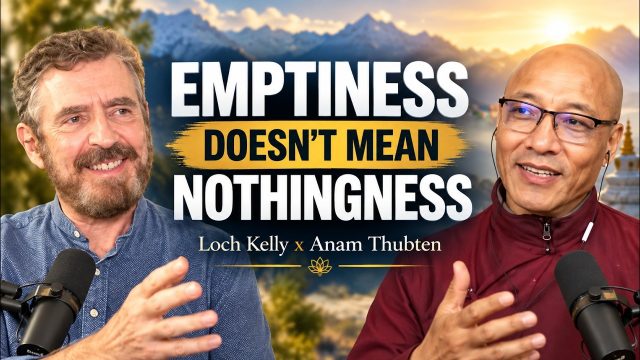
What happens when you stop looking through the lens of your thinking mind and discover an entirely different mode of perception? That's the central question animating a conversation between meditation teacher Stephanie Nash and mindfulness innovator Loch Kelly, recorded after Kelly led a workshop that shifted Nash's understanding of what contemplative practice could offer. At its core, their exchange is about one specific realization: that the thought-based, ego-centered mind—so central to how we navigate the world—is not the only instrument of awareness available to us. And that learning to unhook from it isn't mystical abstraction; it's a learnable skill, grounded in the body and accessible through direct experience.
Kelly traces his own path to these ideas back to his teenage years, when he discovered something unexpected while standing as a goalie on the ice at age fourteen. In that high-stakes position—where reflexive, thought-driven responses are too slow and too rigid—he encountered a radically different way of being present. The moment a puck heads toward the goal, there's no time for the ego-mind to calculate, plan, or second-guess. What emerges instead is pure responsiveness, a kind of open awareness that perceives and acts almost instantaneously. That experience of moving from thought into a subtler, more direct perception became the seed for everything that followed. It's not a mystical story; it's the discovery of an ordinary human capacity that's been hiding in plain sight, latent in moments when thinking steps back and something wiser takes over.
The ego-centered consciousness we call the thinking mind is extraordinary—it's responsible for language, mathematics, planning, and the complex reasoning that built civilization. But Kelly's work points to a limitation that contemplatives have recognized for millennia: the habitual identification with thinking actually narrows perception. When awareness is locked into the narrative stream, the constant commentary and self-referential loop that the mind maintains, we lose access to a broader field of sensing. We become trapped in a dualistic mode: subject observing object, self versus other, right versus wrong. This is not a flaw; it's how the thinking mind was built. But it's not the only way to be conscious.
What distinguishes Kelly's approach—and what drew Nash to reflect on the workshop afterward—is an emphasis on the body as a teacher. Rather than offering purely cognitive or visualization-based meditations, his methods incorporate physicality and sensory awareness. Nash notes her appreciation for techniques that "increase the practitioner's ability to learn through the sensory modalities of see, hear and feel." This is significant because it means the shift in consciousness isn't confined to sitting quietly with closed eyes. It's woven into how we sense, move, and perceive in real time. The eye, the ear, the felt sense of the body—these become portals into a different relationship with awareness. When you can feel the difference between being locked in thought and being openly present, the contrast becomes undeniable. It's not a theory you believe; it's an experience you have.
At the heart of Kelly's teaching is a deceptively simple instruction: "unhook awareness from thought." This isn't about suppressing thoughts or achieving a blank mind—a common misconception that stops many people from contemplative work. Instead, it's about recognizing that awareness and thought are not the same thing. Thought is content; awareness is the space in which content arises. The practice invites a shift in identification: instead of being the thought-generating mind, you become the awareness that observes thinking. This subtle pivot has enormous implications. When you're no longer locked in the narrative self—the "I" that thinks it's running the show—a different kind of intelligence becomes available. It's one that can perceive without judging, respond without planning, and rest without achieving. This is what Kelly calls the "awake person" mode: a consciousness that is alert and responsive but not driven by ego's agenda.
Kelly speaks of moving toward an "open-mind and one-heart" awareness, language that gestures toward a coherence between thinking and feeling, between individual perspective and something vaster. This is not sentimentality or New Age abstraction. When the rigid boundaries of the ego-mind soften, what practitioners report is an expanded sense of connection—to others, to the environment, to the fundamental aliveness of existence. The heart, in contemplative language, isn't just the emotional center; it's another kind of knowing, one that integrates rather than divides. By unhooking from the thought-based defense mechanisms that keep us contracted and separate, we naturally open into a more spacious, more inclusive way of being. This aligns with the embodied approach: you don't think your way into an open heart. You feel your way there, using the body as the guide.
When Nash asked how Kelly developed these techniques, he explained that his path was one of discovering different methodologies and asking rigorous questions about what actually works. This suggests a teaching grounded not in dogma but in pragmatism—what helps people shift? What can be verified through direct experience? This empirical orientation is part of what makes the work accessible to practitioners from many backgrounds. You don't have to believe anything about spirituality or Eastern philosophy. You just have to be willing to try and notice what happens. The techniques are tools, and their value is measured by whether they deliver the promised shift: from thought-bound consciousness into a wider, more natural mode of awareness.
In an era of relentless mental stimulation and cognitive overload, the capacity to unhook from thought is not luxury; it's a survival skill. The mind is magnificent but exhausting when it's always on, always narrating, always defending. What Kelly and Nash point toward is not a rejection of thinking but a liberation from compulsive identification with it. It's the difference between using your mind as a tool and being used by it. And the gateway—according to Kelly's teaching—is available right now, through the body, through sensation, through the willingness to notice that awareness was always larger than thought. That recognition, once felt directly, changes everything.
To explore effortless mindfulness more deeply, Loch Kelly's work is documented at effortlessmindfulness.org and his broader teaching at lochkelly.org. For those interested in embodied mindfulness approaches similar to what Stephanie Nash teaches, her courses and guided meditations are available at strategic-mindfulness.com, with free guided practices on Insight Timer at insighttimer.com/stephanienash. Begin by setting aside time to notice, without judgment, the quality of your awareness right now: Is it locked in thought? Can you sense a space around your thinking? What happens when you shift attention to your breath, your body, the sounds around you? This direct experimentation is where the teaching becomes real.