In a conversation between Aaron Abke, James Benefico, and David the Nazarene, a deceptively simple question becomes a sledgehammer: Can a book be infallible? The answer, they argue, is no—not because the Bible lacks truth or value, but because the concept itself is logically incoherent. What unfolds is not an attack on scripture but a demolition of a doctrine that has shaped Christian belief for centuries, exposing the circular reasoning at its heart.
The core argument is almost childlike in its directness. David the Nazarene puts it plainly: "Once a human being writes anything, it's human. Humans are not infallible. So how can a fallible creature write an infallible text?" This isn't clever wordplay—it's axiomatic. If infallibility means absolute freedom from error, and humans are demonstrably capable of error, then no human-authored text can be infallible by definition. The furthest one can go, he suggests, is to claim a text is true or false. But truth and infallibility are not synonymous. A statement can be true without being infallible; infallibility is a category reserved for God alone.
Aaron Abke extends this further into the epistemological wasteland where infallibility doctrine operates. Even granting, hypothetically, that the original texts were infallible, there is no mechanism by which a reader in the present day could verify that claim. The instrument doing the measuring—the human brain—cannot measure something as precise as infallibility. As Abke notes, "It is like if you had something where you had to measure the length of something to the nearest millimeter, but you only had a tape measure that measured in kilometers. You can't get down that precise."
Even if the words on the page were somehow guaranteed perfect, the moment a human being reads them, subjectivity enters. Language is not a transparent medium. Each word carries baggage—cultural context, personal experience, the reader's own conditions and presuppositions. As Abke explains, "Even if it was infallible, you still can't get past the fact that your brain has to interpret it subjectively according to what you think words mean and all these things. And so again, you're back to appealing to your own subjective interpretation either way."
This reveals the trap many Christians fall into without realizing it. When they claim to defend the infallibility of the Bible, they are not, in fact, defending the infallibility of the text itself. They are defending the infallibility of their interpretation of the text. And that is precisely the opposite of what they claim to believe. It is a subtle but total inversion of their stated position—a logical fallacy wrapped in the language of faith.
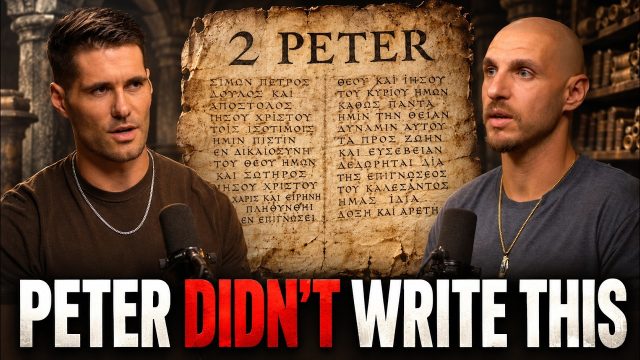
The conversation also addresses a historical elephant in the room: the Bible contains texts that scholars widely recognize as pseudepigraphical—falsely attributed to their claimed authors. Second Peter is examined as a case study. The epistle claims to be written by the Apostle Peter, but scholars have identified numerous reasons to doubt this attribution. If pseudepigraphical texts are present in the canon, and pseudepigraphical means false, then false texts sit within what Christians claim is an infallible collection.
When pressed on this contradiction, some Christians employ a rhetorical move: they suggest that if we acknowledge false or questionable texts, we might as well discard entire gospels and books. David the Nazarene captures the absurdity: "They say, 'Oh, so we need to get rid of Luke and we need to get rid of Peter and we need to get rid of Acts... and we need to get rid of the Wizard of Oz, we need to get rid of Star Wars, we need to get rid of the American Revolution.'" The slippery-slope argument collapses under its own overreach.
But the conversation clarifies an important distinction: scholars do not "reject" texts in the sense of throwing them away or refusing to study them. Academic study treats ancient texts as historical documents worthy of careful examination, regardless of their authorship or authority claims. David notes, "No academic rejects a text. It's an ancient text. We study it as an ancient text." To study something critically is not to reject it; it is to understand it more deeply.
Perhaps the most damaging critique is the charge of circular reasoning. How does one know the Bible is infallible? Often the answer is: because the Bible says it is. This is begging the question—using the conclusion as evidence for itself. Abke articulates the problem: "You can only beg the question. And so we think that, hey, why would I want to base my entire salvation on a question-begging claim that can't be proven? Surely God would not create such a universe."
The conversation points out that this exact same argument structure is used by other faiths. Mormons appeal to the infallibility of the Book of Mormon. Muslims appeal to the infallibility of the Quran. Each religion employs proof-texting from its own sacred text to defend the authority of that text. If a Christian dismisses the Mormon or Muslim approach as circular reasoning while employing the identical method themselves, they have surrendered the high ground. They have become, in Abke's words, indistinguishable from the very thing they claim to critique.
A central question hangs over the entire discussion: How would you even know if you were reading an infallible text? What would be the litmus test? The speakers argue that there is no such test. No objective standard exists by which a fallible human being could verify infallibility in a text. This is not a problem with their skepticism; it is a problem with the doctrine itself. The doctrine makes a claim that is, by its own logic, unfalsifiable and unverifiable.
This leads to a troubling implication for believers who stake their salvation on this doctrine. If a stranger on the internet tells you that you must believe in biblical infallibility or face damnation, you are being asked to trust that they—a fallible person you do not know—have correctly identified an infallible text. Abke captures the absurdity: "I don't trust you that much. I don't even know you. You're some guy on the internet and I'm supposed to believe that you know an infallible text exists."
The speakers propose an alternative epistemological standard, one they trace to Jesus himself: "You just know a tree by its fruits and by no other way." This suggests evaluating truth not by abstract doctrinal claims but by the actual effects of a belief system in the world. Does it produce love, justice, healing, humility? Or does it produce harm, division, control, and certainty masquerading as wisdom?
This framework also addresses a subtler danger: the infiltration of partial truth with partial deception. As the conversation notes, "The devil loves to use truth and sprinkle in a little bit of deception. I'm going to give you 90% truth, 90% light, and then I'll just sprinkle in a little bit of darkness into it." This is why proof-texting—selecting verses that support a predetermined conclusion while ignoring context—is so dangerous. It becomes a mechanism by which error can be hidden inside apparent truth.
The speakers are careful to emphasize that their critique of infallibility is not a critique of the Bible's value or its spiritual truth. "All truth is God's truth," Abke states. The claim is not that the Bible is false or useless, but that treating it as infallible is a category error—a logical impossibility that actually obscures the more important work of discernment, study, and spiritual practice.
What matters is not that every word is perfect, but that the text contains genuine wisdom, genuine encounters with the divine, and genuine moral and spiritual teaching. These can coexist with historical inaccuracies, attributional problems, and human limitations. In fact, acknowledging these limitations may actually deepen faith rather than undermine it, by moving faith from intellectual assent to doctrines toward trust in a God who works through imperfect vessels.
If the doctrine of biblical infallibility collapses under scrutiny, what replaces it? The conversation suggests several directions. First, engage with the Bible as an ancient text, using the tools of scholarship and criticism not to diminish it but to understand it more fully. Second, develop a coherent epistemology—a clear standard for how you arrive at truth—rather than accepting claims simply because they are wrapped in religious language. Third, evaluate spiritual teachings by their fruits: Do they produce love, justice, freedom, and genuine transformation? Or do they produce control, certainty, division, and harm? Finally, recognize that faith in God and critical thinking about doctrines are not enemies. The God worthy of worship is not threatened by questions, scholarship, or honest doubt. A doctrine that requires the suspension of reason to maintain itself may be worth questioning.