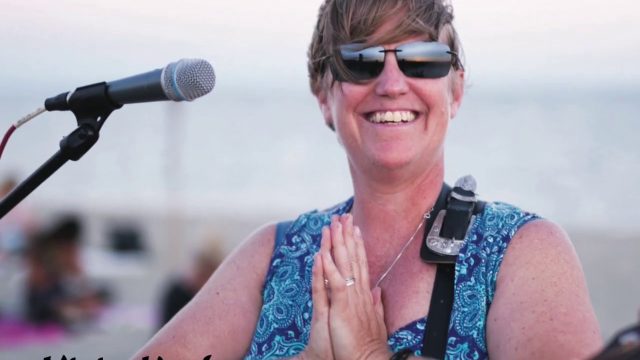
On Thanksgiving morning 2018, the teacher Alicia Mathewson sat down to record a short video before driving to her family's dinner. She had not showered, she still had a cheese ball to finish, and she had just come out of a long meditation. What she shared was a single song, Carey Landry's "Be Not Afraid," a hymn she grew up with in post-Vatican II Catholic services and that she says is often sung at funerals. Her argument is that the song belongs to more than one kind of occasion. Paired with a new moon in Scorpio, a sign she ties to death and rebirth, she treats it as an exercise in letting go, built on a line she attributes to Gandhi: practice dying every day. The video runs under eight minutes, and it is unpolished in a way that serves it. It is a meditation on grief, joy, and the stubbornness of conditioning, and it ends on a lyric she admits she has been singing wrong all along.
The opening is a scene, not a thesis. Mathewson is mid-errand: the phone is about to be switched off so it stops dinging, the family is waiting, and the room is informal. She describes the morning in plain terms. "A lot of amazing amazing love and wisdom has been coming to me," she says, and that is why she is recording at all (video, 0:20). There is no production frame around it, no title card, no lighting setup. The lack of polish is part of the message. A spiritual practice that only works when the conditions are right is not much of a practice, and Mathewson seems to be demonstrating that the song can be sung in the middle of a busy holiday.
She places the song in her own history. It is "a very deep song from my childhood," and she describes it as holding "a very very high universal vibration" (video, 0:37). She is careful about lineage. Those who know the song may connect it to a particular tradition, and she acknowledges that connection: "it is certainly connected to that lineage but for me it is transcendent of that lineage" (video, 0:54). She names the songwriter, Carey Landry, and notes that the song was written in the 1970s. She also places it in a specific setting, the Glory and Praise songbook used in her post-Vatican II Liberal Catholic services, and says the song was often sung at funerals.
That funeral association is the hinge of the whole video. A hymn about being unafraid is exactly what a community reaches for when someone has died, and the lyric she sings is full of crossing and passage: a barren desert, raging waters, burning flames, the power of death. Mathewson does not pretend the song is only comfort. She uses its funeral context to ask a harder question, which is what the song might mean if we sang it while we were still alive.
The timing matters to her. She explains that the video was prompted by a recent new moon in Scorpio, "which is about death and rebirth" (video, 1:27). From there she moves to the Gandhi line, which she gives as "practice dying every day," so that "we don't need to wait for our funeral to die" (video, 1:38). She admits this sounds strange, and then makes it concrete. The practice is not literal death. It is the ongoing work of letting parts of yourself change.
She lists what that letting go looks like. It means releasing "the ways in which we keep ourselves trapped in conditioning." It means letting go of "how we see our family members" and "the roles we think we play." Each of these is something a person can actually do on an ordinary day, without a crisis. Her closing point in this section is the one that gives the teaching its edge:
"We don't have to wait for a giant loss to do it."
(Mathewson, Thanksgiving 2018 video, 2:04)
This reframes the funeral hymn. If the song is usually sung after a loss, she is asking listeners to sing it before one, while the roles and habits that hold them are still negotiable.
Around the two-minute mark, the video turns outward. Mathewson lists the suffering she has in mind: "the fires in California," "the endless pain and suffering and wars in Syria and Yemen," "the incarceration of beautiful young men and women in our own country for profit," "families torn apart by ignorant immigration policies," and "young people who are transcending ideas of sexuality and gender and are therefore not loved fully for who they are" (video, 2:12 to 3:08). The list is blunt, and it does not soften its targets. It also shows the scope of what she means by letting go. The practice is personal, but she does not stop at the family table.
Her response to all of this is the most important idea in the video, and it is not a call to despair. "We're all one, all of this suffering is my suffering," she says, and in the same breath, "at the same time I'm an incredible amount of joy right now" (video, 3:08). Her conclusion is practical: "I can acknowledge that suffering and I can have an incredibly joyful day" (video, 3:21). Grief and gratitude are not treated as competitors. A person can hold both, and holding both is the discipline.
Readers who know contemplative traditions will recognize the move. The idea that another's pain is one's own, while joy remains available, is a familiar balance. Mathewson gives it a specific social edge by naming the institutions and policies she has in mind rather than speaking in generalities.
Near the end of the song, Mathewson stops to confess a mistake. "The interesting thing is the lyric is actually 'I will give you rest,'" she says, "but I always think I will lead you home. I never sing the right lyric" (video, 5:58). The two phrases point in different directions. One is about guidance and movement, a leader taking you somewhere. The other is about stillness, the arrival at rest. She notes the discrepancy with obvious amusement and then sings the line again, both versions, as if testing how each one sits.
The admission matters because it shows how the song works for her. She does not present herself as a perfect performer of a sacred text. She presents herself as someone who has been singing her own version for decades, shaped by what she needed to hear. Whether the mishearing is more about leading or resting is something each listener has to decide. Her point is that the hymn is alive in the hands of the one who sings it, and that the difference between "lead you home" and "give you rest" may be the difference between hoping for guidance and accepting that the work is over.
She ends with a dedication, "may all beings in all the worlds be happy and free" (video, 7:22), and then turns to the people in front of her. "If you're in the United States, may you have a loving, joyful, safe, peaceful, fun, mildly dysfunctional Thanksgiving with your beautiful family who reminds you of who you are and who you aren't" (video, 7:25). The line is funny and true at once. It names the family as a mirror, reflecting both identity and the parts a person is trying to release. The sign-off is simple: "love you all."
The video does not resolve its tensions. It offers a practice, a song, and a reminder that the work is available on an ordinary holiday. For anyone who has sung "Be Not Afraid" at a funeral, Mathewson's version asks what it would be like to sing it at a dinner table.
If this video has you thinking about the song, start by listening to the full recording of "Be Not Afraid" by Carey Landry, and then try both lyrics, "I will lead you home" and "I will give you rest," to notice what each does to your breath. Mathewson's own music and writing are available through her site, aliciamathewson.com, and her Bandcamp page, aliciamathewson.bandcamp.com. For the practice itself, borrow her framing for one week: pick a single role or habit you are holding onto, name it, and notice what would change if you let it go without waiting for a loss. Her Thanksgiving message is short, but it leaves a clear instruction: you do not need a funeral to practice dying, and you do not need to finish every errand before you sing.