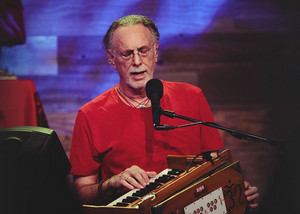
In November 2026, the Kirtan Wallah Foundation opened a rare window: a full weekend retreat, entirely virtual and entirely free, centered on the practice of kirtan—the devotional call-and-response chanting that has become a living bridge between ancient Sanskrit mantra and contemporary Western spiritual seekers. The event brought together Krishna Das, one of kirtan's most recognizable Western teachers and practitioners, alongside chanting specialists Nina Rao, Ambika, and Devadas, in a sequence designed not as performance but as immersion: opening sets from the musician Arjun, sustained kirtan sessions framing the core practices, and a workshop in which Krishna Das could address the deeper dimensions of the work itself.
What distinguishes a retreat of this design—especially one offered without charge—is its implicit philosophy: that the technology of chant is neither commodity nor entertainment, but a tool of transformation meant to circulate freely. The structure itself teaches. Friday evening's opener, "Krishna Das & Friends," runs two and a half hours, a duration that reflects the actual pace of authentic kirtan practice, not the compact concert set. By Saturday, participants have already spent hours in call-and-response; the morning's intensive Hanuman Chalisa chanting, led by three voices experienced in this specific mantra's power, arrives as a deepening, not a detour. The workshop that afternoon creates space for questions and instruction—the intellectual and emotional scaffold that sustains daily practice. And the Saturday evening kirtan closes the circle, allowing whatever has been activated to settle and integrate.
Kirtan is not meditation in silence; it is chanting aloud, usually in Sanskrit or Hindi, with a lead singer and a responding group. The form is ancient—rooted in devotional Hinduism and developed across centuries by bhakti traditions—but its logic is universal: the act of singing, together, with focused intention, shifts the nervous system and the heart. The call-and-response structure, in particular, creates a feedback loop; your voice meets others' voices, and something emerges that belongs to none of you individually.
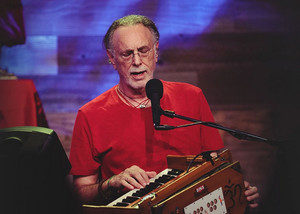
Krishna Das, an American-born kirtan artist who has spent decades in this lineage, has been instrumental in introducing kirtan to Western practitioners who may have no prior connection to Hinduism or Sanskrit. His recordings and live appearances have made the form accessible without diluting its depth. The NYC Urban Retreat signals a maturation of that transmission: not teaching Westerners a "beginner's" version, but inviting them into the full architecture—the opening sets, the long sustained chants, the morning ritual, the workshop reflection, and the closing kirtan—as a genuine practitioner would experience it.
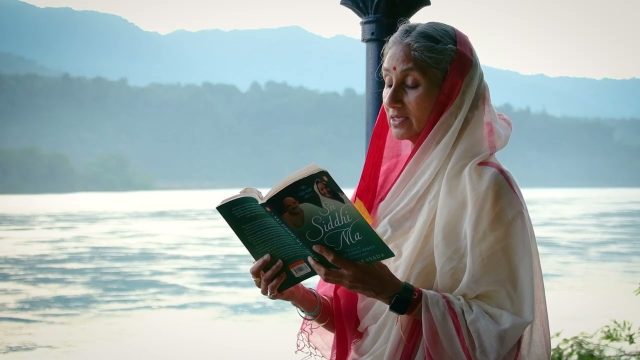
Saturday morning's Hanuman Chalisa—a 40-verse hymn to Hanuman, the monkey deity of Hindu mythology—offers a window into why teachers like Nina Rao, Ambika, and Devadas emphasize specific chants within the broader kirtan ecosystem. The Chalisa is neither an abstract prayer nor a symbolic exercise; it is understood in its tradition as a practice with particular effects. Recitation of the Chalisa is said to cultivate courage, devotion, and the capacity to serve without ego—qualities embodied in Hanuman himself, who is revered as the perfect devotee, the one who surrenders completely to his deity.
By positioning the Hanuman Chalisa as the morning centerpiece—after the opening kirtan, before the workshop—the retreat creators acknowledged that chant practice has rhythm and seasons. Not all chants carry the same energy. The Chalisa, chanted in community and with intention, prepares the nervous system and the heart for the kind of inquiry that the workshop asks: What is happening when we chant? How do we deepen our relationship to the practice? What does devotion actually mean in a modern life?
The decision to offer the weekend without cost places it outside the marketplace logic that has increasingly captured even spiritual practice. The Kirtan Wallah Foundation's choice to stream the event freely, with recordings made available after, suggests a different model: the work speaks for itself; access should not depend on ability to pay. This aligns with one of kirtan's core teachings—that devotion is not a commodity but an expression of love, and that the grace of practice belongs to all who reach for it.
For participants new to kirtan, the free format lowers the risk of trying something unfamiliar. For experienced practitioners, it offers a retreat experience—depth, community, teaching—without the cost of travel or accommodation. And for the teachers and musicians involved, it represents a gift: an entire weekend given to the practice itself, sustained by the belief that the work will find those who need it.
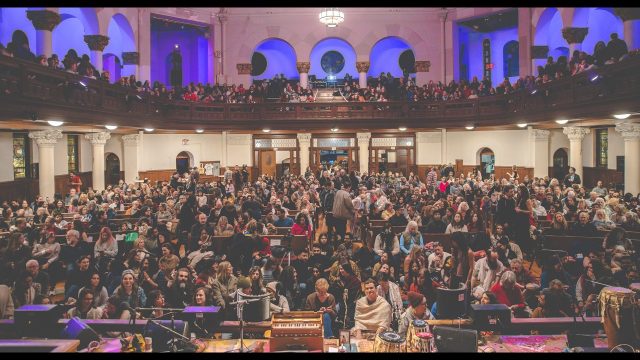
A four-program weekend arranged across two days is not arbitrary. The opening Friday kirtan establishes the basic container: singers and rhythm instruments, the Sanskrit syllables, the repetition, the growing coherence of voices. By evening's end, participants who've never chanted before have felt what it is; they've sat in it for hours. They've discovered that boredom, restlessness, and profound calm can all arise, and that the chant itself—steady, unhurried—holds space for it all.
The Saturday morning Chalisa arrives with fresh energy and a new sonic and spiritual profile. The afternoon workshop creates conscious space: What do we do with what's been activated? How do we work with the practice at home? The Saturday kirtan, arriving in the evening, allows the whole weekend to integrate. Those four hours of chanting across two days don't exhaust; they resonate.
Kirtan has grown substantially in Western spiritual communities over the past two decades, particularly in urban centers. What began as a practice largely confined to ashrams and Hindu temples has moved into yoga studios, concert halls, and retreat centers. That migration has brought new practitioners—people seeking the benefits of chanting without necessarily converting to Hinduism or committing to a lineage—and new questions: How do we honor the form's roots while making it accessible? How do we distinguish between dilution and translation?
Teachers like Krishna Das, Nina Rao, Ambika, and Devadas navigate this territory by teaching both the technique and the philosophy: the proper pronunciation of Sanskrit, the history and meaning of the chants, the yoga of devotion as a transformative path. They treat kirtan not as world music or meditation music—genres that flatten and abstract—but as a living transmission that asks something of the practitioner: attention, vulnerability, and a willingness to sing, however imperfectly.
For anyone drawn to kirtan practice, the foundational step is simple: listen to recordings, then attend a live session. The difference between hearing kirtan and singing kirtan is the difference between reading about swimming and entering the water. The virtual retreat model pioneered by the Kirtan Wallah Foundation makes that threshold accessible—you can attend from home, in real time or via recording, without logistical complexity.
Beyond this retreat, the deeper work unfolds in consistency: returning to the same chants weekly, allowing the Sanskrit syllables to work on the nervous system and heart over time. Many communities now offer weekly kirtan circles, often free or donation-based. Finding one and showing up—with no prior experience required—is the traditional entry point. The practice is not in getting it "right"; it's in showing up, singing, and trusting the form to do what it's meant to do.