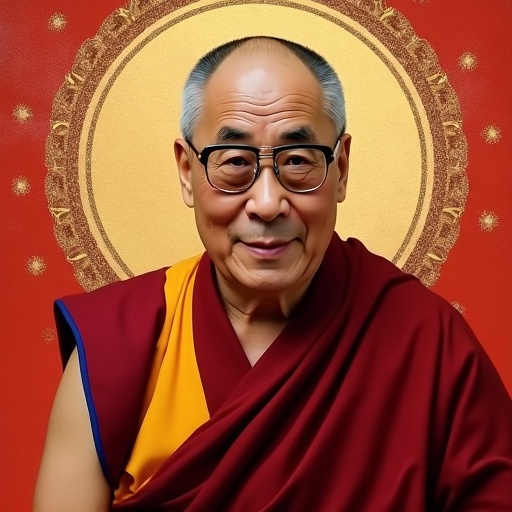
Spiritual practice does not require a monk's robes, a sacred space, or hours spent in ritual solitude. According to the Dalai Lama, the most authentic spiritual life unfolds in the everyday decisions we make—at work, in conversation, in the ordinary friction of professional and social life. The misunderstanding that spirituality belongs only to designated hours in designated rooms represents, he suggests, a fundamental confusion about what the spiritual path actually is.
The Illusion of Compartmentalized Spirit
The Dalai Lama identifies a particular kind of spiritual theater that has become almost comical in its contradiction. A person maintains a room in their home—decorated with statues, sacred texts, perhaps incense or flowers—and dedicates an hour or two daily to meditation or prayer within those walls. During those hours, the person carries themselves with spiritual intention. The moment they step outside that room, however, the spiritual aspiration vanishes. They return to their regular work, their conversations, their choices, unmoved by any sense of higher purpose or ethical commitment.
"Silly," the Dalai Lama calls this arrangement. Not out of mockery, but out of a clear-eyed assessment: if spiritual practice leaves no trace on how we move through the world the rest of the time, then it is merely performance. It is decoration. The sacred room becomes a costume that you put on and take off, leaving your actual life untransformed.
This critique cuts at the heart of a widespread modern assumption—that spirituality is a supplement to ordinary life, something you add to your schedule like a gym membership or a hobby. The Dalai Lama suggests the opposite: spiritual practice must be woven into the texture of daily existence, or it is not spiritual practice at all.
What Makes Work Itself Spiritual?
The turning point in this teaching is simple but radical: any honest work, carried out with genuine compassion and truthfulness, is spiritual practice. This does not mean that work somehow becomes sacred through positive thinking. Rather, it means that the qualities we associate with spiritual development—integrity, service, mindfulness, compassion, clear seeing—are the same qualities that make work meaningful and beneficial.
The Dalai Lama mentions professional work across all domains, explicitly including politics. A politician motivated by sincere intention, by genuine concern for the welfare of others, and by realistic understanding of circumstances—that person is practicing spirituality through governance. A doctor who treats patients with honest attention and compassion is practicing spirituality through medicine. An accountant who maintains integrity in their work, who refuses corners cut at others' expense, practices spirituality through numbers and contracts.
This reframing dissolves the false boundary between the sacred and the mundane. Spirituality becomes not an escape from the world's demands but a way of meeting them—with consciousness, with care, with an awareness that our actions affect others and that we have a choice in how we act.
Compassion as the Irreducible Core
Across this teaching runs a single thread: compassion. The Dalai Lama emphasizes that so long as a human being carries the seed of compassion, spiritual practice is possible. Compassion is not an emotion that arises from technique or from spending time in a designated room. It is a fundamental capacity of the human heart—one that can be cultivated, but that is already present in potential.
When we do our professional work "honestly, truthfully, compassionately," according to the Dalai Lama, we are not performing spirituality. We are living it. The distinction matters enormously. Living it means that our spiritual commitment and our ordinary commitments are one. There is no split between the person at the meditation cushion and the person negotiating with a client, raising children, or navigating a difficult conversation.
This integration—this refusal of compartmentalization—may be more demanding than any formal practice. It requires that we bring intention and awareness to each moment, each interaction, each decision. It means that nowhere is safe from the demand that we act with integrity. But it also means that nowhere is excluded from the possibility of spiritual development. The entire landscape of our lives becomes the field of practice.
Where to Go From Here
If this teaching resonates, the invitation is neither to build a more elaborate meditation practice nor to abandon formal disciplines, but to examine the gap—if one exists—between your dedicated spiritual time and your ordinary life. Where do your actions reflect your values? Where do they diverge? The Dalai Lama's point is not that meditation or prayer is wasted, but that these practices mean very little if they do not change how you show up in the world. The real practice is in closing that gap—in allowing your commitment to compassion, truthfulness, and sincere motivation to guide not just your hours of formal practice, but every hour of your life.


