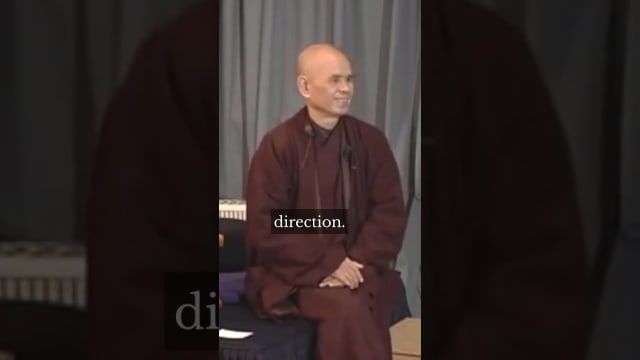
Thich Nhat Hanh, the teacher behind the Plum Village community, makes a claim in a short excerpt from a talk he gave on December 24, 2012 that sounds devotional on first hearing and turns out to be quite practical on the second. The claim is that each of us, the moment we generate mindfulness and concentration, is the Buddha, or more precisely, a continuation of him. The Buddha is not locked in a statue or a sutra. He is present wherever mindfulness, concentration, and insight are alive, whether that is in a person walking across a field, someone scrolling a phone with attention, or a river, or the sun that makes life on earth possible. The four-and-a-half-minute film built from this teaching, released by the Plum Village App, is brief, but it contains a complete argument about where the sacred actually lives.
The word that carries the teaching is "continuation." Thich Nhat Hanh does not say that we are the Buddha in the sense of replacing him. He says that when we practice, we extend something that already exists. The method he describes is simple in its language and demanding in its execution: "We can generate energy of mindfulness and concentration and joy and peace every moment with every breath with every step" (0:05).
Notice the list. Mindfulness, concentration, joy, peace. These are not abstractions to be believed in. They are energies that can be produced, the way a musician produces tone by how they touch the instrument. A guitarist does not get a warm tone from a theory of warmth; the tone comes from the hand, the attack, the amp set just so. Thich Nhat Hanh treats the Buddha's qualities the same way. They arrive through the body and the breath, and they are available in ordinary time.
Later in the excerpt the list widens to "mindfulness, concentration and insight" and, in the same breath, "anyone who has a sense of peace, compassion" (2:03 and onward). The move is democratic on purpose. The qualities are not reserved for monks or for those who have memorized the right texts. Anyone who is "inhabited by the energy" of these qualities participates in the Buddha's continuing life. The teaching is less about who you are than about what is alive in you right now.
The excerpt returns again and again to walking. "Because the way we walk shows that the Buddha is here" (0:36), he says, and then he gives the mechanism: "when you are walking, you touch the earth. You generate the energy of mindfulness and concentration. You feel calm. You feel peaceful. You feel a sense of fulfillment" (1:08 to 1:31).
Walking is the chosen ground for a reason. It is repetitive, bodily, and never fully urgent. You cannot hurry a step without losing the feeling of it, and the attention that stays with the foot on the ground is the same attention that makes a breath feel like a breath rather than a task. Thich Nhat Hanh's phrase "you touch the earth" carries real weight here. The practice is not walking toward a destination; it is a way of arriving in the place you already stand.
The fruit he names is a particular kind of settledness: "You feel at home. You don't feel that you need anything else. You don't need to go around and around anymore" (1:44 to 1:57). That last line is worth sitting with. Much of restless life is a circling, a rehearsing of past arguments and future worries. The teaching offers a way out that does not require solving those circles first. You step, you breathe, and the circling loses its grip for a while. He calls this being "home," and he insists it is available in the present moment: "It is possible to be a Buddha in the here and the now" (1:37).
One of the most striking lines in the excerpt is also the most casual. "He can wear jeans. He might be using a telephone with mindfulness" (0:52 to 1:01). The Buddha, in this framing, is not a figure from a painting, dressed in robes, fixed in a single era. He is the quality of attention, and that quality can appear in a denim-clad person checking a message.
The instruction that follows is the real work: "You have to recognize him in his many new forms" (1:01). Recognition is a practice in itself. It asks you to look for the sacred where you would not expect it, including in the most ordinary objects of your day. For someone who grew up with the image of the Buddha as remote, this is a reorientation. The phone is not the enemy of mindfulness by default. The question is whether attention is present while the hand moves.
This is also where the teaching becomes uncomfortable in a useful way. If the Buddha can be found in jeans and a telephone, then the spiritual life is not a separate zone you enter on weekends. It is the same ground you walk on at the grocery store.
Thich Nhat Hanh draws a clear conclusion from this: "So if we have that insight we will not be attached to a particular form of the Buddha" (2:39 to 2:47). This is the heart of the teaching, and it is a warning as much as an invitation. When we fix the Buddha in one image, one country, one posture, or one lineage's way of looking, we risk missing him everywhere else.
He follows with a series of images that stretch the idea almost playfully: "The Buddha can be a river. The Buddha can house many living creatures" (2:47 to 2:57). A river is never the same water twice, and yet it is recognizably itself. A place that houses many living creatures is a kind of home, full of different lives. Neither image asks you to give up your own form. They ask you to see that the form is a vehicle, not the thing itself.
Thich Nhat Hanh states the point plainly elsewhere in the excerpt: "There's no doubt that after dying the Buddha continues inside of us and that is enlightenment, that is mindfulness that is inside" (2:19 to 2:31). The continuation does not require a single body or a single lifetime. It requires only that mindfulness is inside someone.
The teaching then widens to the sky. "It is possible to look at the star and conceive the star as a Buddha. To look at our star, the sun" (3:09). He calls it "real Buddha, a source of infinite light, a source of infinite lives" (3:14 to 3:17). The reasoning is grounded in plain biology: "without the sun there's no life on earth and all of us are children of the sun" (3:17 to 3:30).
This is a striking move, and it is worth noticing how it works. Thich Nhat Hanh is not making a claim about astronomy. He is using the sun as a teacher of the same thing the practice cultivates: a source that gives life without asking for credit, that keeps giving, and that every living thing depends on. Seeing the sun as Buddha is a way of seeing generosity and sustenance as sacred, and of seeing ourselves as born of that same source.
The excerpt closes with a line the transcript renders as "father son": "Without father son there's no you. You are a continuation of father son" (3:43 to 3:56). In context the phrase points to the sun, the "Father Sun" that the earlier lines build toward. The point is continuity. You are not separate from the source that made you. "Father son is not up there only," he says. "The son is inside of us."
"We are the Buddha. We are the continuation of the Buddha." (Thich Nhat Hanh, talk recorded December 24, 2012)
The teaching asks for very little to begin and a great deal to sustain. A few practical steps follow directly from the excerpt:
- Take one walk this week as a meditation rather than a commute. Feel the foot meet the ground, as the teaching describes, and notice whether calm or fulfillment begins to arrive.
- Pick one ordinary object you use daily, such as a phone or a cup, and practice recognizing the Buddha in that form, the way he invites us to in "his many new forms."
- Notice when you are attached to a single image of what spiritual life must look like, and ask what else might carry the same qualities of mindfulness and peace.
- Step outside and look at the sun for a moment, and consider the line "all of us are children of the sun" as an honest description of your dependence on the world.
The film itself is one of many short pieces in the free collection on the Plum Village App, and the description notes an open invitation to help caption and translate it. For readers who want the full context of the teaching, the complete talk from December 24, 2012 is the place to hear Thich Nhat Hanh's voice in its original length. The excerpt is short, but the idea it carries is large: the Buddha is not behind us in history. He is in the step we are taking now.