BrightStar

Alle Events durchsuchen

Bewusste Zusammenkünfte entdecken

events

Yoga
Meditation
Breathwork
Qigong
Tai Chi
Sacred Music
World Music
Medicine Music
Sound Healing
Ecstatic Dance
Beliebte Reiseziele
BaliSedonaLos AngelesCosta RicaNew YorkSan FranciscoAustinMiamiJoshua TreeTulum
Alle Kategorien anzeigenAlle Reiseziele anzeigen

Alle Funktionen entdecken

Leistungsstarke Tools für Ihre Veranstaltungen

Plattform-Funktionen

Intelligente dynamische Preisgestaltung
Ticket-Kategorien
Sitzplatzreservierung
Warenkorbabbruch-Wiederherstellung
Besucher-Wiedergewinnung
Spenden & Staffelpreise
Affiliate-System
Ticket-Scanner
Rabattcodes
Individuelle Fragen
Ticket-Teilen
Upsells & Extras
Analysen & Berichte
E-Mail-Sequenzen
Warteliste / Benachrichtigen / Erinnern
Menschen & Orte
Artists & TeachersEvent OrganizersVenues & StudiosKnowledge BaseGlossaryInspiration
Alle Funktionen anzeigenÜber uns
PreiseBlog
Language
Saved events
Alle Veranstaltungen durchsuchen

events

YogaMeditationBreathworkQigongTai ChiSacred MusicWorld MusicMedicine Music

Beliebte Reiseziele

BaliSedonaLos AngelesCosta RicaNew YorkSan Francisco

Menschen & Orte

Artists & TeachersEvent OrganizersVenues & StudiosKnowledge BaseGlossaryInspiration

Plattform-Funktionen

Intelligente dynamische PreisgestaltungTicket-KategorienSitzplatzreservierungWarenkorbabbruch-WiederherstellungBesucher-WiedergewinnungSpenden & StaffelpreiseAffiliate-SystemTicket-ScannerRabattcodesIndividuelle FragenTicket-TeilenUpsells & ExtrasAnalysen & BerichteE-Mail-SequenzenWarteliste / Benachrichtigen / Erinnern
Alle Funktionen anzeigenÜber uns
PreiseBlog
AnmeldenSuchendeKreative
  • Alle Events durchsuchen
  • Für Suchende
  • Yoga
  • Meditation
  • Breathwork
  • Qigong
  • Tai Chi
  • Heilige Musik
  • Weltmusik
  • Medicine Music
  • Klangheilung
  • Ecstatic Dance
  • Retreats
  • Workshops
  • Alle Kategorien →
  • Bali
  • Sedona
  • Los Angeles
  • Costa Rica
  • Tulum
  • Byron Bay
  • San Francisco
  • Austin
  • New York
  • San Diego
  • Denver
  • Seattle
  • Portland
  • Miami
  • Alle Städte →
  • Join the Movement
  • Why we list
  • Sell Globally
  • Für Kreative
  • Für Teams
  • Für Autoren
  • Für Lehrer
  • Für Kirtan-Künstler
  • Für Studios
  • Für Festivals
  • Für Retreat-Zentren
  • Für gemeinnützige Organisationen
  • Markenbotschafter
  • Kostenloses Ticketing
  • Elevate
  • Amplify
  • 500.000+ Käufernetzwerk
  • Warenkorbabbruch-Wiederherstellung
  • Intelligente dynamische Preisgestaltung
  • Ticket-Kategorien
  • Wiederkehrende Veranstaltungen
  • Sitzplatzreservierung
  • Affiliate-System
  • Warteliste / Benachrichtigen
  • Ticket-Scanner
  • Einbettungs-Widget
  • Event-Syndication
  • Nachrichten
  • Integrationen
  • Berichte
  • Alle Funktionen →
  • Über uns
  • Das Ökosystem
  • Blog
  • Glossar
  • Inspiration
  • Hilfe-Center
  • Kontakt
  • API-Dokumentation
  • Marken-Assets
  • Karriere
  • Presse
  • Nutzungsbedingungen
  • Datenschutzrichtlinie

Events

  • Alle Events durchsuchen
  • Für Suchende
  • Yoga
  • Meditation
  • Breathwork
  • Qigong
  • Tai Chi
  • Heilige Musik
  • Weltmusik
  • Medicine Music
  • Klangheilung
  • Ecstatic Dance
  • Retreats
  • Workshops
  • Alle Kategorien →

Reiseziele

  • Bali
  • Sedona
  • Los Angeles
  • Costa Rica
  • Tulum
  • Byron Bay
  • San Francisco
  • Austin
  • New York
  • San Diego
  • Denver
  • Seattle
  • Portland
  • Miami
  • Alle Städte →

Für Kreative

  • Join the Movement
  • Why we list
  • Sell Globally
  • Für Kreative
  • Für Teams
  • Für Autoren
  • Für Lehrer
  • Für Kirtan-Künstler
  • Für Studios
  • Für Festivals
  • Für Retreat-Zentren
  • Für gemeinnützige Organisationen
  • Markenbotschafter
  • Kostenloses Ticketing
  • Elevate
  • Amplify

Funktionen

  • 500.000+ Käufernetzwerk
  • Warenkorbabbruch-Wiederherstellung
  • Intelligente dynamische Preisgestaltung
  • Ticket-Kategorien
  • Wiederkehrende Veranstaltungen
  • Sitzplatzreservierung
  • Affiliate-System
  • Warteliste / Benachrichtigen
  • Ticket-Scanner
  • Einbettungs-Widget
  • Event-Syndication
  • Nachrichten
  • Integrationen
  • Berichte
  • Alle Funktionen →

Unternehmen

  • Über uns
  • Das Ökosystem
  • Blog
  • Glossar
  • Inspiration
  • Hilfe-Center
  • Kontakt
  • API-Dokumentation
  • Marken-Assets
  • Karriere
  • Presse
  • Nutzungsbedingungen
  • Datenschutzrichtlinie
BrightStar
Hol dir die App
Laden imApp StoreJetzt beiGoogle Play
© 2026 BrightStar. Alle Rechte vorbehalten.
Inspiration

Why God Doesn't Need a Manual to Make a Rabbit Explained

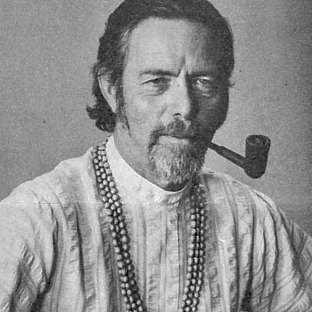
Alan Watts
Alan Watts
Oct 14, 2026
9 Min. Lesezeit
Ansehen · 6

Imagine the question put to the most powerful being you can conceive, at the end of a long day of making things: how did you make the rabbit? In a roughly ninety-second excerpt from his Cosmic Drama audio teaching, Alan Watts poses that question and sets two answers side by side. The first answer imagines a supreme controller who must know exactly how every creature is produced, down to the smallest molecule, and who could explain the process step by step. The second answer, which Watts attributes to the Hindus, is shorter and stranger: the maker simply becomes the rabbit, the way you open or close your hand, without any need to know how in words. From that contrast he builds a quiet but pointed argument about what we mean by understanding, which he traces to our habit of breaking things into small bits and describing them point by point.

Lesen · 6 Abschnitte

What is the rabbit question really testing?

On the surface, the question is playful. Watts begins by picturing a creator who has to be a kind of engineer of the highest order, one who would "have to know how he does every single thing." He mocks the easy alternative, the idea that the rabbit is simply pulled out of a hat. "I mean, as if he doesn't just pull them out of hats like a stage magician," Watts says, "but actually knows in every detail down to the last molecule." The joke lands because it exposes an assumption most of us carry without noticing: that real power must come with a complete, detailed blueprint.

"The person in supreme control would have to know how he does every single thing." (Alan Watts, Cosmic Drama audio teaching, around 0:00)

That assumption shapes a lot of how we think about competence. A surgeon, an architect, a software engineer is trusted when they can walk you through the steps. The blueprint becomes the proof of mastery. Watts is asking whether this standard, which works well for bridges and circuits, should also govern how we imagine creation itself.

What does the "just become it" answer offer instead?

The alternative Watts offers is blunt. Asked how to make a rabbit, the figure he describes responds with what amounts to indifference to the procedure: "no problem at all. I just become it." When pressed on how, the answer is not a more detailed account but a gesture. "Well, you just do it. Like you open your hand or close it. You just do it. You don't have to know how."

"No problem at all. I just become it... Like you open your hand or close it. You just do it. You don't have to know how." (Alan Watts, Cosmic Drama audio teaching, around 0:24 to 0:35)

It is worth sitting with how ordinary this is. Nobody who lifts an arm consults a diagram of the muscle fibers involved. The act is complete in itself, and knowledge of its mechanics, if it arrives at all, comes afterward and in a different language. Watts is pointing toward a kind of making in which the doing and the being are not separate steps, so there is no gap for a manual to fill. The rabbit is not assembled from instructions; it is the same activity that the maker is.

The image is deliberately domestic. Opening a hand requires no theory of anatomy, and yet the hand opens. Watts uses this everyday competence to suggest that some of the deepest things we do are the least explicable in words, and that their lack of a written procedure does not make them any less real.

Can you know something without being able to explain it?

This is where the talk turns from theology to epistemology. Watts names the hidden premise directly: "what we mean by understanding things and explaining things is being able to put them into words." In other words, for most of us, to understand is to be able to articulate. If you cannot say how a thing works, we tend to suspect you do not really grasp it.

"What we mean by understanding things and explaining things is being able to put them into words. And we do that first by analyzing them into many bits." (Alan Watts, Cosmic Drama audio teaching, around 0:40 to 0:51)

Notice the two steps Watts identifies. Understanding, in this sense, begins with analysis: we take a whole and divide it into pieces, and then we describe those pieces. The method is powerful, and it has produced most of modern science. But Watts is suggesting that the method carries an assumption about what knowledge is. Knowing becomes a matter of reconstructing the thing piece by piece in a form that can be spoken or written down.

That is a useful thing to notice in your own life. Think of a piece of music you know by heart. You can play it without being able to describe the chord voicings or the rhythmic displacement that makes it lilt. The knowing is in the fingers and the ear. Only when someone asks for a score does the knowing have to be translated, and the translation is always partial. Watts's point is not that the score is worthless, but that it is a different thing from the playing.

Why does a curve need a grid?

To make his point concrete, Watts reaches for a geometric example. Suppose you want to describe a complicated curve. You cannot simply gesture at it and expect to be understood. Instead you lay a grid of graph paper across it, mark the position of the curve at many points, and in this way produce an accurate description. "By telling the position on the graph of where the curve is at everything," he says, "you get an accurate description of what that curve is or how it is in what we would call scientific terms."

"In order to say how that curve is shaped, you've got to reduce it to tiny points and measure them." (Alan Watts, Cosmic Drama audio teaching, around 0:51 to 1:20)

The analogy is precise, and it is worth following it through. The grid works because it is a system of coordinates: every point on the curve can be located by a pair of numbers. The more points you mark, the more faithful the description becomes. This is exactly the procedure Watts associates with the first picture of God, the one in which the creator must know every molecule and subdivision in order to make the rabbit. The description is an exhaustive list of positions.

What the grid cannot do is reproduce the curve as a living shape. A curve drawn in a single fluid stroke has a quality that no table of coordinates captures. Watts is not claiming that the grid is wrong. He is claiming that it answers one kind of question, the question of how to describe, and that we have quietly come to treat it as the only kind of question worth asking.

What does this mean for how we understand ourselves?

The YouTube description that accompanies the clip puts the point in personal terms: "Neither do you need one to be what you already are." That line extends the parable from the creator to the individual. Many of us spend enormous energy looking for the manual to our own lives, a complete account of how to be patient, loving, or at peace, before we allow ourselves to act that way. Watts's rabbit suggests that the waiting may be the obstacle. The doing does not have to be preceded by a full explanation.

None of this means abandoning careful thought. Watts himself is a verbal thinker, and his whole talk is an attempt to put a difficult idea into words. The lesson is subtler: words are a map of understanding, not its territory. When you find yourself stuck because you cannot yet explain a practice, a relationship, or a skill, it may help to recall the open hand. You already know how to do many things you could never fully describe.

There is also a note of humility in the talk. If the most capable being imaginable does not need to know every molecule in order to create, then perhaps the demand that we must comprehend everything before we can act is a demand we have inherited from a particular picture of power, and not from anything the world requires of us.

Where to go from here

The excerpt is short, but it rewards repeated listening, especially the pause between the grid example and the closing line, where Watts gathers his thought: "That's what we mean when we talk about understanding things." Listen for the moment he switches from the hand that opens to the graph paper, and notice how the mood changes from playfulness to precision. That shift is the whole argument in miniature.

The clip is drawn from Watts's Cosmic Drama audio teaching, which the channel's description notes is also available in the Essential Lectures collection of original recordings. If the question of how the rabbit is made has caught your attention, the fuller lecture will give you the surrounding context Watts builds around it. Then try a small experiment: pick one thing you do well but could never fully explain, and simply do it for a while without writing the manual first. You may find that understanding arrives in a different form than you expected.

  • Notice where you require a complete explanation before you act.
  • Distinguish between describing a thing and being able to do it.
  • Return to the open hand whenever the demand for a blueprint starts to feel like the only way to know.

Comments

Loading the conversation…

Transcript

[0:00] The the person in supreme control would

[0:02] have to know how he does every single

[0:05] thing. So that if you ask God, God, how

[0:08] how do you create rabbits?

[0:10] I mean, as if he doesn't just pull them

[0:12] out of hats like a stage magician, but

[0:14] actually knows in every detail down to

[0:16] the last

[0:17] molecule of a

[0:19] or subdivision thereof.

[0:21] Uh how it's done and could explain.

[0:24] Whereas the Hindus would say, if you ask

[0:26] God, how do you make a rabbit? He just

[0:27] say

[0:28] no problem at all. I just become it.

[0:30] Well, how do you become it? Well, you

[0:32] just do it. Like you open your hand or

[0:34] close it.

[0:35] You just do it. You don't have to know

[0:37] how.

[0:38] In words.

[0:40] Because what we mean by understanding

[0:42] things and explaining things is being

[0:44] able to put them into words. And we do

[0:48] that first by analyzing them into many

[0:50] bits.

[0:51] In the same way, you see, when you want

[0:53] to measure the properties of a curve,

[0:57] which is complicated, you see a thing

[0:59] like that,

[1:00] in order to say how that curve is

[1:03] shaped,

[1:05] you've got to reduce it to tiny points

[1:09] and measure them. So you put, say, a

[1:11] grid, a graph paper or something across

[1:14] this. And so, by telling the position on

[1:17] the graph

[1:18] of where the curve is at everything, you

[1:20] get a an accurate description of

[1:23] what that curve is or how it is in what

[1:26] we would call scientific terms.

[1:29] >> [clears throat]

[1:30] >> That's what we mean when we talk about

[1:32] understanding things.

Alan Watts
ArtistAlan Watts

British philosopher who became one of the most influential interpreters of Eastern wisdom for Western audiences in the 20th century. Through dozens of books and hundreds of lecture…

Profil ansehenWebsite
Themen erkunden
Alan-wattsRabbit-parableCosmic-dramaUnderstanding-vs-beingEastern-philosophy

Hast du Fragen?

Häufig gestellte Fragen

Alan Watts contrasts two answers in his Cosmic Drama teaching. The first imagines a controller who must know every molecule of the process and explain it, while the second, which he attributes to the Hindus, says God simply becomes the rabbit without needing to know how in words.
Watts suggests that some of our deepest actions, like opening a hand, are complete in themselves and do not require a verbal procedure. He argues that our habit of equating understanding with the ability to explain can obscure this kind of competence.
He uses the example of measuring a complicated curve by marking many points on a grid to show how analysis works. The grid gives an accurate description, but Watts implies it describes the curve rather than reproducing its living shape.
In the excerpt he says that understanding and explaining mean being able to put things into words, and that we begin by analyzing things into many bits. He presents this as what we commonly mean by understanding, not as the only possible kind of knowing.
The channel's description of the clip frames the parable this way: neither God nor a person needs a manual to be what they already are. The idea encourages acting from being rather than waiting for a complete explanation first.
The video description says the excerpt is taken from the Cosmic Drama audio teaching and that the full talk is available in the Essential Lectures collection of original recordings on the Alan Watts website.

Weiterlesen

More from Alan

Alle anzeigen
Far Out, Far In: Why You Were Never Really Lost in the Game
Inspire

Far Out, Far In: Why You Were Never Really Lost in the Game

Alan Watts contrasts the everyday ego with the deeper self that grows your hair and shapes your bones. Getting lost in the world, he says, i…

1 min read
The External World Is Your Body Extended
Inspire

The External World Is Your Body Extended

We treat the land as if it's separate from us, then wonder why our buildings crumble. What shifts when you realize the natural world is your…

1 min read
Why Does God Allow Suffering? A Reframing of the Argument
Inspire

Why Does God Allow Suffering? A Reframing of the Argument

A therapist's question about suffering becomes a lesson on why the classic argument against God rests on a flawed picture. Here is Tolle's r…

1 min read
Awareness Beyond the Person: The Direct Path to Universal Consciousness
Inspire

Awareness Beyond the Person: The Direct Path to Universal Consciousness

At Monte Sahaja, a seeker discovers that consciousness itself—not the person—is the unchanging witness of all experience. A radical shift in…

1 min read

Weiter erkunden

Setze deinen Weg fort

Mehr Weisheit und Zusammenkünfte aus dem BrightStar-Verzeichnis.

Mehr Artikel

Durchstöbere die ganze Bibliothek an Lehren, Interviews und Leitfäden.

Zu allen Artikeln →

Lehrer & Künstler

Entdecke die Linien, Musiker und Wegbegleiter der bewussten Welt.

Künstler erkunden →

Event finden

Kirtan, Retreats, Klangbäder, Atemarbeit, Festivals — bald in deiner Nähe.

Events ansehen →