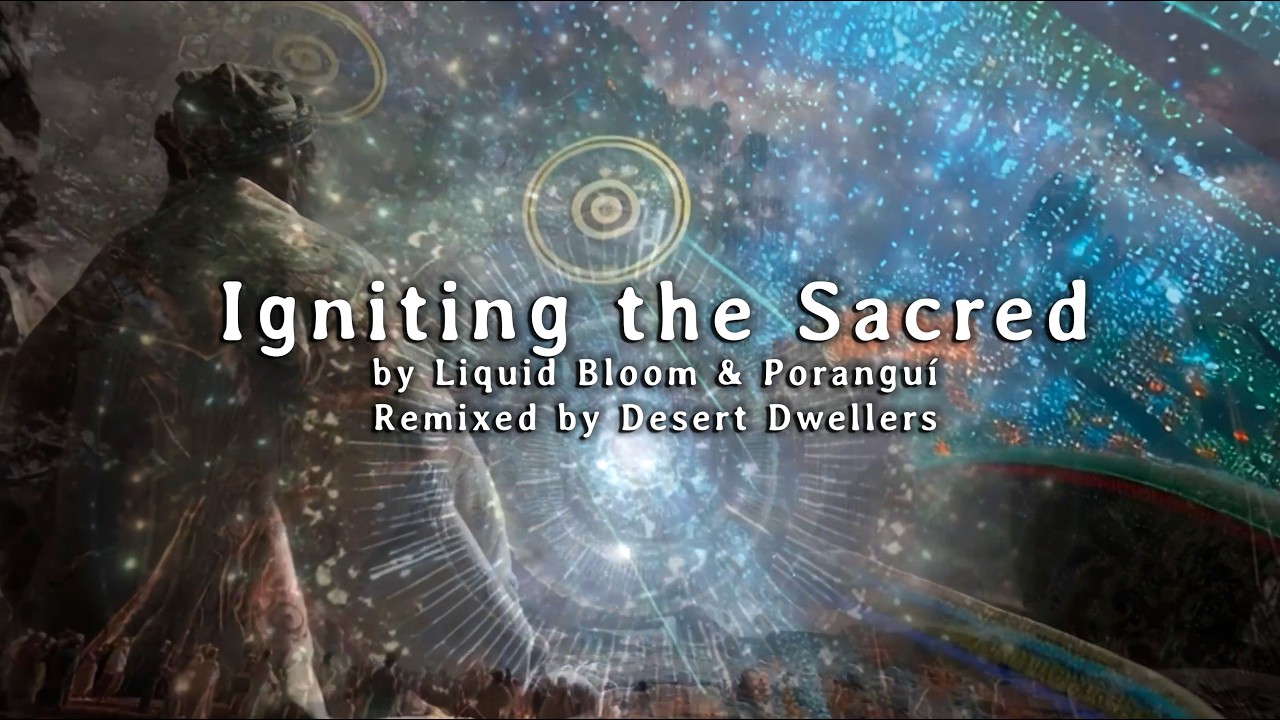
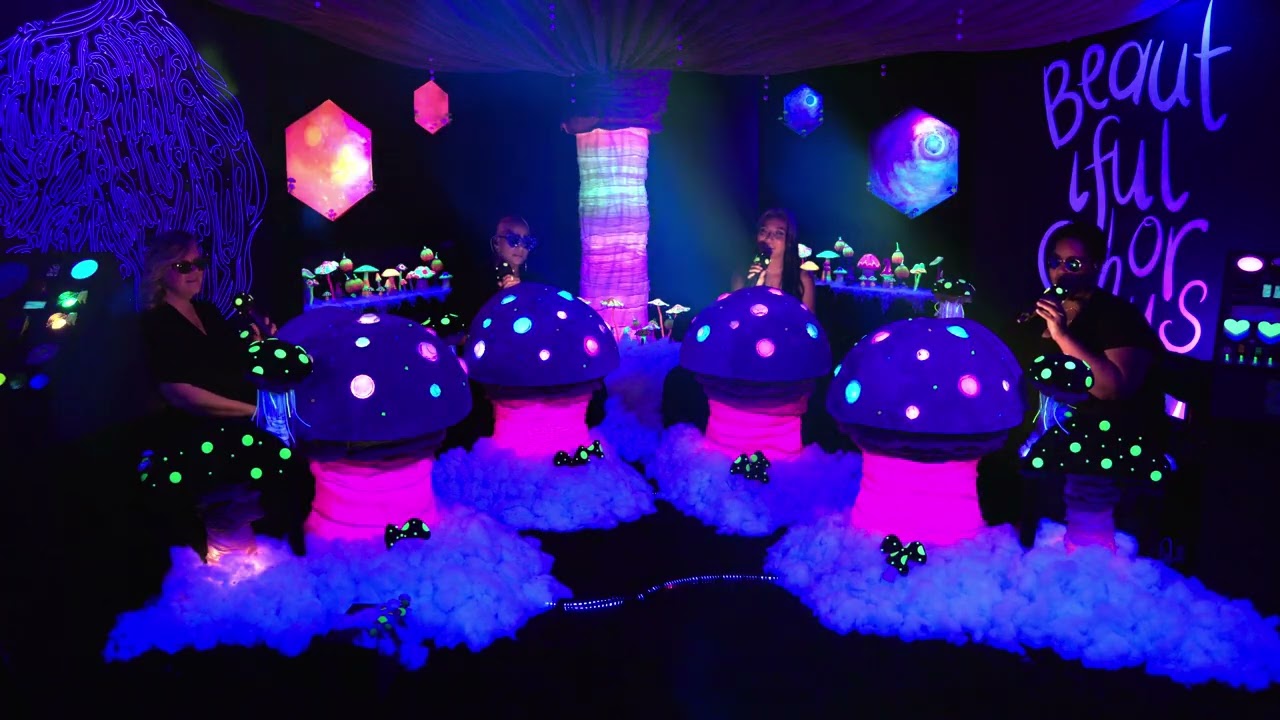
In June 2020, locked indoors and hungry for communion, thousands tuned into a livestream that wasn't built for a stage—just a laptop, a mixer, visionary art, and two hours of sound shaped by Amani of Liquid Bloom. The title was Mind Meld 4, part of an ongoing series in which ambient grooves and fractal animations become a form of collective meditation. There were no words. No doctrine. Just the patient accumulation of spacious soundscapes: tribal percussion, electronic drones, the marriage of ancestral resonance and digital precision. It was not entertainment in any conventional sense. It was infrastructure for consciousness—a two-hour experiment in what happens when sound and vision converge with intentionality.
Ambient music didn't start as meditation music. It started, famously, as "music for thinking to." In 1978, Brian Eno released Music for Airports with a specific intent: to create sound that existed as an environment rather than a foreground event. The album was meant to be heard continuously, to change the mood of a space without demanding attention. This was revolutionary. For decades, Western music had been built around tension and release, arrival and departure. Eno proposed something different: music that could simply be, without narrative arc, without climax.
The mechanism is subtle but powerful. Ambient music typically works with slow harmonic shifts, repetitive structures, and what might be called "luxurious emptiness"—plenty of space for the listener's own mind to move through. When you listen to a pop song, your attention is pulled toward the vocalist, the hook, the beat. Attention is externalized. When you listen to ambient music, there is no center pulling at you. Your attention is free to turn inward or to simply rest. The nervous system, sensing that there is no emergency to which it must respond, begins to downregulate. This is why ambient became the unofficial soundtrack of meditation before meditation apps even existed.
The genius of Eno's invention was that it exploited a neurological principle: the human nervous system cannot remain in high alert forever. Given enough time in a safe, predictable acoustic environment, the body relaxes. The mind settles. This is not transcendence. It is simply the natural outcome of removing threat from the auditory field and then giving time—lots of time—for that safety to register.
Ambient music, when it first appeared, was often sterile—synthetic, empty, almost futuristic. But somewhere in the decades that followed, electronic musicians began to layer something older into that spacious field: the rhythms of the African diaspora, Afro-Caribbean percussion, the groove-based frameworks of traditional cultures. This was not a sudden invention. It was a lineage claiming its rightful place in electronic music.
Artists influenced by indigenous and traditional percussion recognized something that Eno had perhaps overlooked: total silence and absolute spaciousness can become dissociative. The mind needs a heartbeat. The body needs a groove to feel held. When you add a tribal drum pattern—a kick drum with the resonance of a talking drum, or the layered polyrhythms of West African percussion—to an ambient field, something shifts. The listener is no longer just floating in space. They are floating while being held by a heartbeat. This is profoundly different.
The term "tribal" in electronic music carries complicated history and should be approached with care. At its best, it represents a deep listening to the percussion traditions of the African diaspora, Southeast Asian rhythmic frameworks, and indigenous sound-making traditions—not as decoration or appropriation, but as lineage and inheritance. When a sound artist like Amani incorporates tribal grooves into an ambient livestream, they are participating in a dialogue that respects the source while creating something new.
In a meditation context, the tribal drum pattern serves a specific neurological function: it prevents the mind from falling into the diffuse dissolution that can happen in purely ambient music. Some practitioners experience pure ambient as threatening—too open, too empty. The rhythm becomes an anchor, a ground, something to orient around while the spacious elements do their work of calming and opening the nervous system. The groove is the container; the ambient textures are the invitation to expand within that container.
A livestream is not a concert film. It is not a recording of a performance meant to be watched later. A livestream is a live event happening in parallel time: you and the artist and thousands of others present together, now, even if separated by geography. What makes Mind Meld 4 distinctive is that the visual component is not secondary or decorative. It is integral to the experience.
Julius Horsthuis, credited for the fractal animations, works in a lineage of digital artists who discovered something remarkable: mathematical fractals—patterns generated by equations, patterns that repeat infinitely at smaller and smaller scales—mirror the visual language of consciousness itself. A fractal does not depict a state of consciousness; rather, it seems to embody one. As you watch fractals unfold, your eye follows deeper and deeper into nested layers. The movement is hypnotic, recursive, pulling the viewer into what almost feels like infinite depth. Neuroscientists have found that fractal patterns—whether natural (like branches of a tree) or mathematical (like those generated by Horsthuis)—activate specific regions of the brain associated with aesthetic appreciation and calm.
Paired with that visual language is the forest art of Simon Haiduk, whose work carries an entirely different frequency: organic, cellular, suggesting growth and the patient intelligence of natural systems. Together, Horsthuis's fractals and Haiduk's forest art create a synesthetic experience in which sound and vision are not separate events competing for attention, but rather expressions of the same underlying current.
The other visionary artists credited in the description—Robert Venosa's Stargate, Michael Divine's The Glass Onion, Amanda Sage, Mugwort, and visionary mandalas by Johnathan Singer—represent a whole tradition of visionary art that emerged alongside the psychedelic liberation and consciousness exploration movements of the late 20th century. These artists developed visual languages specifically designed to represent expanded states of consciousness. They are not decorative; they are cartographic. When paired with ambient tribal grooves, these images function like what some traditions call a "yantra"—a visual object of meditation, a map the mind can follow inward.
The pairing of sound and image in meditation is ancient. Hindu temples used visual mandalas while chanting mantras. Sufi practices pair whirling movement with music. Shamanic ceremonies have long coordinated drumming with visual elements—firelight, dance, visual symbols. What makes a livestream with fractals and tribal grooves different is not the principle (sound + image = enhanced contemplative practice) but the technology. A laptop and an internet connection can now deliver what once required a temple, a drum circle, or a ceremony space.
This democratization matters. A 2,000-person concert requires a ticket, a physical venue, the logistics of arrival and departure, security, timing. A two-hour livestream requires only an internet connection. The virtual tip jar that Amani offered—Venmo @Amani-Friend, PayPal.me/AmaniFriend—replaced the cover charge. Everyone who wanted to enter could. The barrier to entry, which had long been economic and geographic, dissolved.
Context matters. By late June 2020, four months into a global pandemic, concert halls remained dark. Yoga studios were locked. The spiritual marketplace had suddenly shifted online, and for many practitioners, this shift felt like loss. Losing the studio meant losing the teacher's hands-on adjustment, the presence of other bodies, the ritual of arrival and departure. What was lost was real.
But something unexpected emerged. Livestream events created a paradoxical form of community: genuine solitude within communion. When you watched Mind Meld 4, no one was observing you cry, shift in your seat, or fidget nervously. You were entirely alone in your room, yet joined with thousands of other people in the same exploration, at the same time. This had never been possible before. The solitude was complete; the connection was real. Many practitioners discovered that this paradox—intimacy through distance—offered something their yoga studios sometimes failed to provide: complete permission to be exactly as they were.
There was also a democratization of teaching. A revered yoga teacher in a major city could command premium prices and reach perhaps 100 people per class. A DJ offering a livestream with production value and artistic collaboration could reach 121,569 people. The notion that spiritual practice was a scarce resource, available only to those with proximity to a teacher, began to dissolve.
The title Mind Meld 4 deserves attention. It is not Ambient Livestream #4 or Set #4. It is Mind Meld—a deliberate invocation of consciousness merging, of mutual attunement. The number four suggests iteration, practice, deepening. This is the thinking of someone approaching sound not as entertainment but as a vehicle for collective consciousness work. The series implies that people return, that continuity matters, that over time the container strengthens and deepens.
Two hours is a specific length, neither accidental nor arbitrary. It is long enough for the nervous system to truly settle—short enough that it doesn't become exhausting. In Buddhist meditation practice, two hours is considered a substantial sitting. In a concert, two hours is nearly the maximum attention span for most audiences. But in a livestream meditation, two hours creates a particular kind of container: it is substantial enough to constitute real practice, yet accessible enough that someone listening while cooking dinner or lying in bed can enter and stay present without heroic effort.
A two-hour ambient tribal set also allows for what might be called the "arc of deepening." The first 20 minutes establish the space, the groove, the visual landscape. The next 40 minutes allow the listener to actually settle. By the middle, the edges between listener and sound begin to blur. The final section can then move into territory that would feel abrupt if entered cold, because the ground has been prepared. This is the structure of ritual, whether shamanic, liturgical, or secular. Preparation, deepening, arrival.
For listeners drawn to this lineage of work, the path branches in multiple directions. You can explore Liquid Bloom's ongoing catalogue of ambient sets, developing an ear for the particular aesthetic and intention that Amani brings to sound design. You can investigate the visionary artists credited in the description—Robert Venosa's paintings are available in books and galleries; Michael Divine's work bridges fine art and spiritual practice; Amanda Sage's work engages color and form as consciousness mapping.
You can study fractals as a contemplative practice in their own right, recognizing them as both mathematical entities and visual doorways. You can seek out other livestream meditation experiences that emerged during and after 2020, discovering that virtual events can be every bit as nourishing as in-person ones.
Or you can simply begin to listen differently to the ambient music already surrounding you. The next time you encounter a spacious soundscape—whether through headphones, in a meditation space, or in a waiting room—pause. Ask yourself: What is this frequency inviting me toward? What does this rhythm want me to notice about my own being? The sound is not trying to save you or transform you. It is simply inviting you to notice what is already here.