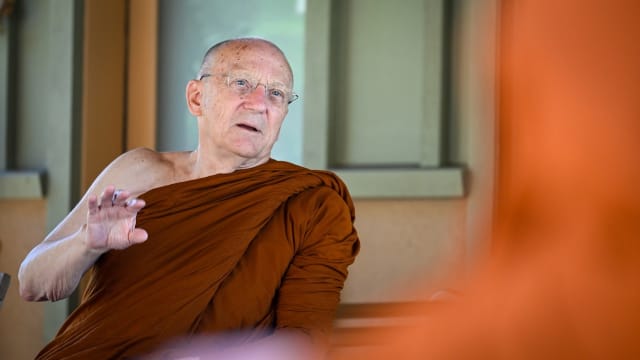
In a Dhamma talk offered on October 19, 2026 at Abhayagiri Buddhist Monastery, and published under the title "A Path of Relinquishment," Ajahn Pasanno returns to the basics of the Buddha's teaching and asks a deceptively simple question: how do we experience this right now, and what is its effect on the mind? The talk warns against the restless habit of perfecting a method until it becomes an end in itself, then moves through mindfulness as a quality of presence that is "in time" for whatever is happening, through the four foundations of mindfulness in the Satipatthana Sutta, and into a cluster of qualities for applying the path, beginning with seclusion and building toward vosagga, relinquishment. What makes it worth a close read is how plainly it describes an inner shift that most practitioners only half-notice: practice stops being a project and starts being a way of holding experience.
The talk opens with a confession that will sound familiar to anyone who has spent years on a cushion. Ajahn Pasanno observes that it is helpful to keep coming back to fundamentals, and to see how those fundamentals keep opening into something deeper, richer, and more liberating. The danger he names is not bad practice but sincere practice that goes too far. Even committed meditators, he says, can get caught up in trying to perfect a method or a technique, or in chasing some logical conclusion of the teachings. There is an endless quality to that pursuit, and it is easy to mistake it for progress.
It's not as if any of it is wrong or not viable, but it's how we hold it and how we end up misapplying, misapprehending the teaching and the training.
(Ajahn Pasanno, Dhamma talk at Abhayagiri Buddhist Monastery, October 19, 2026, opening segment, approx. 0:52–1:20)
This is the hinge of the whole talk. The problem is not the technique; the problem is the grip. A method held tightly becomes another object of craving, and the mind that is busy perfecting its procedure is not the mind that is actually present. Ajahn Pasanno keeps returning to the same test: the Dhamma is described as timeless and here and now, so the question is not whether a practice is correct in theory but what it does for you in the moment you are living.
The talk's central image of mindfulness is a quality of presence rather than a technique. Ajahn Pasanno describes it as being alert, clear, and present in the current moment, and he calls on Ajahn Chah, who used the Thai word for wisdom, paññā, to describe the quality of mind that does this work. The key phrase is that such a mind is "in time" for the moods and impressions that arise. It is present for them. It is not rushing too far ahead, not lagging behind, and not running around in circles.
Anyone who has played in a band will recognize the metaphor. A drummer who is "in time" is not playing the fastest or the loudest; they are locked to the pulse that is actually happening, so the groove holds. Rushing and dragging are both forms of not being there. Ajahn Pasanno's point is that mindfulness works the same way: it is less a matter of forcing attention onto the breath and more a matter of being synchronized with what is actually occurring, so that the response is useful, beneficial, and fruitful. He ties this directly to the Buddha's stated purpose of the path, the ending of suffering, or dukkha. Mindfulness is valuable not as a pleasant state but as the means by which one can apply oneself skillfully and avoid getting lost.
Crucially, he insists that this mindfulness must carry through activity, not only sitting. Mindfulness of bodily postures, of clear comprehension, and of what is happening around us is part of the same training. The talk treats daily life as the place where the foundation is either built or neglected.
To ground this, Ajahn Pasanno turns to the Satipatthana Sutta, which he calls one of the seminal teachings of the Buddha. Its method is the application of mindfulness to four foundations, or establishings: the body, feelings, mind, and dhamma objects, which are mind objects. He points out that the body can be observed in many layers, and that a meditator who starts looking can keep finding more: the physical body, an ethereal body, and further bodies beyond that. "There is no end to it," he says. The lesson is not to chase the layers but to recognize that there is always more to see, which is exactly why the training needs a grounded quality of mind rather than an appetite for discovery.
He then describes the teaching's movement from observation to understanding. The practitioner attends to internal and external phenomena, and to the rising, the coming into being, and the origins of things, as well as their ending and cessation. The mindfulness the Buddha describes is simply this: there is a body, there is a feeling, there is mind, and there are these states and objects, known with enough clarity to see them as they are.
The next step is where the talk gets most interesting. The Buddha says this mindfulness allows one to remain independent and not cling to anything in the world. Ajahn Pasanno frames this as the clue to how the practice should be applied. The question he poses is how we cultivate independence and non-clinging. His answer is blunt and reassuring: not through forcing, not through pushing, and not through running away. Just through mindfulness, just being present and clear.
It is to a certain degree very simple and straightforward, but it reveals itself and deepens and becomes more and more penetrative as we learn how to apply the mind appropriately.
(Ajahn Pasanno, Dhamma talk at Abhayagiri Buddhist Monastery, October 19, 2026, approx. 7:45–8:20)
Here the talk introduces a set of qualities that Ajahn Pasanno says recur throughout the suttas and that he has never heard named as a single set. Whether one is applying the Eightfold Path, the seven factors of awakening, the five faculties, or the four bases of spiritual success, these qualities describe how the practice is carried out. The first is viveka, usually translated as seclusion or solitude.
He separates seclusion into levels. Physical seclusion, kāya viveka, is the most familiar: a quiet place and conditions that do not press too hard on the mind. A monastery provides these conditions by design. A lay practitioner has duties and responsibilities to attend to, and for them the task is balance, keeping enough distance from the affairs of the world that they do not become entangled in them. The aim is not to escape daily obligations but to avoid being pulled around by the reactions of desire and aversion that usually govern how we relate to the world.
The deeper level is mind seclusion, citta viveka. This is the seclusion of mind from sensuality and unwholesome states, which Ajahn Pasanno describes as the fundamental seclusion the Buddha points to when he describes meditation itself. It is a seclusion we can carry into any circumstance, including activity and engagement. The question he asks is whether, even while busy in the world, we can separate the mind from its attractions and aversions, its confusions, its dullness, and its restlessness.
Mindfulness becomes more clear, becomes more sharp, more satisfying and fulfilling when we're not agitating it with the tiring reactivities of attraction, aversion, and confusion.
(Ajahn Pasanno, Dhamma talk at Abhayagiri Buddhist Monastery, October 19, 2026, approx. 12:10–12:40)
This is a practical correction to a common misunderstanding. Many people assume that seclusion means withdrawal, and that they cannot practice without a retreat. The talk suggests the opposite: external quiet helps, but the real work is the internal quality of not being agitated, even when the schedule is full.
The title's word, vosagga, appears near the end of the portion of the talk available for this article. Ajahn Pasanno describes it as the culmination of a sequence or set of teachings. The surrounding passages return to the language of cessation and settling: letting things cease, letting the mind settle, and recognizing that there is a flowing quality to experience even where there seems to be stillness. He cautions against stretching this into a notion of some fixed state, pointing instead toward a becoming that moves in a direction, the movement of letting go.
That is the logic of the title. Relinquishment is not a dramatic act of renunciation. In the path Ajahn Pasanno describes, it is what happens when mindfulness is clear enough, seclusion is steady enough, and the mind is no longer grabbing. The letting go follows from seeing clearly rather than being imposed as a rule. This is also why the talk keeps stressing "not forcing." Relinquishment that is forced is just another form of clinging dressed in better clothes.
The talk ends its opening movement with three questions that serve as a practical handle for any listener: How do we experience this right now? What is its effect? How do I hold that? Each question is a way of checking practice against experience rather than against a mental model. If the method is making the mind more present, more independent, and less agitated, it is working. If it is making you tighter, more anxious, or more fixated on getting it right, the talk suggests that the grip, not the technique, needs attention.
A reader who has not heard the talk can take three things from it. Keep the fundamentals alive rather than chasing ever-finer refinements of a method. Practice mindfulness as being in time with what is actually happening, in activity as well as on the cushion. And treat seclusion as a quality of mind you can carry into daily life, not only a condition you need a monastery to supply.
- Watch the full talk, "A Path of Relinquishment," on the Abhayagiri channel. This article draws on the portion of the 27-minute recording available to it, and the later sections on vosagga and relinquishment deserve a listen in full.
- Read the Satipatthana Sutta directly, paying attention to the four foundations and the repeated instruction to see arising and ceasing, since Ajahn Pasanno builds much of his argument on that passage.
- Explore Ajahn Chah's teachings on mindfulness and paññā, the source Ajahn Pasanno invokes for the idea of mindfulness being "in time."
- Test the talk's three questions in a single ordinary hour: How am I experiencing this right now? What is it doing to my mind? How am I holding it?