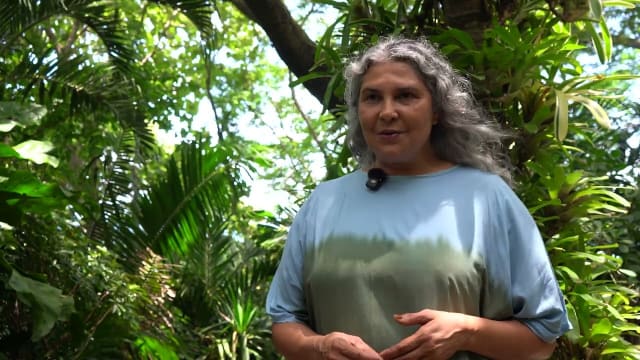
Alexia Chellun's "Healing Song" is a nearly ten-minute piece of music built around a short run of first-person health affirmations: that body, mind and spirit are healthy, that the cells and atoms are healed, that health is something already held and worth thanking for. Released as a video on November 18, 2020, it is credited as music and lyrics by Chellun, with production, recording, mixing and mastering by Moshik Kop at NXNE Studios. The video has since drawn more than 678,000 views, a number that suggests the words are doing something for people who return to them. What follows is a close reading of that text, the way it is constructed and the practice it invites, based on the lyrics printed in the video's description.
The description sets the sung text out in full, and it is short enough to hold in the mind at once:
My body, mind and spirit are healthy.
I give thanks for the health of my being.
I see my cells and atoms healed.
Everyday I bless the health I have.
And I say:
Thank you for my healing.(Lyrics as printed in the video description, "Healing Song," Alexia Chellun, 2020)
Read closely, the lyric moves in a deliberate arc. It begins with the whole person, naming three layers in a single breath: body, mind and spirit. It then descends to the smallest scale the text reaches, the cells and atoms, before returning to the everyday, the "every day" in which the speaker blesses the health already present. It closes not with a request but with a statement of thanks. Nothing in the song asks for health to arrive. Everything in it treats health as a condition to be acknowledged.
This is the craft decision that does most of the work. "My body, mind and spirit are healthy." "I see my cells and atoms healed." Grammatically, these lines are declarations, not hopes. Many people who first try affirmations find that "I want to be healthy" feels like a reminder of absence, while "I am healthy" asks the mind to stand on ground it has not yet fully reached. Chellun's lyric chooses the second path throughout, and the repetition is what gives the declarations weight over ten minutes of sung time.
It is worth noticing the verb "see" as well. The line is not "I believe my cells are healed" or "I hope." It asks the singer to picture something. Visualization and affirmation have long been paired in contemplative and self-help traditions, and the song quietly joins them: say the thing, and see it.
Gratitude runs through the whole text. "I give thanks for the health of my being." "Everyday I bless the health I have." And the last line is an act of thanks in itself: "Thank you for my healing." The song's emotional logic is that healing is not only a future state to pursue but a present relationship to be entered into through appreciation. A reader who wants to take one thing from the lyric might take this: the thanks comes before the evidence. That order is itself a practice. It asks the listener to appreciate first and notice results second.
The word "bless" is worth a second look too. To bless is to name something as good and to wish it well at once. It makes the daily act of attention a small ritual rather than a checklist.
The phrase "And I say" is a stage direction hidden in the text. It marks the moment the lyric turns from description to speech, and it invites whoever is listening to become the one speaking. The final line, "Thank you for my healing," is designed to be said aloud by the listener, not only received. This is what separates a sung affirmation from background music: the song is written to be borrowed.
For that reason, the most useful way to meet this piece is probably not to play it once and move on, but to sing or speak its lines yourself, slowly, pausing after each one. The recording gives you a tempo and a melody to hold onto. Your own voice does the rest.
A responsible reading matters here. The lyric speaks of cells and atoms being healed, and that language belongs to the realm of intention and imagination. Affirmation is a contemplative practice; it is not a medical treatment and it does not replace care from a qualified professional. Treat the song as a way to settle attention, cultivate gratitude and rehearse a relationship with your own body and mind. If you are living with illness, let the song sit alongside your medical care rather than in place of it.
The description also credits the production without describing the arrangement, so this article will not characterize the sound beyond that credit. What the text itself gives you is clear enough: a short, repeatable structure that moves from whole to small to daily, that speaks in the present tense, and that ends in thanks. That is a fairly complete practice in six lines.
Start by listening to the full recording once without speaking, so the melody and the lyric can settle. On the second pass, say each line aloud after the singer, or let your own voice take the lead. Try the present-tense structure on your own words afterward: name what is already working in body, mind and spirit, see it clearly, bless it, and close with thanks. Chellun's own work and recordings are available at alexiachellun.com, where the wider body of her music can be found beyond this single video.